Outrank is a capable AI blogging platform: about one article a day, many publishing destinations and a backlink programme, for a flat monthly fee. People look elsewhere for a few recurring reasons, usually cost once add-ons are counted, the Shopify custom-app setup, the link-exchange model, or wanting something built around a store's catalog. This page lists the alternatives worth a look and what each one's own page says. Citelift publishes it and is one of the options, so read our entry with that in mind.
The short answer
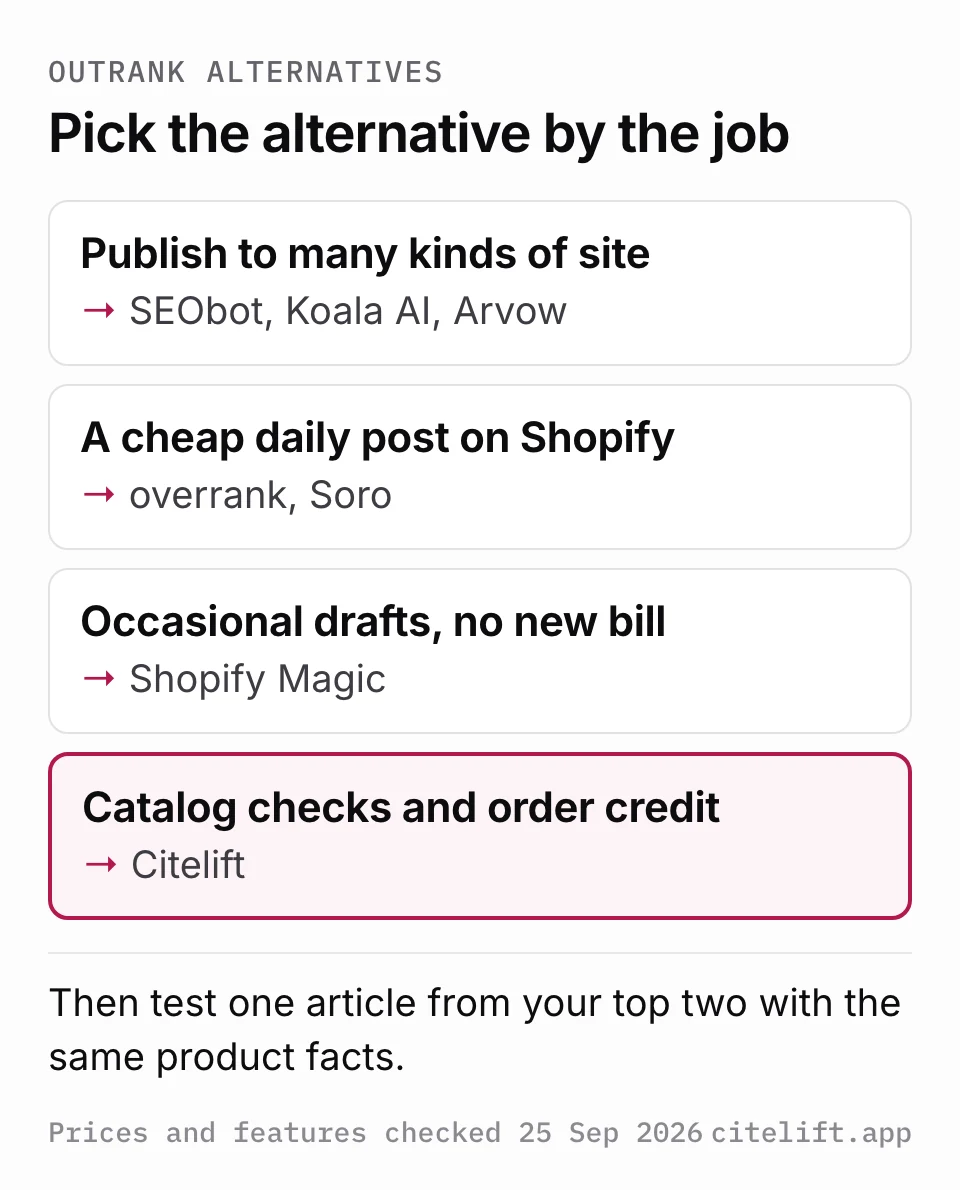
If you publish to several kinds of site, look at SEObot, Koala AI or Arvow. If you only sell on Shopify and want a cheap daily post with little setup, look at overrank or Soro. If you write occasionally and just need a draft, Shopify Magic is free in your admin. If you want articles planned from your catalog, checked before publishing and credited with the orders they bring in, look at Citelift, which is new: its Shopify App Store listing went live on 5 October 2026 and had no reviews when we checked on 10 October 2026.
Every price and feature below is what the vendor's own page or Shopify App Store listing said on 25 September 2026; the SEObot, Arvow, overrank and Shopify Magic entries were re-checked and corrected on 26 September 2026. We have not tested these products except Outrank, in one dated trial.
Alternatives to Outrank: type, starting price, how each reaches a Shopify blog and its source
Product
Type
Price, as the vendor states it
Best for
Source
SEObot
AI blog agent, many CMSs
Subscriptions start at $49 a month, with a full refund on the $49 plan if you are not satisfied after the first article. The page does not list the higher plans.
Teams running sites on several platforms who want weekly articles with light review.
$39 a month, or $300 a year billed annually, on its general page and its Shopify App Store listing; its Shopify page shows $39 a month billed through Shopify. Both of its own pages mention a 7-day money-back guarantee.
Merchants who want the lowest-effort daily posting on Shopify and accept little review.
Outrank base plan: $99 a month or $999 a year for 30 articles, with keyword research, backlink building, AI images and every integration. Outrank pricing, checked 25 September 2026.
Outrank add-ons: More articles (+$85 or +$160 a month), human editing ($1,399 a month), extra backlink credits ($199 to $1,899 a month) and others. Outrank pricing, checked 25 September 2026.
Outrank on Shopify: Connected through a custom app the store owner creates and authorises by hand. Outrank Shopify custom-app guide, checked 25 September 2026.
Why Shopify merchants look for an Outrank alternative
The first reason is total cost. Outrank's $99 base plan is good value for 30 articles, but its pricing page lists add-ons for more articles, human editing, better images and extra backlink credits. A merchant who needs a few of those can end up paying several times the headline. If you only need a handful of articles a month, a cheaper tool or a free one may do.
The second is setup. On Shopify, Outrank connects through a custom app that the store owner creates in the developer dashboard, then pastes credentials into Outrank. Some merchants would rather install an app and approve access in the normal way.
The third is the backlink model. Outrank's base plan builds links by placing your links in articles on other blogs it writes for, paid for with credits you earn by hosting their links in yours. Some merchants like that; others do not want outbound links to strangers in their buying guides, or want to read Google's link-spam policy first.
The last is fit. Outrank is built to publish anywhere. A store that mainly wants articles about its own products, checked against its own catalog, may prefer a tool that starts from the catalog instead of a keyword list. None of this makes Outrank a poor product. It makes it one option among several, and the right one depends on the job.
The alternatives, one by one
1. SEObot
An AI agent that researches your site and keywords, plans content and publishes articles every week, with optional moderation. Its page lists twelve publishing integrations, Shopify among them. It is the closest like-for-like swap if you publish to more than one platform.
Price: Subscriptions start at $49 a month, with a full refund on the $49 plan if you are not satisfied after the first article. The page does not list the higher plans.
On Shopify: Listed as one of twelve integrations, alongside WordPress, Webflow, Ghost, Framer, Wix, Notion, HubSpot and others.
Best for: Teams running sites on several platforms who want weekly articles with light review.
Check first: Ask for one article about a product you know and check every product fact and link; the page does not describe reading a store catalog.
A long-form AI writer priced by words rather than articles, with a brand-voice feature, bulk writing and publishing integrations. It suits someone who wants to control how many articles they write and review each one.
Price: Starter $25 a month for 45,000 words, Professional $49 and Boost $99, with 20% off on annual billing.
On Shopify: Its Starter plan lists WordPress, Shopify, Webflow, Ghost and webhook publishing.
Best for: Writers and small teams who want to generate and edit articles themselves at a low monthly cost.
Check first: Work out how many words a month your articles need, and what share of drafts you will rewrite before publishing.
An AI SEO automation tool with an autoblog, a site optimizer, internal and external linking and images, priced by monthly credits and number of websites. It targets agencies and multi-site owners as well as single sites.
Price: Solo is $69 a month, or $39 a month billed yearly, for 1,000 credits and one website. Business and Ultimate cover more sites.
On Shopify: Its integrations list includes Shopify, WordPress, Wix, Ghost, Webflow, Framer, Blogger, Squarespace, Zapier and webhooks.
Best for: Agencies or owners of several sites who want automation across platforms.
Check first: Find out how many credits one of your articles uses, so the plan's credit allowance becomes an article count.
A done-for-you service that publishes a keyword-researched post every day. Its Shopify page describes an app that reads your storefront to learn the brand and links each post to the product or collection it is about. It also runs a capped link network between customers.
Price: $39 a month, or $300 a year billed annually, on its general page and its Shopify App Store listing; its Shopify page shows $39 a month billed through Shopify. Both of its own pages mention a 7-day money-back guarantee.
On Shopify: Native Shopify blog posts through its Shopify App Store app, listed since July 2026; an API, webhooks or a hosted subdomain for other sites.
Best for: Merchants who want the lowest-effort daily posting on Shopify and accept little review.
Check first: Record which price and route you are offered at checkout, then check the first week's posts for product facts.
A Shopify app that identifies keywords and writes daily articles in your brand voice, with internal linking, image generation and translation. You can review drafts or turn on auto-publishing. It launched on the App Store in February 2026.
Price: $39 a month or $216 a year, billed through Shopify. The listing showed a 4.4 rating from 21 reviews.
On Shopify: Installed from the Shopify App Store and billed on the Shopify invoice.
Best for: Merchants who want an App Store install and a daily cadence at a low price.
Check first: Read the App Store reviews, then compare a draft's product details with your admin before switching on auto-publishing.
Shopify's built-in AI writes a blog title and body from your prompt in the blog-post editor, and Sidekick, its admin assistant, can create a blog post when you ask. Shopify's documentation does not describe it planning topics or publishing on a schedule for you, but it costs nothing and is already there.
Price: Shopify says Shopify Magic tools are free regardless of your subscription plan.
On Shopify: Built into Content > Blog posts; you edit, then publish or schedule.
Best for: Merchants who publish occasionally and are happy to choose topics and check facts themselves.
Check first: Shopify says you are responsible for the accuracy of what you publish; check every product detail against the product page.
Citelift plans articles from your Shopify catalog and the questions buyers ask, drafts product-linked articles, holds any draft that fails a product, claim, link or media check, publishes to your Shopify blog and credits orders to each article under a seven-day rule. It is new: listed on the Shopify App Store since 5 October 2026, with no reviews when we checked on 9 October 2026.
Price: Three plans priced per store with no add-ons; the amounts are on the pricing page.
On Shopify: Install from the Shopify App Store and approve a plan in your Shopify admin. No custom-app credentials to copy.
Best for: One Shopify store that wants fewer, checked articles and orders credited to each one.
Check first: Weekly ceilings are four, seven or fourteen articles by plan, and checks can hold drafts, so expect fewer articles than Outrank's 30.
Choose by the job you need done, then test one article in your top two.
Start with where you publish. If the answer includes WordPress, Webflow, Ghost or client sites, the multi-platform tools (SEObot, Koala AI, Arvow) are the realistic replacements, and Outrank itself may still be the best of them for you. If the answer is only Shopify, the Shopify-focused options are simpler to set up.
Then decide how much you will review. Daily autoblogs such as overrank and Soro are built to run without you; that is their appeal and their risk. Tools priced by words, such as Koala AI, assume you will edit. Citelift sits in between: it drafts on a schedule but holds anything that fails a check, and Core and Growth can require your approval.
Finally, decide what you will measure. Most of these tools report search traffic. If you want to know which articles were credited with orders, or whether AI assistants name your store for buyer questions, check that the tool reports those things before you pay, and keep each measure separate.
Whichever you pick, run the same test: one buyer question, one product with known facts, one article from each tool. Count the corrections, check the links, open the published page signed out and write down how long it took. That is a fairer comparison than any vendor's page, including ours.
How this list was made
Citelift publishes this page and sells one of the products listed. We read each vendor's own pricing or product page, or its Shopify App Store listing, on 25 September 2026, re-checked four entries on 26 September 2026, and link each source beside the entry. We ran a paid Outrank trial on one demo store on 6 September 2026, described on the comparison page; we have not bought or run the other products. A feature missing from a vendor's page is not evidence the product lacks it. Prices change, so confirm them at checkout. If a line is out of date, tell us and it gets corrected.
Questions
What is the best Outrank alternative for Shopify?
It depends on the job. For several publishing platforms, SEObot, Koala AI or Arvow. For a cheap daily post on Shopify, overrank or Soro. For occasional drafts, Shopify Magic. For catalog-checked articles with order credit, Citelift. Test one article in your top two before committing.
Is there a free Outrank alternative?
Shopify Magic is free on every Shopify plan and drafts blog titles and bodies from a prompt. Shopify's documentation does not describe it planning topics or publishing on a schedule for you.
Which Outrank alternatives are on the Shopify App Store?
Of the products here, Soro, overrank and Citelift (since 5 October 2026) have Shopify App Store listings. We did not find listings for SEObot, Koala AI or Arvow when we searched the App Store on 26 September 2026; each names Shopify among its publishing integrations.
Do these alternatives build backlinks?
Outrank and overrank describe link programmes between customers. Citelift does not run an exchange; its Growth plan includes one manually fulfilled resource a month with outreach, which does not guarantee a link. Check each vendor's page for the others.
Where is the full Citelift and Outrank comparison?
On the Citelift vs Outrank page, which covers our dated trial, the line-by-line differences and how to switch.
See whether ChatGPT names your store for three buyer questions in your category, which competitors it names instead, and which sources it cites. No sign-in needed.