Citelift / compared with / overrank
Citelift compared with overrank
Updated · first published 6 September 2026
overrank's current pages describe automated keyword research, writing, images, internal links and daily publishing. Its Shopify page says each post links to the relevant product or collection, while its developer documentation offers an API, signed webhooks and hosted delivery. Citelift publishes this comparison and has not run overrank. Every overrank statement below is a vendor claim, first checked on 10 September 2026 and re-checked on 25 September 2026.
The short answer
Pick overrank if you want the lowest-effort route to a new blog post every day, on Shopify or on a custom site through its API, and you are comfortable with a link network between its customers. Pick Citelift if you want fewer, catalog-checked articles, the option to approve each one, and orders credited to the article that sent the shopper.
On 26 September 2026 overrank's Shopify page and its Shopify App Store listing showed $39 a month billed through Shopify, and its general page showed $39 a month or $300 a year billed annually. We have not run overrank. Citelift has been listed on the Shopify App Store since 5 October 2026 and its prices are on the pricing page.
overrank at a glance
| What overrank’s page says | Source | |
|---|---|---|
| Price on the Shopify page | $39 every 30 days on your Shopify invoice, with a 7-day money-back guarantee. | overrank Shopify pagechecked 25 September 2026 |
| Price on the general page | Growth Plan at $39 billed monthly, or $300 billed yearly (shown as $25 a month). The struck-through $78 and $50 beside them are anchor prices, not a second plan. | overrank product pagechecked 26 September 2026 |
| Shopify App Store listing | Listed as Overrank: Automate SEO with AI, launched 10 July 2026: $39 a month or $300 a year, rated 5.0 from 3 reviews. | overrank on the Shopify App Storechecked 26 September 2026 |
| Cadence | Approve 30 AI-picked keywords or upload your own, then articles publish daily. | overrank product pagechecked 25 September 2026 |
| Shopify behaviour | Reads the storefront to learn brand and catalog, publishes native Shopify blog posts, and gives each post a call to action to the product or collection it is about. | overrank Shopify pagechecked 25 September 2026 |
| Other delivery | A read-only content API, signed webhooks, or a hosted blog subdomain. | overrank developer docschecked 25 September 2026 |
| Links | A community network that adds one contextual link between customers' sites, capped at one per site, plus one data-rich article a month meant to attract links. | overrank product pagechecked 25 September 2026 |
| Reporting | Search Console clicks, impressions and rankings in one dashboard with a weekly recap. | overrank Shopify pagechecked 25 September 2026 |
Citelift’s own prices are on the pricing page, read from the same plan ladder Shopify bills. Vendor pages change; if a line here is out of date, tell us and it gets corrected.
Line by line
| overrank | Citelift | |
|---|---|---|
| Price | The general page shows $39 billed monthly, or $300 billed yearly (presented as $25 a month). The Shopify page and the App Store listing show $39 a month billed through Shopify. Confirm the route and total at checkout.Source: vendor documentation, 26 September 2026 | Three monthly or annual tiers per Shopify store. Current amounts, article ceilings and billing terms come from the same plan ladder Shopify charges and are shown on the pricing page. |
| Planning and writing | The general page says merchants approve 30 selected keywords or upload their own, then the service writes in a learned brand voice and publishes daily.Source: vendor documentation, 25 September 2026 | The planner uses catalog and brand context plus buyer questions. Product, claim, link and media checks can hold a draft for correction before it becomes live. |
| Shopify product context | The Shopify page says the app reads the storefront to learn brand and catalog context, then gives every article a call to action to the relevant product or collection.Source: vendor documentation, 25 September 2026 | Catalog products inform the plan and draft. Article product links carry an identifier used to credit eligible orders under the stated attribution rule. |
| Review and publishing | The Shopify page says merchants can review and refine the first article, after which a native Shopify post publishes daily. We have not tested its review controls or storefront state.Source: vendor documentation, 25 September 2026 | Draft, scheduled, live and held are distinct states. Core and Growth can add an optional approval hold; every tier can hold a draft that fails automated checks. |
| Publishing destinations | Their developer documentation offers a read-only content API, signed webhooks and a hosted subdomain. The Shopify page separately describes native Shopify posts.Source: vendor documentation, 25 September 2026 | Publishing is to the connected Shopify blog. The workspace reconciles saved state with Shopify so held, draft, scheduled and live content remain distinct. |
| Links and authority content | The general page describes a contextual community link network and one data-rich article each month intended to attract natural links. Those are vendor-stated mechanisms and outcomes are untested here.Source: vendor documentation, 25 September 2026 | Citelift does not operate a customer link exchange. Growth includes a manually fulfilled monthly authority asset; neither publication nor outreach guarantees links. |
| Measurement | The general page displays Search Console and AI-search metrics plus leads, clicks and estimated value. The Shopify page advertises Search Console clicks, impressions, rankings and a weekly recap. We have not inspected the underlying reports.Source: vendor documentation, 25 September 2026 | Search data when eligible, sampled AI-answer mentions and orders attributed to each article remain separate reports. Attribution uses available Shopify journey data and does not prove incremental sales. |
| Cancellation and refund | Both current pages say cancellation is available without a contract and state a seven-day money-back policy. The Shopify page says native posts stay on the store after cancellation.Source: vendor documentation, 25 September 2026 | An eligible seven-day trial begins at Shopify plan approval. Published Shopify posts remain in Shopify, and export remains reachable after cancellation; refund terms are on the pricing and legal pages. |
Citelift sells one of the products compared. We read overrank's general product page, Shopify page and developer documentation on 10 September 2026 and again on 25 September 2026, and re-checked its prices and Shopify App Store listing on 26 September 2026. We did not create an account, approve a charge, generate an article or inspect its reporting. An unmentioned capability is unknown rather than absent.
Daily volume or checked volume
overrank's pitch is volume without effort: approve a keyword list once, and a post goes up every day. On a Shopify store that is roughly 30 posts a month for $39. For a merchant who has never published anything, that is an easy way to find out whether blog content brings in search traffic at all.
Citelift publishes less and checks more. Its weekly ceilings are four, seven and fourteen articles by plan, and a draft that fails a product, claim, link or media check is held rather than published. Core and Growth can add an approval hold so nothing goes live until you say so. Some weeks that means fewer articles than the ceiling. The idea is that one article with correct sizes and working product links is worth more to a store than three that need fixing.
Which is right depends on how much you trust unreviewed output about your own products. If your catalog is simple and mistakes are cheap, daily volume may win. If a wrong ingredient, size or care instruction would cause returns or complaints, checks matter more than cadence.
What overrank costs
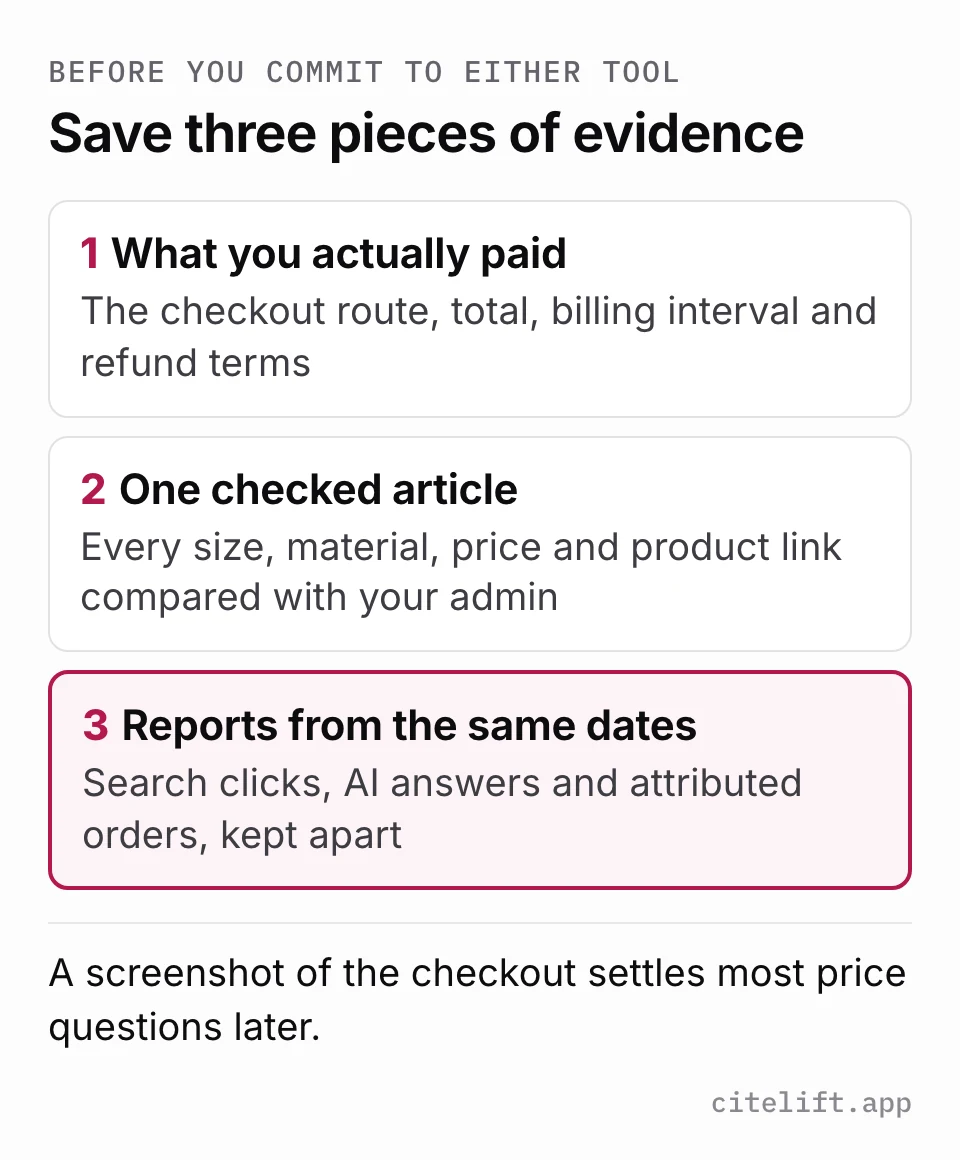
When we re-checked on 26 September 2026, overrank's prices agreed across its pages. The general page's Growth Plan is $39 billed monthly or $300 a year billed annually, which it presents as $25 a month; the struck-through $78 and $50 beside those figures are anchor prices. Its Shopify page and its Shopify App Store listing show $39 a month billed through Shopify, and the listing offers $300 a year. An earlier version of this page read the annual view's struck-through $50 as a monthly price; that was our mistake. Save a screenshot of the exact checkout you accept, including the billing interval and refund terms.
Both pages describe cancellation without a contract and a 7-day money-back window. The Shopify page says posts stay on your store as normal blog posts if you cancel.
About the link network
overrank describes a community network: when another overrank customer has a relevant article, it adds one natural link to it from yours, you earn the same back over time, links are contextual, never to a competitor, and capped at one per site. It also publishes one data-rich article a month intended to attract links from journalists and publications.
Read the link-spam section of Google's spam policies before relying on any exchange, including this one; it names excessive link exchanges and cross-linking schemes. A capped, contextual network may be fine for your store, but you should make that call with the policy in front of you. Citelift runs no link exchange. Growth includes one manually fulfilled resource a month with outreach, which does not guarantee a link.
What each one reports
overrank's Shopify page promises Search Console clicks, impressions and rankings with a weekly recap, and its general page shows AI-search metrics, leads, clicks and an estimated value. We have not seen the dashboards behind those screenshots.
Citelift keeps three measures apart: search data where a matching Search Console property is connected, sampled AI-answer mentions from its scheduled checks, and orders credited to each article under a seven-day rule. None of them proves an article caused a sale, and a check that could not run is shown as unavailable rather than as zero.
Verify the offer and one published article
overrank sells through its own site and through a Shopify app, with different delivery routes. Save the exact checkout terms you receive, then evaluate one article against known product facts before expanding the schedule.
- Record whether you entered through the general site or Shopify page, the billing interval, total charge, refund terms and included publishing destination.
- Use one buyer question and a product with verified composition, size or quantity, care or use instructions and a working URL.
- Review the selected keywords, first draft, product or collection link, images and live storefront page. Record every correction and the time it required.
- Compare actual reports using the same window. Search impressions, AI-answer observations, leads, estimated value and article-attributed orders are different measures.
overrank general product page (checked 25 September 2026)
overrank Shopify page (checked 25 September 2026)
overrank developer documentation (checked 25 September 2026)
overrank on the Shopify App Store (checked 26 September 2026)
Citelift publishes this comparison. The examples are not customer growth results. For the measurement rules behind our reports, read article order attribution and AI visibility measurement.
What you would buy with Citelift
One subscription covers one Shopify store. Connect for free, choose a plan on Citelift and approve the charge in Shopify. An eligible store’s seven-day trial starts at that approval. AI generation begins after approval; review your brand, plan and first draft before completing setup.
| Plan | Monthly USD | Publishing ceiling | Measurement and review |
|---|---|---|---|
| Starter | $49 | Up to 4 per rolling week | AI checks monthly. Automated publishing checks; no optional approval hold or Search Console connection. |
| Core | $99 | Up to 7 per rolling week | AI checks weekly. Optional approval hold and eligible Search Console connection. |
| Growth | $199 | Up to 14 per rolling week | AI checks weekly. Optional approval hold and eligible Search Console connection. |
Failed checks can hold drafts on every plan. Search Console needs a matching verified property and available data. AI checks are samples of answers, and order attribution assigns credit using available Shopify journey data. Neither establishes incremental sales or guarantees rankings. See annual prices and full plan terms.
Our 17-page product-information pilot shows why source facts need manual review: a simple HTML extraction missed care instructions that browser review recovered on three pages. This research did not measure either tool’s output or growth.
Bring the same evidence to either trial
- Save a product URL, its materials or ingredients, its size or quantity, and its care or use instructions. Resolve missing facts before asking a writer to use them.
- Choose one buyer question. Compare both drafts against that same fact sheet, including product links and unsupported claims.
- Record review time and any corrections. If you authorize publication, open the storefront URL while signed out and check Shopify’s visibility state.
- Keep a dated baseline of search clicks, observed AI answers and attributed orders. Record “not available” separately from a measured zero.
Who should pick overrank
Pick overrank if you want its stated daily publishing cadence, general-site delivery options or community link network, after confirming the exact route and price you receive.
- You want a new post every day with almost no involvement after setup.
- You publish to a custom or headless site and want an API or webhook feed.
- You are happy to take part in a capped link network between customers.
- Your catalog is simple enough that unreviewed product details are low risk.
Who should pick Citelift
Pick Citelift if you want Shopify catalog context, automated quality holds, optional approval control on Core and Growth, and orders attributed to each article under a stated rule.
- You want drafts held when a product fact, claim, link or image fails a check.
- You want to approve each article before it publishes, on Core or Growth.
- You want AI-answer checks and article-attributed orders reported separately.
- You would rather publish fewer articles you trust than one a day you have not read.
Switching between overrank and Citelift
Both publish native Shopify blog posts, so the articles stay on your store. Plan the handover so the blog does not fill with near-duplicates.
- Export your Shopify article list with URLs, visibility and publish dates.
- Pause daily publishing in the tool you are leaving before starting the other.
- Review a sample of daily posts for product facts and broken product links before deciding which to keep, merge or redirect.
- Look for links added through a link network and decide whether each one belongs in the article.
- Keep URLs stable, and redirect any retired post in Shopify to the closest live article or collection.
- Record a dated baseline of blog clicks, AI-answer observations and attributed orders.
Questions
How much does overrank cost?
On 26 September 2026 its general page showed $39 a month, or $300 a year billed annually, and its Shopify page and App Store listing showed $39 a month billed through Shopify. Confirm the route and total at checkout.
Does overrank publish every day?
Its pages say you approve 30 AI-picked keywords or upload your own, and articles then publish daily. We have not run it to confirm the cadence on a store.
Does Citelift publish every day?
It can on Core, which allows up to seven articles a rolling week, and on Growth, which allows fourteen. Starter allows four. You choose the publishing days, and automated checks can hold a draft, so output can be lower than the ceiling.
Can I approve articles before they go live?
overrank's Shopify page says you can review and refine the first article. Citelift offers an optional approval hold on Core and Growth for every article.
Is Citelift on the Shopify App Store?
Yes. Citelift has been listed on the Shopify App Store since 5 October 2026. It had no reviews when we checked on 9 October 2026.
Inspect a sample of answers for your store.
See whether ChatGPT names your store for three buyer questions in your category, which competitors it names instead, and which sources it cites. No sign-in needed.