Guide · updated 23 September 2026 · 7 min read
Shopify agentic storefronts and ChatGPT Shopping: a merchant guide
How Shopify products reach ChatGPT, Gemini, Copilot and Meta through agentic storefronts, how ChatGPT Shopping ranks them, and what to check first.
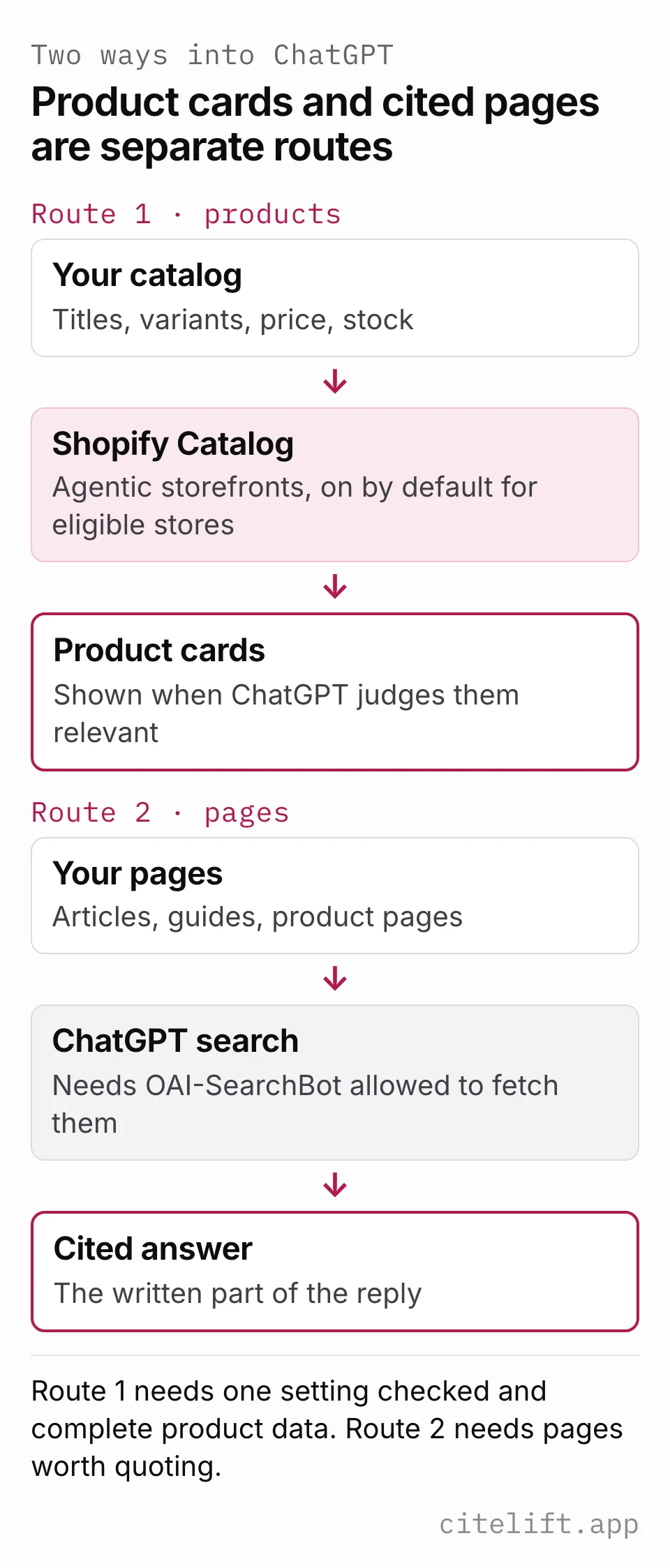
A Shopify store can show up in ChatGPT in two separate ways. Its products can appear as shopping cards, fed by Shopify Catalog through a feature Shopify calls agentic storefronts, which is on by default for eligible stores. Its pages can be cited in written answers, if ChatGPT's search crawler can fetch them. The first route needs no app and no feed work: check one setting, then make your product data complete. The second route is the ordinary work of publishing pages worth quoting. This guide covers the first route in detail and links to the second.
What agentic commerce means on Shopify
"Agentic commerce" is the industry's name for shopping that starts in an AI assistant rather than a search engine. A shopper describes what they want, the assistant proposes products, and the shopper buys, sometimes without visiting a website first.
Shopify's version is agentic storefronts. Shopify says it "lets customers discover and purchase your products in AI channels, such as ChatGPT, Google AI Mode and Gemini, Microsoft Copilot, and Meta" and that it "is active by default for eligible stores" (Shopify Help Center, Shopify agentic storefronts, read 23 September 2026). Products reach those channels through Shopify Catalog, or for Google AI Mode and Gemini through the Google & YouTube sales channel or Google Merchant Center.
Checkout differs by channel, and that difference matters for how you think about the channel:
| Channel | How the purchase completes | Direct-checkout toggle |
|---|---|---|
| ChatGPT | On your own store checkout, in a ChatGPT in-app browser or a new tab | No: ChatGPT is a discovery channel |
| Google AI Mode and Gemini | In the channel's Shopify-powered direct checkout, if activated | Yes |
| Microsoft Copilot | In the channel's Shopify-powered direct checkout, if activated | Yes |
| Meta | In the channel's Shopify-powered direct checkout, if activated | Yes |
Source: the same Shopify page, read 23 September 2026. Shopify adds that for orders placed through AI channels "you retain full ownership of the customer relationship and post-purchase experience", and that those orders show in your admin "with channel or referrer attribution".
The channel is not a sideshow. Shopify reports that in Q1 2026 "AI-driven traffic to Shopify stores grew 8 times year over year, while orders from AI-powered searches increased nearly 13 times" (Shopify, How agentic commerce works, read 23 September 2026). Those are platform-wide growth rates from a small base, not a forecast for any one store.
Check your settings first
This is the five-minute step most merchants skip, and it is the one both assistants told us to do first when we asked them how to get a Shopify store into ChatGPT (see our dated observations).
- In your Shopify admin, open Sales channels > Agentic.
- See which AI channels are listed and whether Allow Shopify to manage for me is on.
- Open ChatGPT and confirm Shopify Catalog access has not been switched off.
- For Google AI Mode and Gemini, confirm the Google & YouTube channel or Merchant Center connection, and decide whether you want direct checkout where it is offered.
Shopify's ChatGPT page lists a few conditions worth reading before you assume everything is flowing (Shopify Help Center, Selling on ChatGPT, read 23 September 2026):
- "You don't need to do anything for your products to be discovered by ChatGPT through Shopify Catalog."
- Relevant legal disclosures should sit in "the first 6,000 characters" of a product description.
- B2B-only products aren't supported, and products in ChatGPT's prohibited categories don't display.
- "There are no fees associated with selling in ChatGPT. You pay only your standard payment processing fees."
Eligibility is decided by Shopify, not by an app. If the Agentic section doesn't appear or a channel shows as unavailable, Shopify's help pages for each channel are the place to check, not a third-party checklist.
How ChatGPT Shopping picks products and sellers
ChatGPT's documentation lists how its product results are chosen, and it is more specific than most advice about it (ChatGPT Help Center, Shopping with ChatGPT Search, read 23 September 2026). There are two decisions.
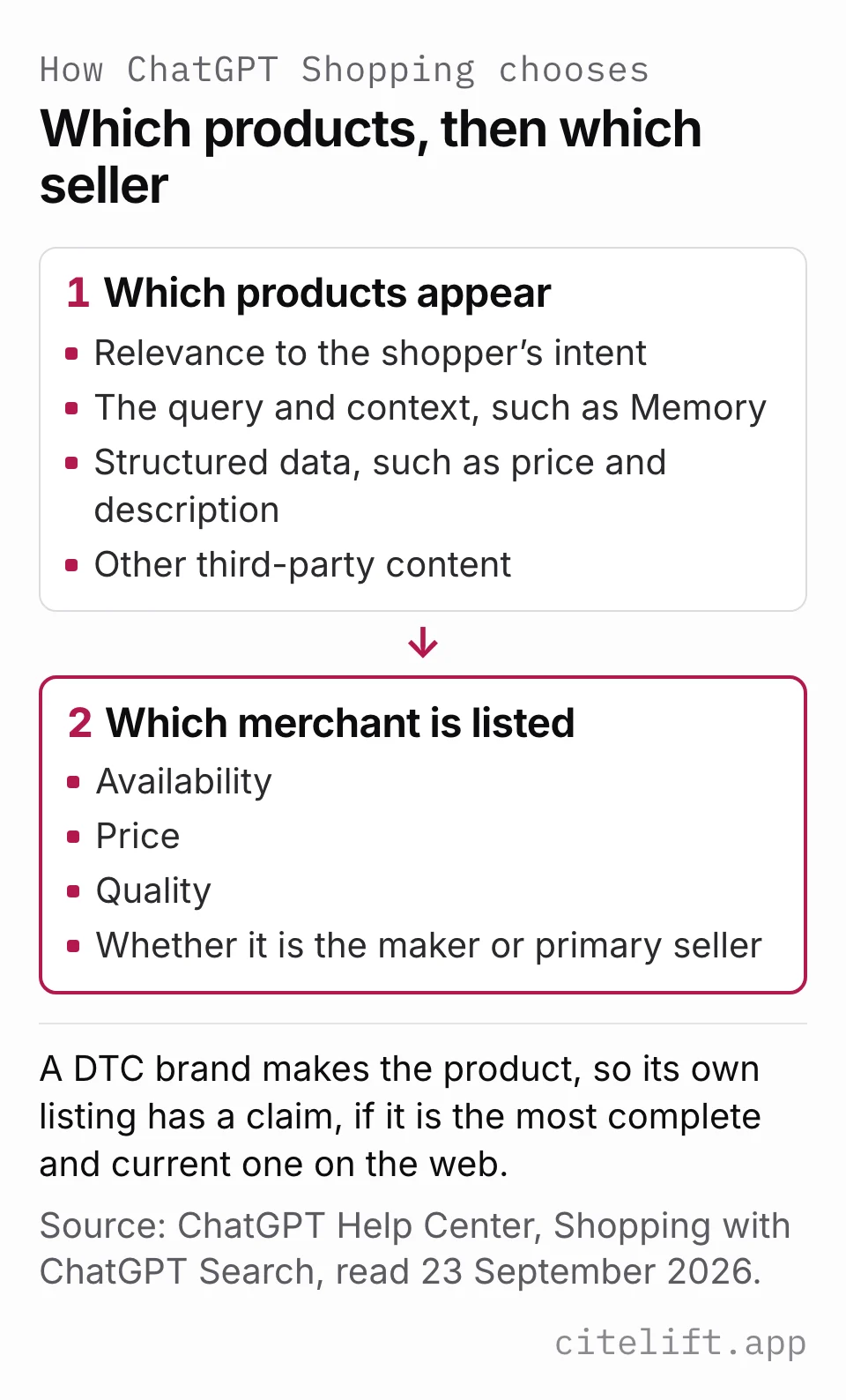
Which products appear. "A product appears in the carousel when ChatGPT perceives it to be relevant to your intent." It weighs the shopper's query and context, such as Memory or custom instructions, and considers "structured metadata from first-party and third-party providers (e.g., price, product description) and other third-party content". The same help page states that product results "are not ads" and are not influenced by partnerships.
Which merchant is listed. When a shopper opens a product, "merchants are ranked based on factors like availability, price, quality, and whether they are the maker or primary seller of that item." For a DTC brand that last factor is the interesting one: you make the product, so you have a claim to it, if your own listing is the most complete and current version of that product on the web.
Two further details from the same page change how you should write product data:
- ChatGPT "may generate simplified product titles and descriptions" from what it receives, so clear attributes survive better than clever copy.
- Labels such as "Budget-friendly" are "generated by ChatGPT" and are "not guarantees or verified statements".
For Shopify merchants the same page adds: "product data is already integrated into ChatGPT through Shopify Catalog ... No additional work is required from individual merchants." A direct product feed is a separate, application-based option for merchants who want fresher data.
What we saw when we asked
On 23 September 2026 we asked consumer ChatGPT and Claude eight product questions across six DTC categories, once each. ChatGPT showed product cards in five of eight answers; Claude in seven of eight. Three observations are relevant here:
- Cards can be wrong. One ChatGPT card described a hydrating skincare serum as a "high-protein supplement for muscle recovery". That is consistent with ChatGPT's warning that card text is model-generated, and it is a reason to keep your own product data unambiguous.
- The source often wasn't the brand. Claude's cards frequently showed marketplaces and resellers as the source of a product rather than the brand's own store.
- Location leaks through. Even with "I'm shopping in the US" in the question, ChatGPT's cards showed prices in the observer's local currency, rupees. Test from the market you sell to.
These are single answers from one observer, not rates. The full table, sources and limits are in what ChatGPT and Claude recommend in six DTC categories.
Product data is the lever you control
Every source above points at the same thing: the assistant can only match a product it understands. For a Shopify store that means:
- Specific titles. "Men's heavyweight cotton crew tee, 6.5 oz" tells an assistant who and what; "The Classic" does not.
- Complete variants. Sizes, colours and materials as real options with their own availability, not buried in a paragraph. Our guide to product variants in search and AI shopping covers the structure.
- Current price and stock. Availability and price are named ranking factors for the seller list.
- Barcodes where you have them. GTINs help any system match your listing to the same product elsewhere.
- Policies filled in. Shipping and returns are questions shoppers ask assistants before they buy.
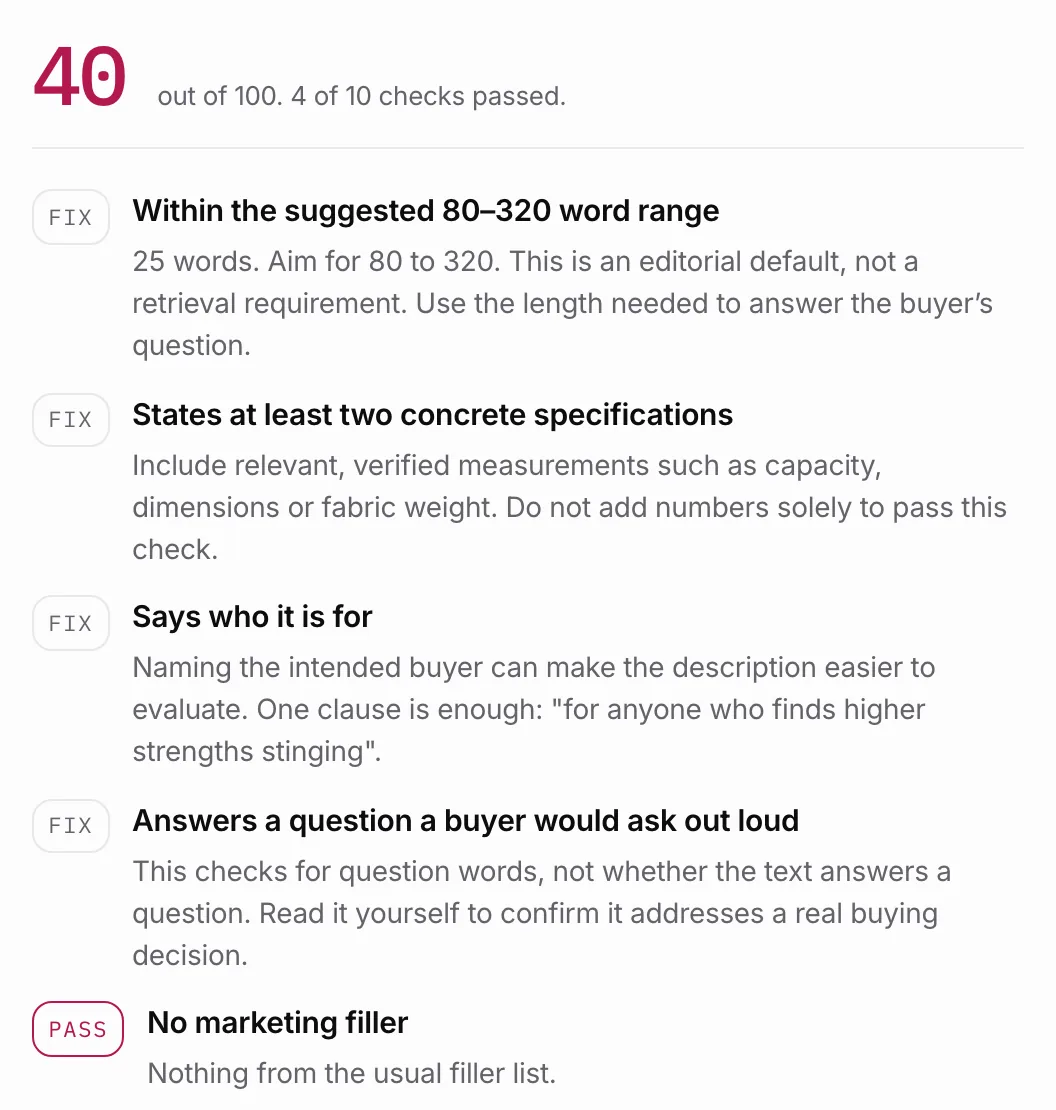
- Descriptions that state facts. Ingredients, dimensions, care, who the product is not for. The free product description scorer checks a draft for the basics.
Where articles still matter
Product cards are half of it. When a shopper asks "which magnesium is best for sleep?" the written part of the answer comes from pages ChatGPT fetched a moment earlier, and those can be your articles, a retailer's guide or a competitor's comparison. ChatGPT's crawler documentation says sites opted out of OAI-SearchBot "will not be shown in ChatGPT search answers" (ChatGPT crawler documentation, read 23 September 2026). Check that crawler is allowed, as our AI crawlers and robots.txt guide explains, and then publish pages that answer the questions your buyers ask. The full method is in how to rank in ChatGPT.
This is where Citelift works: it writes catalogue-grounded articles that answer buyer questions and link to your products, and it reports observed AI mentions and the orders those articles earn. It does not control product cards, and no tool can promise a placement in them.
Measure it
Two numbers tell you whether the channel is working for your store, and neither needs a paid tool:
- Orders by channel. Shopify says orders from AI channels display in your admin with channel or referrer attribution. Watch which products sell through them and which never appear.
- A fixed question panel. Ask the same five buyer questions, without your brand name, in ChatGPT once a week from the market you sell to. Record whether your products or pages appear. Our guide to measuring AI visibility sets out the method.
Judge the change over weeks. Answers vary from run to run with no change to your store, so a single appearance is noise and a pattern is signal.
Questions.
Do I need an app to sell through ChatGPT on Shopify?
No. Shopify says you don't need to do anything for your products to be discovered by ChatGPT through Shopify Catalog, and agentic storefronts is active by default for eligible stores. Check the setting under Sales channels > Agentic in your admin rather than installing an app to switch it on.
Does ChatGPT charge a fee on these sales?
Shopify's help page for selling on ChatGPT says there are no fees associated with selling in ChatGPT and that you pay only your standard payment processing fees. Buyers check out on your own store checkout, in a ChatGPT in-app browser or a new tab.
Are ChatGPT product cards and cited articles the same thing?
No. Product cards draw on structured product data, which for Shopify stores comes through Shopify Catalog. Cited text answers come from pages ChatGPT retrieves through web search, which depends on OAI-SearchBot being allowed to crawl your site. Most stores need both routes working.
How does ChatGPT choose which seller to show for a product?
ChatGPT's documentation says merchants are ranked on factors like availability, price, quality, and whether they are the maker or primary seller of the item. A brand selling its own products on its own store has a claim to that last factor, provided its product data is complete and current.
Can I stop ChatGPT from showing my products?
Yes. Shopify documents how to remove ChatGPT's access through Shopify Catalog under Sales channels > Agentic. It also warns that products may still be referenced through web crawling and indexing, and links separate steps for hiding a product from AI channels completely.
Citelift is listed on the Shopify App Store: Citelift on the Shopify App Store.