Citelift / compared with / SEObot
Citelift compared with SEObot
Updated · first published 6 September 2026
SEObot is built to be left alone: you connect a CMS and it researches, writes and posts. Its product page lists Shopify among a longer list of integrations, along with keyword research, fact-checking, internal and external linking, and optional article moderation. We have not bought or run it, so every line in the left column is theirs, dated, and says so.
The short answer
Pick SEObot if you want an AI agent that plans, writes and posts to almost any CMS, including Shopify, and you are happy to let it run with light moderation. Pick Citelift if you sell on Shopify and want each article planned from your catalog, checked against it and credited with the orders it brings in.
SEObot's own page said subscriptions start at $49 a month when we read it on 25 September 2026, and it listed twelve publishing integrations. We have not bought or run SEObot. Citelift is Shopify-first, listed on the Shopify App Store since 5 October 2026, and priced per store on its pricing page.
SEObot at a glance
| What SEObot’s page says | Source | |
|---|---|---|
| Starting price | Subscriptions start at $49 a month. The page does not list the higher plans. | SEObot product pagechecked 26 September 2026 |
| Refund | A full refund on the $49 plan if you ask after the first article and are not satisfied. | SEObot FAQchecked 25 September 2026 |
| Publishing integrations | Unicorn Platform, Webflow, Ghost, WordPress, Framer, Wix, Shopify, Notion, HubSpot, Next.js, webhooks and a REST API. | SEObot product pagechecked 25 September 2026 |
| How it works | Researches your site, audience and keywords, makes a content plan and produces articles every week. You can approve, decline or moderate articles. | SEObot product pagechecked 25 September 2026 |
| What an article includes | Up to 4,000 words, internal linking, generated images, YouTube embeds, tables and a fact-checking step with cited sources. | SEObot product pagechecked 25 September 2026 |
| Editing | Articles can be edited inside SEObot before they are published to your CMS. | SEObot FAQchecked 25 September 2026 |
Citelift’s own prices are on the pricing page, read from the same plan ladder Shopify bills. Vendor pages change; if a line here is out of date, tell us and it gets corrected.
Line by line
| SEObot | Citelift | |
|---|---|---|
| Price | Their site advertises subscriptions starting at $49 a month. The higher plans are not listed on the page we read.Source: vendor documentation, 26 September 2026 | Three tiers priced per store rather than per article, so the bill does not move with the output. The amounts are on the pricing page. |
| Where it publishes | Shopify alongside a list of other content platforms and a direct API.Source: vendor documentation, 25 September 2026 | Your Shopify blog only. Every other destination is a destination we could not attribute an order to. |
| What it writes about | Keyword research it runs itself, with fact-checking and internal and external links described as part of the writing.Source: vendor documentation, 25 September 2026 | Buyer questions from your category pack, weighted toward the ones where an assistant named a competitor and not you. |
| Review before publish | Article moderation is offered as an option on their page.Source: vendor documentation, 25 September 2026 | Review hold from Core upward: nothing publishes until you approve it, and each article shows the gates it passed on the way. |
| Your catalogue | Their product page describes research, fact-checking and linking. It does not describe reading a store's product catalogue, and we have not run SEObot against one, so we cannot tell you either way.Source: vendor documentation, 25 September 2026 | The catalogue is the input. Articles are planned from it, linked to it, and checked against it before they can be scheduled. |
| What it reports | Their page markets the published output and the search results it is meant to produce. We have not run it, so we cannot describe its reporting first-hand.Source: vendor documentation, 25 September 2026 | Orders attributed to each article, and AI mentions with the prompts. |
We have not bought or run SEObot. Every line in the left column comes from their public product page, first read on 7 September 2026 and re-read on 25 September 2026, and is dated on the row. A feature absent from a marketing page is not evidence the product lacks it, so nothing here claims a gap we did not test for.
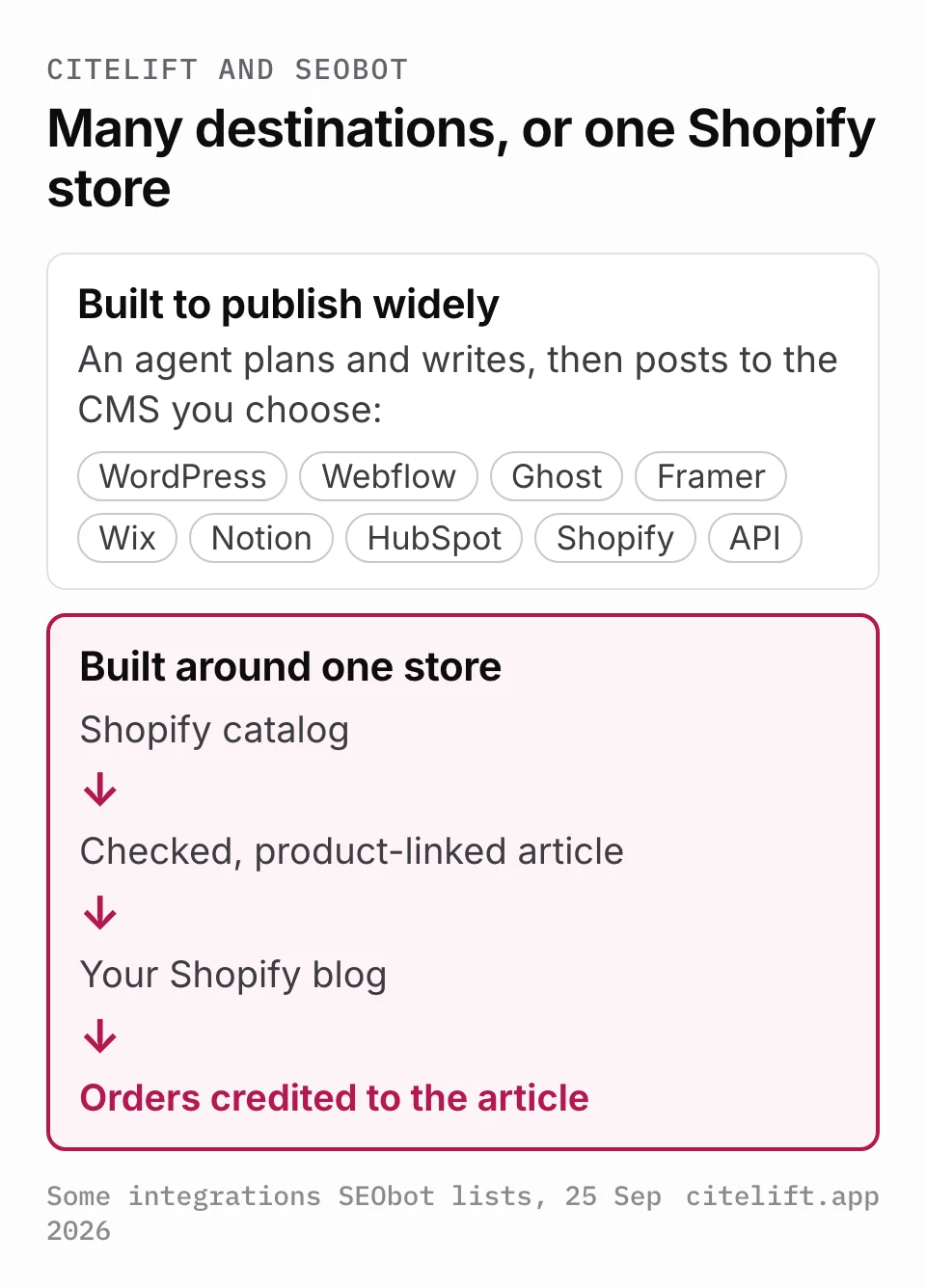
Two different starting points
SEObot starts from your website and a keyword list. Its page describes an agent that researches your site, your audience and the keywords you could win, builds a plan, and then writes and publishes on a weekly rhythm. That is a sensible design for a software company, a publisher or a services business, where the thing being sold is the site itself.
Citelift starts from what a store sells. It reads the Shopify catalog, the brand's own descriptions and the questions buyers in that category ask, and plans articles that answer those questions with the products that genuinely fit. The article exists to help someone choose a product, so the product facts in it have to match the catalog.
Neither approach is wrong. The question is which one matches how your business earns money. If your revenue comes from a checkout on a Shopify store, the catalog is the most useful input a writer can have. If it comes from sign-ups, leads or ad views, a keyword-first agent across your CMS of choice is the more natural fit.
What SEObot's page does and does not tell you
The page is specific about the writing: long articles, internal links, images, YouTube embeds and a fact-checking step that cites sources. It is specific about publishing too, with a dozen named integrations. It offers a refund on the entry plan after the first article, which is a fair way to let you judge the output.
It says nothing we could find about reading a store's product catalog, checking product facts against it, or reporting on orders. That is not evidence those features are missing; a marketing page leaves things out. It does mean you should test those points yourself before assuming them. Ask for one article about a product you know well, then check every size, material and price in it against your admin.
Where Citelift is narrower
Citelift publishes to a Shopify blog and nowhere else for the public. It will not post to Webflow, Ghost or HubSpot. Its weekly ceilings are four, seven and fourteen articles by plan, and its checks can hold a draft, so output is not guaranteed to hit the ceiling. It has been listed on the Shopify App Store only since 5 October 2026 and had no public merchant reviews when we checked on 9 October 2026. If you run several sites on different platforms, SEObot is the more practical choice.
What you get in exchange is a workflow built around the store: catalog-grounded planning, automated checks on product claims, links and media, an optional approval hold on Core and Growth, and a report that credits orders to the article that sent the shopper. That credit uses available Shopify journey data within seven days. It is an attribution rule, not proof that the article caused the sale.
How to compare them in a week
Pick one buyer question you know customers ask, such as how to choose between two of your products. Write down the facts a correct answer needs: names, sizes, materials, prices and the right product URLs. Ask each tool for an article on that question. Then count the corrections each draft needs, check every product link, and note how long the review took.
If you publish, open each article signed out and confirm it is visible. Keep a dated note of search clicks, observed AI answers and attributed orders as separate numbers. After a few weeks you will know which tool produced work you could publish with less correction, which is a better basis for a decision than either vendor's page.
Who should pick SEObot
Pick SEObot if you publish somewhere other than Shopify, or across several stacks at once. It is the broader tool, and its own page lists the destinations.
- You publish on Webflow, Ghost, WordPress, Framer, Wix, HubSpot or Notion, not only Shopify.
- Your site sells software, services or content rather than physical products from a catalog.
- You want an agent to research keywords and publish weekly with little day-to-day input.
- You want to judge the output cheaply first, using the entry plan's refund after one article.
Who should pick Citelift
Pick Citelift if the point of publishing is to sell the products you already stock, and you want the article table sorted by the orders each post produced.
- You sell physical products on Shopify and want articles planned from your catalog.
- You want product claims, links and media checked before an article can be scheduled.
- You want an approval hold before anything publishes, available on Core and Growth.
- You want an article table sorted by the orders each post was credited with.
Moving a Shopify blog between SEObot and Citelift
Both tools publish into your Shopify blog, so the articles stay where they are when you switch. The work is in avoiding duplicates and keeping URLs stable.
- Export every Shopify blog article with its URL, visibility and publish date before you change anything.
- Stop the old tool's publishing schedule first. Two schedulers writing to one blog can produce near-duplicate posts on the same question.
- Give the new tool your existing article list as topics already covered, so it does not plan the same questions again.
- Keep old URLs live. If a post is retired, add a Shopify URL redirect to the closest current article or collection.
- Revoke the old tool's access in Shopify admin once you have cancelled, and remove any leftover API credentials.
- Record a dated baseline of blog clicks, observed AI answers and attributed orders so the switch can be judged later.
Questions
Does SEObot work with Shopify?
Its product page lists Shopify among twelve publishing integrations when we read it on 25 September 2026. We have not connected it to a store, so we cannot describe the setup first-hand.
How much does SEObot cost?
Its page said subscriptions start at $49 a month, with a full refund on the $49 plan if you are not satisfied after the first article. Check the current plans before buying.
Does SEObot read my product catalog?
Its page describes researching your site, audience and keywords. We did not find a description of reading a Shopify product catalog, which does not prove it cannot. Test it with a product whose facts you know.
Can Citelift publish to Webflow or WordPress?
Not publicly. Citelift publishes to a connected Shopify blog, and a WooCommerce connector is in private beta. If you need other CMSs, SEObot covers many more.
Is Citelift on the Shopify App Store?
Yes. Citelift has been listed on the Shopify App Store since 5 October 2026, at apps.shopify.com/citelift. It had no App Store reviews when we checked on 9 October 2026. You can install it there or connect a store through Citelift's own sign-up flow.
Inspect a sample of answers for your store.
See whether ChatGPT names your store for three buyer questions in your category, which competitors it names instead, and which sources it cites. No sign-in needed.