Guide · updated 11 October 2026 · 15 min read
Best Shopify blog apps: top picks compared by job, rating and price
Bloggle, Tapita, DropInBlog, Magefan, Outrank, overrank and Citelift compared by job, App Store rating and starting price, checked 25 September 2026.
For most Shopify stores, Shopify's own blog editor is enough if you already have the words. Pick Bloggle when layout is the job, Tapita for a free AI blog builder with a drag-and-drop editor, DropInBlog for a team blog engine, or Outrank and overrank for automated daily posting. Look at Citelift if you want catalog-checked articles with order credit; it is new, on the Shopify App Store since 5 October 2026.
The top Shopify blog apps compared
Ratings, review counts, starting prices and launch dates come from each app's Shopify App Store listing, checked 25 September 2026. Outrank's price comes from its own pricing page on the same date. The overrank row was re-checked against its App Store listing and pricing page on 26 September 2026. Ratings move daily, so treat them as a snapshot.
| App | What it does | App Store rating | Reviews | Starting price | Launched |
|---|---|---|---|---|---|
| Shopify's own blog | Write, publish and schedule text and image posts | Built into Shopify | Not applicable | Included with eligible Shopify plans | Not applicable |
| Bloggle: SEO Blog Builder | Drag-and-drop editor, templates, product embeds, live SEO scoring | 4.8 | 338 | From $19.90/month; 14-day trial | 26 July 2021 |
| Tapita SEO AI Blog Builder | AI-generated posts, drag-and-drop layout, bulk generation and scheduling | 4.9 | 484 | Listed as Free | 14 February 2022 |
| DropInBlog: Blog Engine | Replacement blog engine with embedded products, AI Blog Pilot and team permissions | 4.4 | 198 | From $199/month; 7-day trial | 19 February 2020 |
| SEO Blog Writer by Magefan | Blog management, related posts and products, translation on Pro | 4.2 | 34 | Free plan; Standard $19/month | 8 March 2023 |
| Content Maker Studio | AI article writing with one-click publishing to a Shopify blog | No rating yet | 0 | Listed as Free; the listing says external charges may apply | 1 May 2026 |
| Outrank | Automated research, writing and publishing to ten destinations | Its Shopify docs use a custom app | Not applicable | $99/month for 30 articles | Not confirmed |
| overrank | A new keyword-researched post every day | 5.0 | 3 | $39/month or $300/year | 10 July 2026 |
| Citelift | Catalog-grounded articles, fact checks, Shopify publishing and order attribution | New; listed on the Shopify App Store since 5 October 2026, no rating yet | 0 (checked 9 October 2026) | $49/month Starter | 5 October 2026 |
Sources: the linked listings and pricing pages, checked 25 September 2026 (overrank re-checked 26 September 2026). Citelift's price is read from its current plan ladder, and Citelift publishes this guide.
How to read that table
The best Shopify blog app depends on the job holding your team back. Use Shopify's own editor when you already have topics and copy. Choose Bloggle when visual composition is the main task. Consider DropInBlog for a dedicated blog engine with team controls, or Magefan for a blog workflow with translation and related-content features. Consider Outrank or overrank when you want a broader automated publishing system. Consider Citelift when you want a recurring Shopify workflow grounded in catalog facts, with publishing checks and article-level order attribution.
Citelift publishes this guide and sells one of the products compared. The competitor details below come from official public pages accessed on 17 September 2026; the prices they quote matched when we rechecked them on 25 September 2026. We did not install the competing apps for this comparison, so their capabilities are vendor claims rather than hands-on findings. Products and offers can change after the access date.
If AI monitoring is central to your decision, the visibility-tool buying checklist explains which raw evidence to request before comparing scores.
Keep that separate from a repeatable AI visibility measurement with fixed questions, source URLs and unavailable answers recorded.
For sitewide technical SEO, image optimization and app selection beyond blogging, see our Shopify SEO app decision guide. For our own demonstrations and current limitations, inspect Citelift proof and progress.
Quick shortlist by the work you need done
| Your main bottleneck | Start by evaluating | The decision to verify |
|---|---|---|
| You have copy and need to publish it | Shopify's native blog | Whether the existing editor and theme are sufficient |
| You want to compose richer article layouts | Bloggle | Theme fit, reusable sections and the plan containing them |
| You need a dedicated blog engine for a team | DropInBlog | Users, author roles, publishing location and migration needs |
| You need translation and related-content organization | Magefan | Which content fields and features your plan supports |
| You want recurring content across publishing systems | Outrank or overrank | Actual setup, review controls and the complete recurring cost |
| You want catalog-grounded Shopify production and order credit | Citelift | Required fact checks, review options and the attribution limits |
This is a task-based shortlist, not a best-to-worst league table. More features do not establish a better fit. If publishing occasional posts is already straightforward, retaining Shopify's editor is a valid decision. Start with the Shopify blogging setup and SEO guide before adding a subscription.
Download the app-evaluation scorecard. It records the exact plan, source, trial task, setup work, review effort and what remains after cancellation. An unanswered field stays unknown.
Start with five jobs, not one feature list
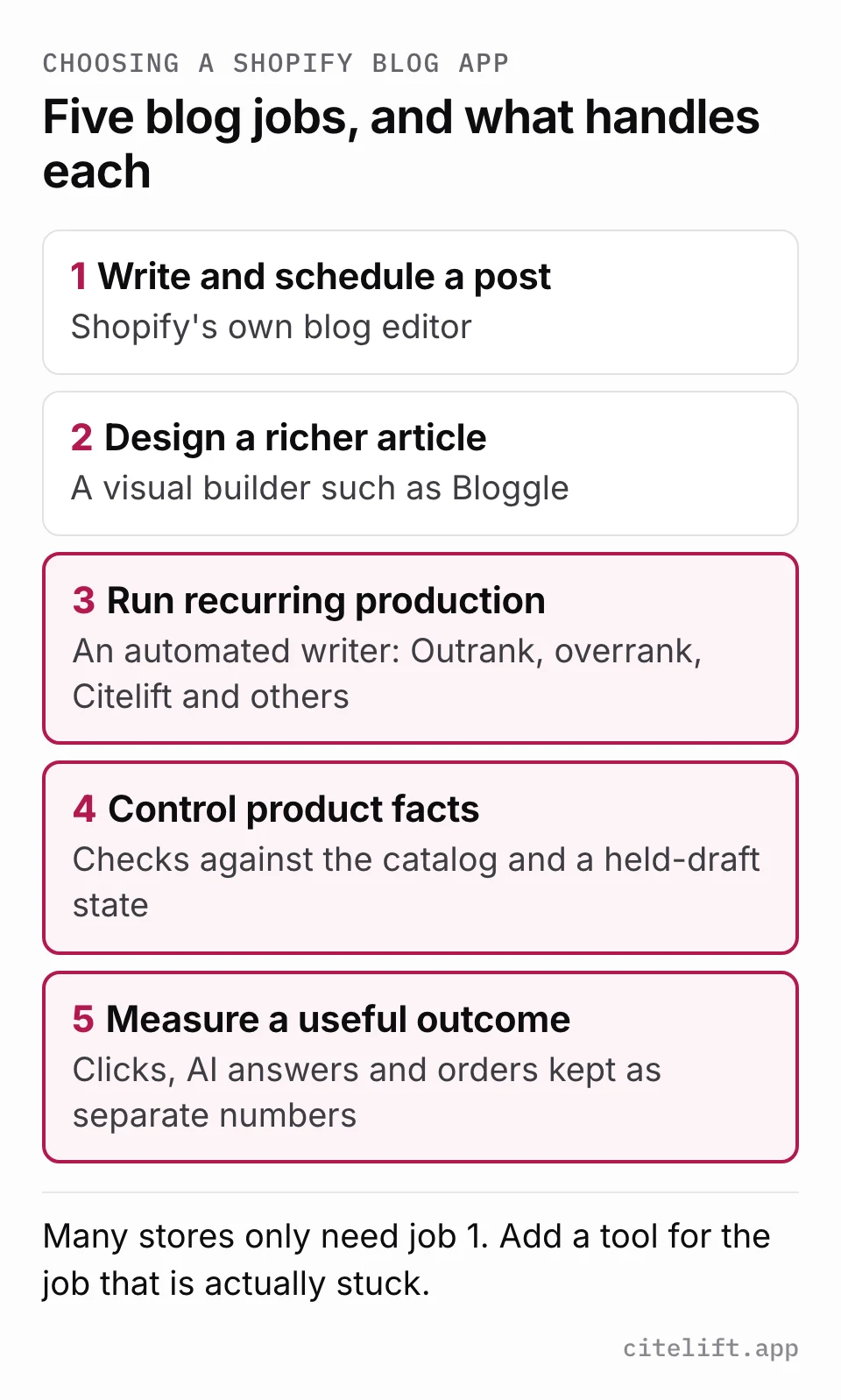
A long feature checklist hides the decision. Write down which of these jobs you actually need:
- Write and schedule a post by hand. Shopify's built-in blog can already publish text and images immediately or on a future date.
- Design a richer article. A visual editor, reusable sections and product galleries matter more than automated topic research.
- Run recurring production. Topic selection, research, drafting, images, links and delivery need to move without a new prompt for every post.
- Control factual risk. Product claims need a known source, a review step and a clear held-draft state when checks fail.
- Measure a useful outcome. Search impressions, AI-answer observations, article visits and orders credited to an article are different measures.
The answer may involve two tools. A content system can create a draft while Shopify remains the publishing destination. A visual editor can improve an article supplied by a writer. Price the whole workflow rather than treating an app subscription as the total cost; the Shopify blog content cost guide includes a worksheet for that calculation.
Current public prices and stated scope
These are public list prices or route-specific offers displayed on 17 September 2026. They exclude your Shopify subscription, taxes, internal labor and any optional service or add-on unless stated.
| Option | Public price observed | Main stated job | What to verify |
|---|---|---|---|
| Shopify blog | No separate blog-app charge beyond an eligible Shopify plan | Manual writing and scheduling | Theme layout and staff effort |
| Bloggle | $19.90 Starter, $49.90 Pro or $79.90 Business per 30 days; 14-day trial | Visual article building and reusable sections | Plan-specific design and reporting features |
| DropInBlog | Shopify listing: Team $199/month or $1,908/year; Business $499/month or $4,788/year; Business Plus $11,988/year; 7-day trial | Dedicated blog engine, authors and team controls | Shopify purchase route, user limits and migration requirements |
| Magefan | Vendor page: Basic $0, Standard $19/month, Pro $39/month; 7-day trial offered | Blog management, AI writing, translation and related content | Free-plan scope and which features need a paid tier |
| Outrank | $99/month or $999/year for 30 articles/month | Recurring research, writing and publishing integrations | Add-on charges and human review needs |
| overrank | General page and App Store listing: $39/month or $300/year; Shopify page: $39/month (checked 26 September 2026) | Daily automated article production | Which route and terms apply at checkout |
| Citelift | $49 Starter, $99 Core or $199 Growth per month | Catalog-grounded Shopify publishing and article order attribution | Plan ceilings, review controls and measurement scope |
Sources: Shopify blogging documentation, Shopify writing and scheduling documentation, Bloggle's Shopify App Store listing, DropInBlog's Shopify App Store listing, Magefan's product and pricing page, Outrank pricing, Outrank's Shopify connection documentation, overrank's general product page and overrank's Shopify page, all accessed 17 September 2026, plus overrank's Shopify App Store listing and Magefan's Shopify App Store listing, checked 26 September 2026.
Use Shopify's editor when the process is already yours
Shopify says its online store includes a blogging engine. Its current help pages document text and image posts, immediate publishing, scheduled publishing, templates and bulk visibility changes. That is enough when your team already supplies the topic, facts, copy, images and final review.
The cost is therefore not “free content.” The separate blog-tool charge can be zero while staff or contractor hours remain substantial. Shopify also localizes plan pricing, so confirm the store's own plan instead of copying a universal subscription amount into a budget.
For occasional launches, founder notes or company news, the native workflow can be the simplest fit. Compare it with Shopify Magic's prompted drafting workflow if the blank page is the bottleneck rather than design or recurring production.
Choose Bloggle when the article itself needs a visual builder
Bloggle's official listing emphasizes a drag-and-drop editor, templates, theme-style syncing, SEO scoring and product embedding. Its feature page also describes reusable sections, blog-list layouts, scheduled posts and images loaded to Shopify's CDN. The listing says content remains on the store after uninstalling.
That makes Bloggle a strong candidate when a content team already has a draft but needs more control over how a recipe, buying guide, interview or product-led article looks. Check the exact tier for saved sections, galleries and navigation; those are not interchangeable plan entitlements.
We did not install it, time a design task or inspect the result in a theme. The public pages do not prove how much editor time a particular team will save, how a custom theme will behave or which reporting will matter to you. Use the Citelift vs Bloggle comparison for a source-by-source decision checklist.
Consider DropInBlog when team publishing and blog infrastructure matter
DropInBlog's Shopify listing describes embedded products, an SEO analyzer, AI-assisted Blog Pilot planning and user permissions. The Team tier lists five users and fifteen authors; Business adds a staging environment and employee audit logs. Those differences are relevant when several people edit and approve a publication. Official Shopify listing, checked 17 September 2026.
The starting Shopify offer observed here is $199 monthly, so do not budget from an older low-price roundup or assume another purchase route has identical terms. Before moving an established blog, ask where posts and images are served, what can be exported and how existing URLs will behave after cancellation. We have not tested that migration or run the app in a merchant theme.
Consider Magefan when localization and content organization matter
Magefan's own product page describes AI-assisted writing, related posts and products, customizable blog layouts and translation of its blog content and metadata. It lists Basic, Standard and Pro offers at $0, $19 and $39 monthly. Those prices do not imply every capability is available on Basic. Magefan product page, checked 17 September 2026; the product page did not load on 26 September 2026, and the Shopify App Store listing showed the same three prices, with translation on Pro.
Evaluate one article in the actual languages you need. Check translated metadata, URLs, product destinations and how the blog fits the storefront search experience. An app's content model can differ from native Shopify resources; the multilingual release checklist helps verify that boundary. This is a documentation-based candidate for the job, not a hands-on endorsement.
Choose Outrank when destination breadth and volume lead the decision
If Outrank is already on your shortlist, the Outrank alternatives page compares it with other recurring-content options, each with dated sources.
Outrank's current pricing page describes one $99 monthly plan with 30 articles, automated keyword research, images, automated backlink building and its publishing integrations. Its Shopify documentation uses a merchant-created custom app and lets the merchant choose immediate publication or drafts. Higher article volumes, human curation, premium images and other services have separate prices on the pricing page.
Outrank can therefore fit a team that publishes across several content systems or wants its backlink and directory products in the same vendor relationship. Total the add-ons you would actually buy. The base article count alone does not tell you how much review, correction or publishing labor the workflow will require.
Citelift previously ran a disclosed paid Outrank trial on a demo store; that separate Citelift vs Outrank comparison labels the one-store observations and their date. This shortlist relies on today's official offer for price and scope rather than presenting that older run as current product-wide behavior.
Choose overrank when daily automation and broader delivery fit
overrank's current general page describes automated keyword selection, writing, daily publishing, internal links, images, Search Console data and a link network. Its developer documentation offers a content API, signed webhooks and a hosted option. Its Shopify page separately describes an app, listed on the Shopify App Store since 10 July 2026, that reads the storefront and publishes native Shopify posts with a product or collection call to action.
When we re-checked on 26 September 2026, the prices agreed: the general page shows $39 billed monthly or $300 a year billed annually, and the Shopify page and App Store listing show $39 a month billed through Shopify. The struck-through $78 and $50 on the general page are anchor prices; an earlier version of this guide read the $50 as a second monthly price. Record the checkout screen you actually receive.
We have not run overrank. Claims about automatic publication, analytics, backlinks and outcomes remain the vendor's. The refreshed Citelift vs overrank comparison keeps that boundary beside every row.
Choose Citelift when catalog facts and order credit are central
Citelift plans from buyer questions and catalog context, then drafts product-linked Shopify articles. Automated product, claim, link and media checks can hold a draft. Starter allows up to four articles per rolling week and monthly AI-answer checks; Core allows up to seven with weekly checks, an optional review hold and eligible Search Console connection; Growth allows up to fourteen with the same check cadence and review option plus priority generation.
Current monthly prices are $49, $99 and $199. An eligible store's seven-day trial starts when the merchant approves the plan in Shopify. The free AI visibility checker is separate: with no sign-in, it asks ChatGPT three buyer questions for your category and shows whether your store is named and which sources are cited. A manual prompt-and-paste checker is also available without an account or model call.
Paid planning and generation begin only after Citelift verifies an active Shopify subscription approval. Connecting a store or using the free check does not start paid generation.
Citelift also credits eligible Shopify orders to an article using available journey data within a seven-day window. That is an attribution rule, not proof the article caused a sale. Read how article order attribution works before comparing it with traffic, rank or lead reports.
Run one same-task evaluation before choosing
Use one existing product and one buyer question for every candidate. Record the source facts first: product name, URL, current price, composition, sizing or quantity, and care or use instructions. Then compare:
| Check | What to record |
|---|---|
| Input | Topic, catalog fields, brief and assets you had to supply |
| Draft | Unsupported product claims, missing facts and links that need correction |
| Design | Mobile and desktop layout, product placement and theme fit |
| Control | Draft, approval, scheduling, failure and correction states |
| Ownership | Where HTML and images live; what remains after cancellation or uninstall |
| Measurement | Published URL, search data, observed AI answers, referrals and order-credit rule |
| Labor | Setup, writing, review, revisions, imagery, publishing and monthly maintenance time |
Do not mark an unlisted feature as absent. Ask the vendor or test it within an authorized trial. Open the published URL while signed out, because a dashboard status alone does not establish storefront visibility. Use the free draft audit for a consistent content review, then decide which workflow removes your actual bottleneck.
A worked evaluation worksheet, with inspectable evidence rows
We filled the rubric on 14 September 2026 with a deliberately synthetic apron catalog, then reran the linked deterministic contracts on 18 September 2026. Download the row-by-row worksheet and the claim-by-claim public proof map. This is not a completed Citelift same-task run. Harbor Linen Apron is not a customer or a live product, and we deliberately inserted the wrong measurement so the decision is easy to reproduce.
| Rubric stage | What the worksheet records | Evidence boundary |
|---|---|---|
| Catalog input | 100% linen; 82 cm long; 68 cm wide; 95 cm waist tie; machine wash cold; line dry | Synthetic fact sheet; repeatable test input, not a merchant observation |
| First draft | Change the supported length from 82 cm to 92 cm | Error seeded by the evaluator; Citelift did not generate or find it for a merchant |
| Fact decision | Stop on the unsupported measurement and request a correction | Synthetic code contract rerun locally on 18 September; narrow gate coverage only |
| Correction | Change only the unsupported sentence and leave the rest of the draft intact | Synthetic code contract rerun locally on 18 September; not a model-output sample |
| Review decision | Keep the article held until the reviewer chooses publish or skip; a repeated choice does not create another action | Synthetic database and signed-route contracts rerun locally on 18 September |
| Published rendering | The separate owned QA screenshot below shows Shopify-confirmed visibility, permalink and preview | Read-only QA capture from 14 September; it is not the apron fixture |
| Proposed steps | Prepare the facts; inspect the failure; review the change; approve; open the Shopify URL; record the remote state | Six proposed evaluator decisions; elapsed time was not measured |
The rows come from separate fixtures. They show how to evaluate Citelift's current controls, but they do not prove that the apron draft moved through Citelift from generation to publication. The 18 September check passed 140 focused tests across six named files covering the deterministic writing scorer, product-truth gate, bounded repair, hold decision and article-route presentation. That is code-contract evidence for those fixtures, not a writer benchmark or aggregate quality guarantee. No competitor was run for this example, so it supplies no winner score or competitor result.
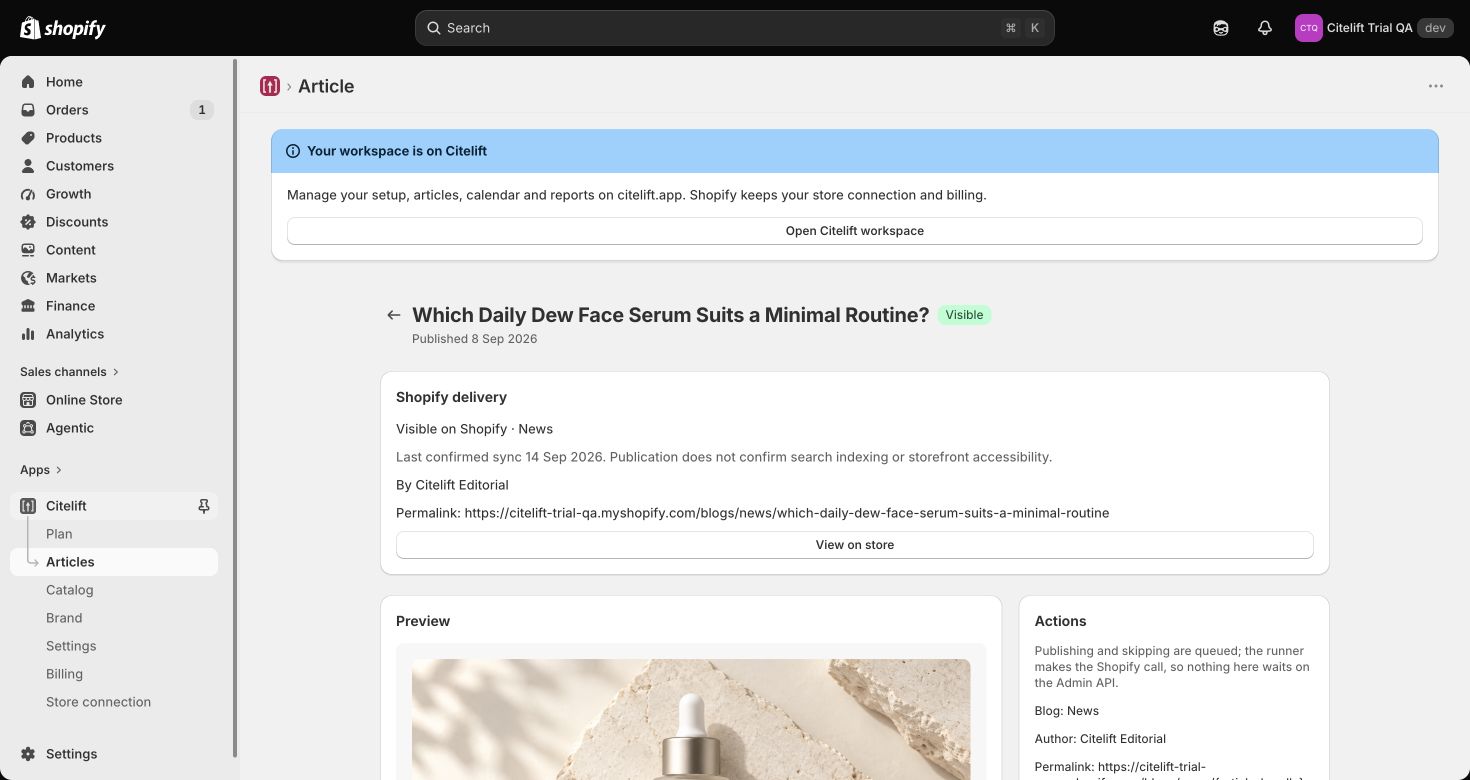
Owned fictional QA store, captured read-only on 14 September 2026. The article was published on 8 September and is a rendering reference, not a customer result and not the apron fixture. No generation, approval or publication action was performed during capture.
To reproduce the safe fact test now, download the worksheet and exact before-and-after scorer inputs, paste each description into the product-description scorer, and confirm that both receive the same structure score. The dated machine-readable run records the two input hashes, source hash and all check results. The existing 75-second product-claim walkthrough shows this source-sheet comparison with another fictional product. Then inspect the source and boundary columns in the public proof map. To conduct a real evaluation, replace the six synthetic catalog fields with one product and selected variant you control, preserve one continuous evidence chain, and follow the six proposed decisions. The worked fact-audit guide shows how to preserve source and rendered observations. The editorial-control walkthrough explains what approve, hold and publish mean in the shipped workflow. Citelift proof and progress keeps this demonstration beside the evidence still missing.
Choose using evidence from one complete article
Shortlist two options that solve your main bottleneck, including the native editor if it remains plausible. Use the same approved brief and product facts for each. Record the exact paid tier before comparing a feature demonstration with a cheaper plan.
Separate active work from elapsed time: importing content, writing, fact review, layout correction and publishing are different costs. A fast first draft can still need extensive correction. A vendor score is not a substitute for checking the live article, its links and your ability to edit or export it.
A defensible decision reads: “We chose this option because it completed our required workflow, preserved our URLs and reduced the review work we measured.” If those facts remain untested, write a provisional shortlist instead of a winner. For AI-monitoring claims, use the visibility-tool evidence checklist.
What this shortlist does not establish
This is a current desk comparison of official documentation, authored by Citelift. It is not an independent ranking, a customer survey or a test of organic growth. Vendor usage counts, testimonials and outcome charts are not treated here as verified merchant results.
Prices can change, annual plans can bill upfront and Shopify app charges can follow a separate 30-day cycle. Confirm the exact checkout amount, refund terms and cancellation behavior before approving a charge. A publishing tool can change throughput; it cannot by itself establish search visibility, AI inclusion or incremental revenue.
Questions.
What is the best Shopify blog app for visual design?
Bloggle is the clearest fit in this shortlist when the main job is arranging a post with a drag-and-drop editor, reusable layouts and product sections. That conclusion is based on its current public listing and documentation, not a hands-on Citelift test.
Do I need an app to publish a Shopify blog?
No. Shopify includes a blogging engine with eligible online-store plans. You can write posts with text and images, publish immediately or schedule a date without buying another blogging app.
Which option writes and publishes on a recurring schedule?
Outrank, overrank and Citelift each describe recurring research, writing and publishing workflows, with different prices, volumes, review controls and measurement. Verify the workflow on your own store before choosing.
Will a blog app improve rankings or sales?
A tool can make research, editing or publishing easier, but its use does not establish rankings or incremental sales. Measure published URLs, search performance and commercial outcomes separately.
Citelift is listed on the Shopify App Store: Citelift on the Shopify App Store.