Guide · updated 9 October 2026 · 13 min read
Best Shopify SEO apps: top picks compared by job, rating and price
TinySEO, Avada, SearchPie, StoreSEO, Yoast and Citelift compared by job, App Store rating, reviews and starting price, all checked 25 September 2026.
For most Shopify stores, start with TinySEO, Avada or SearchPie for image, speed and technical fixes; each has thousands of App Store reviews and a free or free-to-install plan. Choose Yoast if editors want page-by-page SEO and readability feedback, or StoreSEO for a free plan with an AI-assistant connector. Look at Citelift only if the gap is recurring product-linked articles; it is new, on the Shopify App Store since 5 October 2026.
The top Shopify SEO apps compared
Every row below comes from the app's Shopify App Store listing, checked 25 September 2026. Ratings and review counts move daily, so treat them as a snapshot.
| App | What it does | App Store rating | Reviews | Starting price | Launched |
|---|---|---|---|---|---|
| TinySEO: SEO & Image Optimizer | Image and speed optimization, audits, JSON-LD, redirects, IndexNow and an AI blog builder | 5.0 | 2,519 | Free to install; paid plans from $14/month | 12 June 2019 |
| Avada AI SEO Image Optimizer | AI SEO audit agent, on-page optimizer, speed, structured data, sitemaps and redirects | 4.9 | 4,677 | Free plan; Pro $34.95/month | 21 April 2020 |
| SearchPie: SEO, Schema & Speed | Metadata, schema, speed, broken links, Search Console data; AEO and llms.txt on Enterprise | 4.9 | 2,446 | Free plan; Premium $39/month | 9 July 2019 |
| StoreSEO AI SEO Optimizer | Product SEO, schema, image optimization, llms.txt and agents.md editing, an MCP connector for Claude and ChatGPT | 5.0 | 754 | Free plan; Lite $14.99/month | 19 October 2021 |
| Yoast SEO for Shopify | SEO and readability analysis, structured data, bulk editor and an llms.txt file | 4.3 | 176 | $19/month; 14-day trial | 27 September 2021 |
| Citelift | Product-linked article planning, fact checks, Shopify publishing and article order attribution | New; listed on the Shopify App Store since 5 October 2026, no rating yet | 0 (checked 9 October 2026) | $49/month Starter | 5 October 2026 |
Sources: each app's linked Shopify App Store listing, checked 25 September 2026. Citelift's price is read from its current plan ladder. Citelift publishes this guide.
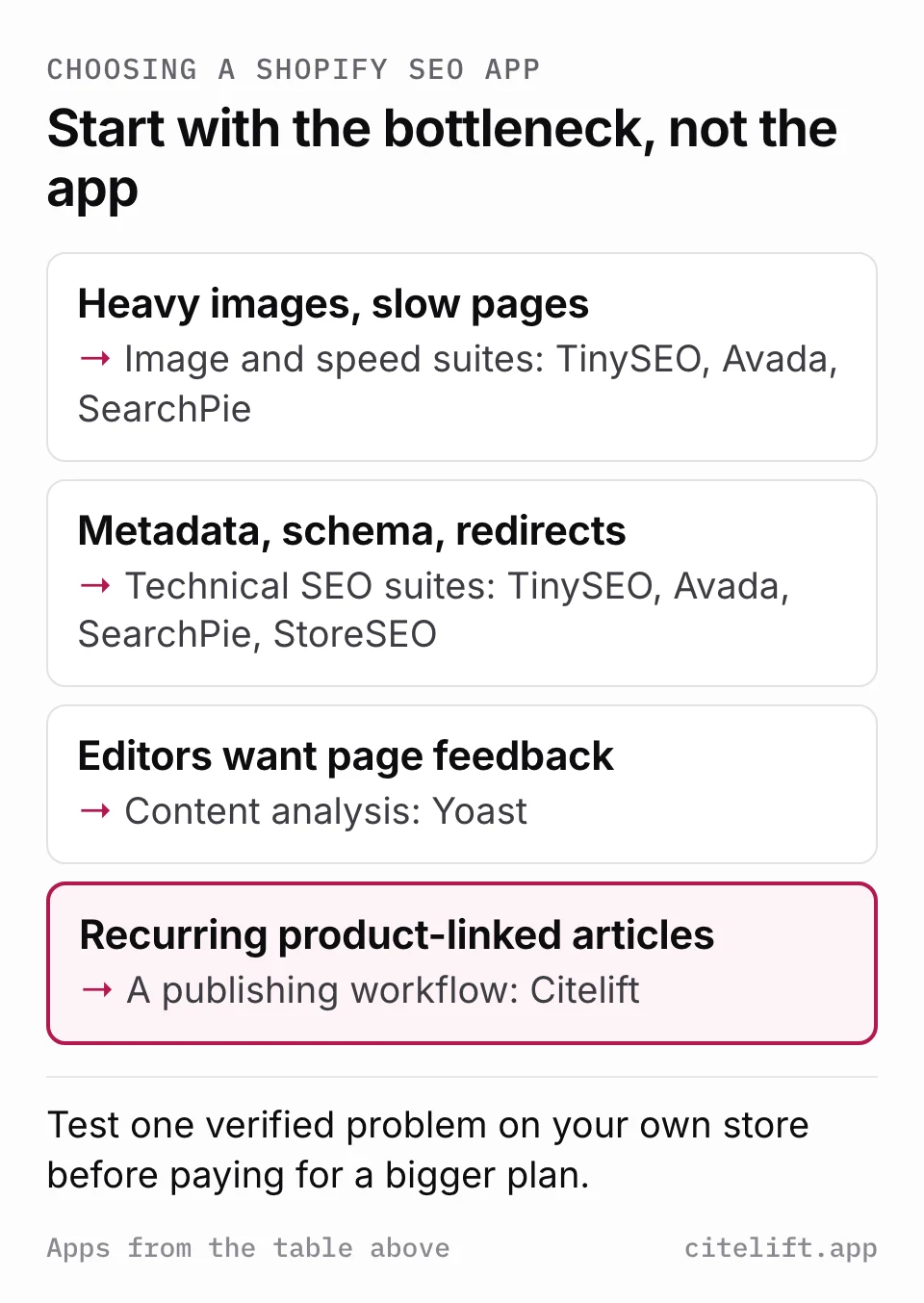
How to read that table
The best Shopify SEO app is the one that fixes a specific, verified constraint in your store. If oversized images are the problem, begin with image and speed tools. If editors need help improving titles, descriptions and readability, test a content-guidance tool. If the missing capability is a recurring product-linked publishing workflow, compare that workflow directly. Buying the longest feature list can leave the original problem untouched.
This guide compares TinySEO: SEO & Image Optimizer, Avada AI SEO Image Optimizer, SearchPie: SEO, Schema & Speed, StoreSEO, Yoast SEO for Shopify and Citelift. Citelift publishes this guide and develops one of the products compared. Competitor facts come from official pages first accessed on 18 September 2026 and rechecked on 25 September 2026; the prices below had not changed. We did not install or run the four competing apps, so their features are vendor claims rather than hands-on findings.
Citelift's own evidence has limits too. Its current controls have been checked in code, automated fixtures and an owned fictional QA store. Those checks do not establish merchant adoption, time saved, search rankings, AI citations or sales lift. As of 18 September 2026, Shopify showed the submission as “Submitted,” with no rating; Citelift was not App Store approved, had no clients and had no real merchant pilot available for this comparison. The Citelift proof and progress page brings the current proof, aggregate discovery baseline and missing evidence into one place.
This page is about storewide Shopify SEO app selection. If your decision is specifically about article editors, blog engines or automated blogging, use the separate Shopify blog app comparison.
Shortlist by the work that is actually blocked
| Your verified bottleneck | Start by evaluating | Why it belongs on the shortlist | What the public pages do not prove |
|---|---|---|---|
| Heavy images, missing alt text or speed work | TinySEO, Avada or SearchPie | All three official listings describe image optimization and speed features | The speed change on your theme, visual quality and ranking impact |
| Storewide metadata, broken links, redirects, schema and technical checks | TinySEO, Avada or SearchPie | Their listings describe broad, overlapping technical SEO toolsets | Which changes are safe with your theme and existing apps |
| Editorial feedback for products, collections and posts | Yoast | Yoast documents SEO and readability analysis, metadata controls, schema and bulk editing | That a green score will produce traffic or sales |
| An AI-assisted blog builder inside a wider SEO suite | TinySEO | TinySEO explicitly lists an AI blog builder and optimizer | Article quality, fact accuracy, review labor and publication outcome |
| AI-assisted page audits and one-click fixes | Avada | Avada describes an AI SEO Audit Agent plus an on-page optimizer and checklist | That every suggested change is correct for your theme or market |
| A broad free starting point for audits and templates | Avada or SearchPie | Both listings show free tiers with limited image, metadata, schema or audit allowances | That the free allowance covers your catalog or preferred automation |
| Recurring product-linked articles with fact gates, review states and article order credit | Citelift | This is Citelift's stated product workflow and the focus of its owned control evidence | Real merchant outcomes; App Store approval and merchant pilots were pending |
| AI-answer observation | Citelift, or a separately evaluated visibility tool | Citelift includes scheduled API-based checks by plan | Consumer ChatGPT, Claude or other interface rankings; an API sample is a different population |
This is a task map, not a ranking. Several apps overlap. TinySEO has an AI blog builder, Avada has an AI audit agent, and SearchPie and Yoast both advertise AI-assisted metadata or content work. Citelift should not be selected because it is “the AI option.” It should enter the shortlist only when its product-linked publishing and review workflow matches the job.
Current prices and the offer to verify
The table records public list prices shown on 18 September 2026 and unchanged when rechecked on 25 September 2026. It excludes Shopify fees, taxes, usage above allowances, staff time, implementation help and any optional service. Annual prices may bill upfront. Confirm the exact in-app approval screen before accepting a charge.
| App | Public offer observed | Main job stated on reviewed official pages | First limit to verify |
|---|---|---|---|
| TinySEO | Free to install with 50 image optimizations monthly and 3¢ per extra image; Beginner $14/month; Advanced $23/month; Expert $49/month | Image and speed optimization, audits, metadata, schema, redirects, IndexNow and an AI blog builder | Image allowance, usage charges, backup window and which tier contains each technical feature |
| Avada | Free; Pro $34.95/month or $348/year; Enterprise $99/month or $990/year; 7-day trial on paid tiers | Image and speed optimization, on-page audits, schema, sitemaps, redirects and AI-assisted checks | AI credits, audit allowance, theme changes and whether Enterprise-only agent work is needed |
| SearchPie | Free; Premium $39/month or $374.40/year; Enterprise $99/month or $950.40/year; 7-day trial on paid tiers | Storewide SEO and speed checks, metadata, schema, broken links, indexing tools, Search Console work and AEO features | Catalog/image limits, what “submit backlinks” delivers, and the evidence behind indexing or traffic claims |
| Yoast | $19/month or $190/year; 14-day trial | SEO and readability analysis, metadata, structured data, bulk editing, technical SEO and llms.txt |
Theme integration, language-specific analysis and how much editor work remains |
| Citelift | $49 Starter, $99 Core or $199 Growth per month | Product-linked article planning, drafting, quality gates, Shopify publication, visibility observations and article order credit | App Store availability, plan ceilings, review mode, source quality and the attribution rule |
Official sources: TinySEO Shopify listing, Avada Shopify listing, SearchPie Shopify listing, Yoast Shopify listing, Yoast Shopify documentation and Citelift pricing. All were reviewed on 18 September 2026 and rechecked on 25 September 2026; Citelift prices above are populated from the application's current plan ladder.
TinySEO: begin with image, speed and technical cleanup
TinySEO's official listing describes image compression and resizing, alt text and filename work, lazy loading, JavaScript and CSS minification, JSON-LD, audits, broken-link and redirect tools, IndexNow, metadata generation and Search Console insights across its tiers. The free-to-install offer includes 50 image optimizations a month, extra-image charges and a 30-day image backup.
The listing also explicitly includes an AI Blog builder & optimizer. That matters because “writes blog content with AI” is not a Citelift-exclusive claim. A useful trial should therefore compare one article's required inputs, source fidelity, correction work, publishing state and ownership instead of checking whether an AI button exists.
For an image-heavy catalog, freeze a baseline before allowing bulk changes: page weight, representative image dimensions and quality, current alt text, Core Web Vitals source, and a theme backup. Then test a small product sample. A listing's speed or ranking language is the vendor's claim; it is not a measured result for your store.
Avada: evaluate the audit agent and its change controls
Avada's listing positions the product around an AI SEO Audit Agent, an on-page optimizer and an SEO checklist. It also describes image compression and resizing, alt text, speed work, metadata, structured data, sitemaps, redirects and broken-link detection. The free tier lists 20 on-page audits and 100 AI credits; Pro lists unlimited audits and 1,000 AI credits; Enterprise lists the audit agent and 10,000 AI credits.
The buying question is therefore not whether Avada “has AI.” It does. Ask what the agent changes, whether it proposes or applies each fix, how a change can be reviewed or reversed, and how it behaves beside theme SEO output or another schema app. Run the same pages through the storewide SEO checklist before and after the trial.
Avada's listing mentions blog-post and content work, but the page reviewed here does not establish a recurring catalog-grounded article workflow equivalent to Citelift's. That is an unverified scope difference, not proof that Avada lacks another workflow elsewhere.
SearchPie: price the broad suite and inspect outcome claims
SearchPie's listing combines image and speed optimization, metadata templates, schema, broken links, redirects, Search Console work, page indexing tools, AI generation, audits and reporting. Premium lists 500 image compressions, 250 AI-generated SEO tags and ten backlink submissions. Enterprise adds unlimited image compression, AEO and LLM.txt, keyword work and unlimited backlink submissions.
Broad suites can reduce the number of separate apps, but each job needs its own acceptance test. A backlink submission is not an acquired, relevant link. An indexing tool is not proof that Google indexed a URL. An AEO setting is not proof that a consumer assistant mentioned or cited the store. Request the resulting URLs, reports or raw observations and check them independently.
Use SearchPie as a candidate when several storewide tasks need work and one vendor relationship is valuable. If only one narrow issue is verified, compare the labor and risk of a focused solution with the larger suite.
Yoast: use editorial analysis when people still own the page
Yoast's official listing and documentation emphasize SEO analysis, readability analysis, search and social appearance, structured data, technical SEO, AI-generated titles and descriptions, llms.txt, and a CSV bulk editor. Yoast documents analysis for products, collections, pages, blogs and blog posts. It is the clearest fit in this group when an editor wants guidance while retaining direct control of the page.
Yoast's developer documentation says the app changes or replaces SEO-related theme output, including titles, metadata, canonicals and structured data. Before installation, back up the theme and inventory any other app or customization that emits the same fields. After setup, inspect actual storefront HTML for a product, collection, post and page rather than relying only on dashboard scores.
An SEO or readability score is editorial feedback. It is not a ranking prediction, and the AI title and description generator is not a complete content-production system. If recurring topic planning, product fact sourcing and publication are the bottleneck, compare a publishing workflow separately.
Citelift: evaluate product-linked publishing, with the evidence boundary visible
Citelift plans buyer-question articles from a connected Shopify catalog, prepares drafts with product links, and runs named checks for claims, product truth, citations, duplication, structure, readability, images, links and media. A required failure holds the draft. Core and Growth include an optional review hold; Starter can continue after required checks pass. Current ceilings are four, seven and fourteen articles per rolling week for Starter, Core and Growth.
Those are product behaviors and plan limits, not outcome evidence. The Citelift proof and progress page is the shortest route to the full evidence boundary. Its linked editorial-control walkthrough includes an owned QA screenshot and a claim-by-claim proof map. The fixtures demonstrate hold, bounded correction, approval state and remote-publication controls, but they are synthetic or owned QA evidence. The product-fact audit demonstrates why a writing score can remain perfect while a measurement is wrong. Neither page is a real merchant case study.
Citelift also credits eligible Shopify orders to an article using its documented journey rule and a seven-day window. The article attribution guide explains why that credit is not causal lift. Paid visibility checks are monthly on Starter and weekly on Core and Growth. These are API-based observations. They must not be reported as consumer ChatGPT, Claude or other interface rankings; the AI visibility tool checklist shows the raw fields required for a fair comparison.
Keep that separate from a repeatable AI visibility measurement with fixed questions, source URLs and unavailable answers recorded.
Citelift's App Store listing went live on 5 October 2026; when rechecked on 9 October 2026 it had no reviews and no real merchant pilot was available for this guide. A buyer can inspect the public documentation and owned proof today, but should defer any adoption conclusion until the workflow has been tested on an authorized store.
Compare one task without pretending it is a benchmark
Use one store-owned page set and one defined acceptance criterion. Do not ask every app to perform a different showcase and then add the results into a score.
| Test field | What to record |
|---|---|
| Problem | Exact pages and observed defect, with capture date |
| Baseline | Storefront HTML, image weight, field values, Search Console state or editorial time relevant to that defect |
| Plan | Exact paid or free tier and the allowance required for the test |
| Access | Data and theme permissions requested, plus any integration or duplicate-output risk |
| Change | Every field, file, image, redirect, schema block or article the app changed |
| Control | Preview, approval, rollback, backup and cancellation behavior actually observed |
| Output | Public URL or storefront HTML checked while signed out |
| Labor | Setup, review, correction and ongoing maintenance time |
| Outcome | The narrow acceptance criterion, separated from later traffic, ranking or revenue measures |
| Unknowns | Anything the listing did not answer and the trial did not test |
For image optimization, a valid acceptance criterion could be “reduce bytes on ten representative product images without a visible quality failure and without duplicate lazy-loading behavior.” For metadata, it could be “render one intended title, description and canonical for each sampled page type with no duplicate schema.” For article workflow, it could be “retain supplied product facts, stop on a seeded unsupported claim, preserve the reviewed correction and publish one accessible Shopify URL only after the required decision.”
The downloadable app-evaluation scorecard provides a reusable record. The completed Citelift row linked from the blog app guide is a composite synthetic example, not a competitor benchmark or merchant run.
Four sample buyer scenarios
A 2,000-product image catalog with slow collection pages
Shortlist TinySEO, Avada and SearchPie. Measure a representative group rather than optimizing the entire catalog first. Compare compression quality, resizing, backups, duplicate speed scripts, usage charges and rollback. Yoast's editorial analysis and Citelift's article workflow do not directly answer this primary problem.
A small team rewriting products and collections by hand
Start with Yoast if the desired change is consistent editorial feedback, metadata templates, structured data and bulk editing. Keep Shopify's native fields in the comparison. Verify theme output and the languages the team needs. An analysis score should remain one input to review, not the publication target.
A merchant with scattered technical defects and no SEO operator
Compare Avada, SearchPie and TinySEO using the same storewide defect inventory. A broad dashboard may help organize work, but test who approves changes and what support actually does. Price the tier that covers the catalog, not the lowest advertised amount.
A merchant that needs recurring product-linked buying guides
TinySEO belongs in the content shortlist because its listing includes an AI blog builder. Citelift belongs because it documents recurring catalog grounding, named gates, review states, Shopify delivery and article order credit. Compare one identical brief and fact sheet when Citelift is approved and available. Until then, Citelift's side remains owned QA and synthetic control evidence, so there is no fair winner claim.
Make the decision provisional until the store proves it
Write the decision in one sentence: “We chose this app and tier for these pages because it completed this defined task, left this inspected output, and required this much review.” Attach the baseline and after-state. Set a date to check whether the output remains correct.
Keep later measures separate. Search Console impressions and clicks are not revenue. A platform API answer is not a consumer-chat ranking. An attributed order is not proof the app caused the purchase. If the trial did not produce the evidence needed for the original job, record the result as unknown or failed rather than awarding points for unrelated features.
Prices, allowances and product claims can change after 18 September 2026. Reopen the official listing, confirm the checkout terms and rerun the exact store-level check before approving a subscription.
Questions.
What is the best Shopify SEO app?
For image, speed and technical fixes, TinySEO, Avada and SearchPie are the most reviewed on the Shopify App Store, each with thousands of reviews and a free or free-to-install plan on 25 September 2026. Yoast suits editors who want page-by-page feedback. Citelift suits recurring product-linked articles and has been on the App Store since 5 October 2026. There is no universal winner; verify the job on your own store.
Which Shopify SEO apps have a free plan?
The official listings checked on 18 September 2026 showed a free plan for Avada and SearchPie, and a free-to-install usage-based option for TinySEO. Yoast listed a paid plan with a trial. Citelift listed paid plans; its App Store listing went live on 5 October 2026. Confirm the checkout because offers can change.
Do TinySEO or Avada include AI features?
Yes. TinySEO's current listing includes an AI blog builder and optimizer. Avada's listing includes AI generation and an AI on-page audit agent on Enterprise. Citelift is therefore not the only product in this group with AI features.
Will an SEO app make my Shopify store rank?
No app installation proves a ranking outcome. A tool can help change metadata, structured data, images, speed settings, content or publishing workflow. Measure the affected pages in Search Console and check real storefront output separately.
Is this a hands-on test of all five apps?
No. Competitor capabilities and prices are drawn from official public pages checked on 18 September 2026. Citelift evidence is limited to owned QA, code and synthetic fixtures; no real merchant pilot or same-store competitor benchmark was available.
Citelift is listed on the Shopify App Store: Citelift on the Shopify App Store.