Guide · updated 11 October 2026 · 15 min read
Best AI visibility tools and trackers for ecommerce
Ten AI visibility trackers for online stores compared by entry price, prompts and engines, rechecked 9 October 2026, plus free checkers and a buying checklist.
For a few buyer questions billed monthly, start with Otterly.AI at $29 a month for 15 prompts. Rankscale looks cheaper at $17 a month, but only on a yearly plan. Peec AI, from $95 a month, is the tracker here whose pricing page names Shopify catalogue import for product-level tracking, though the page does not say which plans include it. Already on Ahrefs or Semrush? Price their add-ons first. Citelift reports scheduled buyer-question checks beside article-attributed orders. For a free first look, try Ahrefs' checker or ours.
AI visibility tools compared
Prices are as each vendor's own page showed them. The first four rows were checked 25 September 2026 and rechecked 9 October 2026; the rest were first checked 9 October 2026. We have not bought or run these tools. The engines listed are the ones each vendor names, which is not the same as engines we watched it track.
| Tool | What it tracks | Engines the vendor names | Entry price as shown | Free plan or trial | Source |
|---|---|---|---|---|---|
| Otterly.AI | Brand mentions and link citations for prompts you set, daily, plus a GEO audit | ChatGPT, Google AI Overviews, Perplexity and Microsoft Copilot; Claude, Google AI Mode and Gemini as add-ons | Lite $29/month for 15 prompts ($25/month billed annually) | Free trial for new users, length not stated | Otterly.AI pricing, checked 25 September 2026 and rechecked 9 October 2026 |
| Peec AI | Brand visibility for prompts you set, daily; an AI Shopping view whose catalogue is "Fetched from Shopify, or uploaded as a CSV" | Choose 3 on Starter from ChatGPT, Google AI Mode, AI Overviews, Copilot, Gemini, Perplexity and Naver AI; up to 13 on Enterprise | Starter $95/month for 50 prompts, shown to us in US dollars | "Start free trial" button, length not stated | Peec AI pricing, checked 25 September 2026 and rechecked 9 October 2026 |
| Profound | Citations, sentiment and competitor presence in AI answers; SKU-level ChatGPT Shopping visibility on Enterprise | Trial: ChatGPT, Gemini and Google AI Overviews. Enterprise: up to 9, including Perplexity, AI Mode, Copilot and Claude | Enterprise, priced on request | Free 7-day trial, 50 prompts a day, prompts not customisable | Profound pricing, checked 25 September 2026 and rechecked 9 October 2026 |
| Ahrefs Brand Radar | Custom prompts you define, plus an index of AI answers across 470M+ prompts | Index: AI Overviews, AI Mode, ChatGPT, Perplexity, Gemini and Copilot. Custom prompts add Claude | Custom prompts Basic $50/month for 2,500 extra checks; Brand Radar AI from $199/month | Paid Ahrefs plans include 5 to 20 daily custom prompts (Lite is $129/month); trial not stated | Ahrefs Brand Radar and pricing, checked 25 September 2026 and rechecked 9 October 2026 |
| Semrush AI Visibility Toolkit | Daily prompt tracking, brand performance reports and an AI crawler site audit | "Platforms like Google AI Mode and ChatGPT"; full list not stated | $99 per month for 25 prompts. Semrush One Starter SEO + AI Search: $199/month, or $165.17/month billed annually, for 50 prompts | Toolkit: no free trial. Semrush One: "Try for free", length not stated | Semrush AI toolkit help page and prices, checked 9 October 2026 |
| SE Ranking | Linked and unlinked brand mentions, and where you sit among cited sources | Google AI Overviews, Google AI Mode, ChatGPT, Gemini and Perplexity | Core $129/month ($103.20/month billed annually) with 100 prompts tracked daily | 14-day trial | SE Ranking AI visibility tracker and plans, checked 9 October 2026 |
| LLMrefs | Imports your SEO keywords and writes the prompts; citation tracking in 50+ countries | ChatGPT, ChatGPT Search, Google AI Overviews, AI Mode, Gemini, Perplexity, Claude and Copilot; its FAQ adds Grok, Meta and DeepSeek | All in One $79/month for 500 prompts, labelled "Limited time only", with weekly reports | Free account, limits not stated; 7-day trial | LLMrefs pricing, checked 9 October 2026 |
| Rankscale | Credit-based monitoring, the searches engines run while answering, and shopping cards in ChatGPT, AI Mode and Copilot Shopping | ChatGPT, Gemini, Perplexity, Claude, DeepSeek, Mistral, Grok and Copilot "and more"; its home page says 17+ engines. Essentials coverage not shown | Essentials $17/month, yearly only, for 120 credits; Pro $99/month | 7-day trial of Pro | Rankscale pricing, checked 9 October 2026 |
| Scrunch | 125 tracked prompts, 5,000 responses and 5 site audits a month on Core | Core: ChatGPT, Perplexity, Google AI Overviews and Copilot. Enterprise: 9, adding Claude, Gemini, Meta AI, AI Mode and Grok | Core $250/month; annual pricing not shown | 7-day trial | Scrunch pricing, checked 9 October 2026 |
| Citelift | Scheduled checks of buyer questions for your store, monthly on Starter and weekly on Core and Growth, reported beside article-attributed orders | Search-backed model APIs, not the consumer apps | Included in plans from $49/month | Free check with no sign-in; plans start with a seven-day trial approved in Shopify | Citelift pricing; listed on the Shopify App Store since 5 October 2026 (listing) |
Two things the table cannot show. First, a "prompt" is not the same unit everywhere. Ahrefs sells checks and gives 80 prompts a day on one platform as an example of what 2,500 a month buys; a Claude update uses 8 checks. Rankscale sells credits, typically 0.25 per engine per prompt. Others sell prompts refreshed daily or weekly. Second, Peec AI did not make clear which plans include AI Shopping, and we could not check whether visitors in the EU see euros instead of dollars.
Content suites track too. Frase, Surfer and Writesonic now bundle AI visibility prompts with their writing tools. The AEO tools guide sorts those, schema apps and crawler tools by the job they do. We corrected the Ahrefs engine list on 26 September 2026 from the coverage stated on its Brand Radar page. Citelift publishes this guide and is one of the products compared.
Which AI visibility tracker fits which store
There is no single best AI visibility tracker for ecommerce. The basis for each pick below is the vendor pages in the table, read on the dates shown, not a test of the tools.
- A small panel, billed monthly. Otterly.AI Lite covers 15 prompts on four engines. That is enough for one fixed set of nonbrand buyer questions, which is where most stores should start.
- Product-level visibility. Peec AI's AI Shopping view and Profound's ChatGPT Shopping tracking are the two that describe SKU-level results, and Rankscale says it analyses shopping cards. Confirm the plan first: Profound's trial excludes ChatGPT Shopping, and Peec's page did not say which plans include it.
- You already pay for an SEO suite. Ahrefs Lite and above include 5 to 20 daily custom prompts at no extra cost, so check that before buying anything. Semrush's toolkit is $99 a month with no free trial. SE Ranking's Core plan tracks 100 prompts daily alongside its keyword tools.
- Many prompts for little money. LLMrefs offers 500 prompts for $79 a month, but the price is labelled limited time and the reports are weekly, not daily.
- Enterprise or multi-retailer brands. Profound's Enterprise plan names up to 9 answer engines plus SKU-level ChatGPT Shopping tracking. Scrunch Enterprise also names 9 engines. Neither publishes an enterprise price, so budget for a sales call.
- You want visibility read next to what your articles sold. Citelift runs your buyer questions on a schedule and reports them beside article-attributed orders. It is new, listed on the Shopify App Store since 5 October 2026, and asks through search-backed APIs, which can differ from what a shopper sees in the apps.
Free AI visibility checkers
A free AI visibility checker is a good first look and a poor tracker. Each one asks a few questions once. Use it to decide whether a paid panel is worth setting up, not to report progress.
- Ahrefs Free AI Visibility Checker. No signup. Ahrefs says it queries ChatGPT, Gemini, Perplexity, Copilot and Google AI Overviews with search-backed prompts and reports total mentions, mentions by platform, top topics, and the top cited domains and pages. The free report is a limited preview. Checked 9 October 2026.
- SE Ranking's free AI visibility check. Runs a check against your competitors, limited to 5 checks. The page does not say which engines the free check covers. Checked 9 October 2026.
- Citelift's free check. No sign-in. It asks ChatGPT three buyer questions for your category, with web search on, then shows whether your store is named, which competitors are named instead and which sources are cited. Your store's name is not put into the questions; it is matched in the answers afterwards.
- Do it by hand. The manual checker prepares five templated questions and analyses one answer you paste, with no AI call.
Frase lists a free AI Visibility Checker among its free tools and Surfer offers a free AI visibility audit. We did not run either.
What ChatGPT and Perplexity recommended on 9 October 2026
On 9 October 2026 we asked ChatGPT, with web search on, and Perplexity's Sonar model, with web search, through DataForSEO's API for a United States, English-language user. Each question was asked once per engine. This is a single dated sample, not an endorsement and not a ranking.
"best AI visibility tracker for ecommerce". ChatGPT led with Peec AI and shortlisted five: Peec AI, Promptwatch, Profound, Otterly.AI and Vizby. Perplexity led with Promptwatch and named six: Promptwatch, Peec AI, Otterly, Sixthshop, Cognizo and Triple Whale. Three appeared in both answers: Peec AI, Promptwatch and Otterly.
"free tool to check if my store shows up in AI search". Both engines led with Ahrefs' free AI Visibility Checker. ChatGPT added Semrush's AI Search Visibility Checker and RankBits. Perplexity added FixMyStore, PowerChord, an AI Shopping Readiness Checker and a manual check.
Neither engine named Citelift for either question.
The sources behind those answers are worth a look. ChatGPT cited 9 links for the tracker question: four roundup articles and five vendor home pages. All 10 of Perplexity's were "best tools" posts, and three came from vendors it then named (Promptwatch, Cognizo and Triple Whale). So the recommendations partly repeat what vendors publish about themselves.
Promptwatch, Vizby, Sixthshop and Cognizo are not in our table because we did not check their pricing pages for this refresh. A repeat run could name different tools, and API answers can differ from the consumer apps. The per-answer citation counts are in the citation CSV.
How we built this comparison
Choose an AI visibility tool by the decisions its evidence lets you make. Before comparing scores or subscriptions, ask whether you can inspect the questions, answers, dates, source URLs and missing runs behind the dashboard. A store needs to know whether a tool measures brand discovery, product recommendations, source citations or visits that actually reach the store. Those are different jobs.
The rest of this guide is an evaluation procedure, not a claim that one vendor wins. We checked the linked primary documentation on 17 September 2026. The pricing table was first built on 25 September 2026, and every row was read again on 9 October 2026. The numerical example is deliberately synthetic, and its calculations can be reproduced from the downloadable files. We did not buy trials, run these questions in the vendors' tools, or test any vendor on a merchant store for this guide.
Start with the decision you need to make
Write one sentence that ends with an action. For example: “If important sizing questions cite another page because ours lacks measurements, we will improve our sizing evidence.” That is more useful than “increase our AI score.”
| Merchant decision | Evidence the tool needs | What would leave the decision unresolved |
|---|---|---|
| Which buying questions miss our brand? | A stable set of relevant nonbrand prompts and their complete answers | A score without the underlying questions |
| Which sources explain a recommendation? | Exact cited URLs and the claims they support | Competitor names without source pages |
| Are our product details represented accurately? | The named product or variant, answer context and current catalog facts | A brand-level mention metric alone |
| Did the content produce a measurable store visit? | Referral or campaign evidence from the site's analytics | Counting a citation as a visit |
| Should we keep paying for the tool? | Useful decisions made, comparable measurements and actual operating cost | More charts without changes to the work |
For the underlying collection method, use the AI visibility measurement guide. This buying guide adds the questions to ask a vendor and the evidence to request before adopting its workflow.
Require a measurement contract before a demo score
Ask the vendor to identify the surface it actually observes: a consumer ChatGPT, Claude or Perplexity interface; a specific search-enabled API; Google AI Overviews or AI Mode; or a stored response index. Also record location, language, model or mode where exposed, collection time and refresh cadence. If a field is not available, it should be marked unknown rather than silently assumed.
A product name in a dashboard does not by itself establish how the answer was collected. A search-enabled API observation can be useful, but label it as that observation instead of treating it as every shopper's consumer experience. A stored index and a custom prompt panel also answer different questions. Ahrefs sells both, which makes the difference easy to see.
As a concrete documentation example, Ahrefs lets users select assistants, locations and refresh frequencies for custom prompts. Its help page distinguishes those checks from the broader Ahrefs prompt dataset and defines a check around a prompt execution, model and location. That makes sampling configuration and included data important comparison questions. These are vendor-documented capabilities, not our independent validation of their collection. Ahrefs custom prompt documentation, checked 17 September 2026.
Keep a fixed core panel when comparing periods. If you add new questions, show them as a separate group first. Otherwise, a change in the mix of easy and difficult questions can look like improved visibility.
Find out what the word citation means
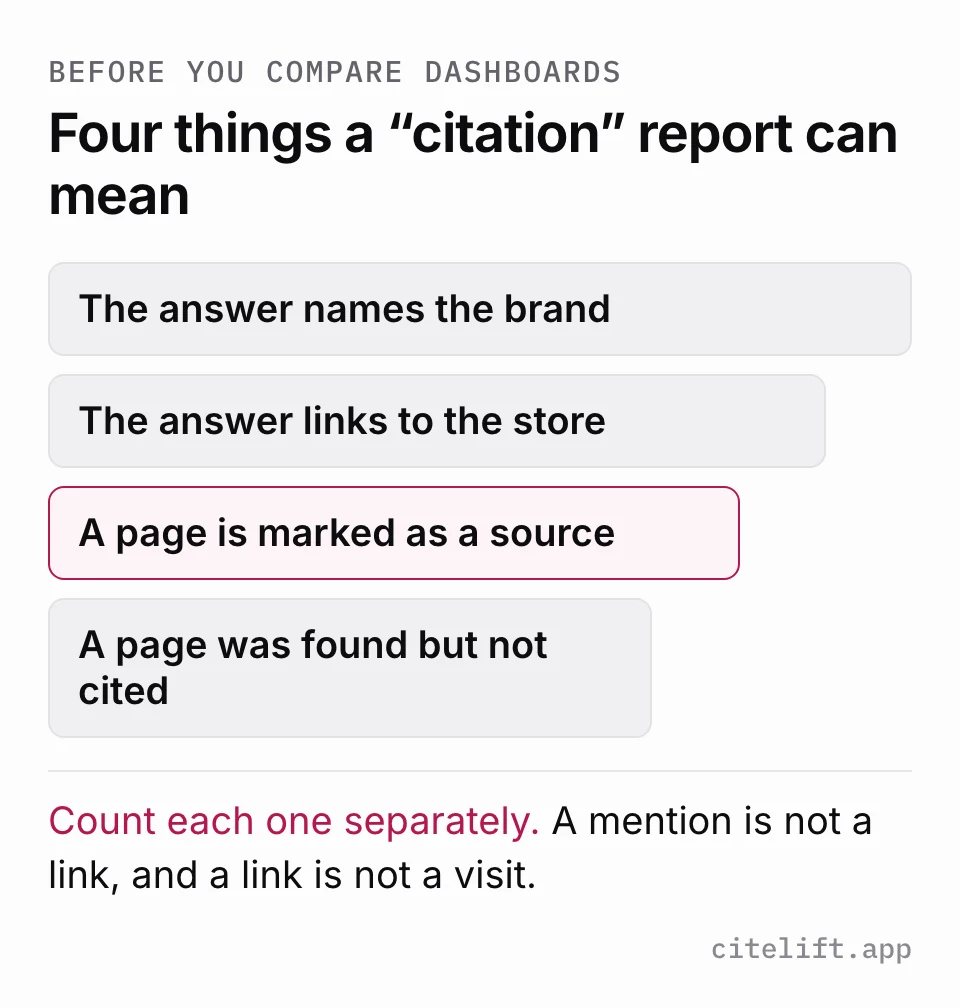
Request the vendor's definition, then inspect several examples. There are at least four distinct observations worth recording:
- The answer names the brand.
- The answer contains a link to the store.
- The interface marks a page as a supporting citation.
- The interface reports finding a page without visibly citing it.
Do not collapse these into one number. A merchant-owned URL appearing in a list is not automatically evidence that it supports the claim beside it.
Ahrefs explicitly distinguishes citations from pages found during retrieval and defines domain citations separately from page citations. Its documentation also describes estimated impressions using search-volume data. Those definitions explain why a modeled impression total should not be presented as an observed count of people who saw an answer. Ahrefs metric definitions, checked 17 September 2026.
For Google, AI feature traffic sits inside Search Console's Performance report under the "Web" search type and is not reported separately (Google Search Central, AI features and your website, checked 9 October 2026). The Google AI reporting guide explains that measurement boundary.
A worked example: three different scores from the same file
Download the synthetic observation CSV, calculated result, and local calculation script. Engine A and Engine B are fictional. Every row is invented teaching data, not an assessment of ChatGPT, Claude, Perplexity or a vendor.
The file contains four planned questions for each engine. Each engine has two fresh successful answers, one successful cached answer, and one unavailable attempt. The observations were intentionally constructed so that cached answers contain the brand more often than the fresh answers.
| Calculation | Numerator / denominator | Result | Meaning |
|---|---|---|---|
| Returned-answer coverage | 6 successful / 8 planned | 75% | Two attempts did not produce usable answers; cached rows are included here |
| Mention rate across successful answers | 4 with a mention / 6 successful | 66.7% | A mixture of fresh and cached observations |
| Fresh-answer mention rate | 2 with a mention / 4 fresh successful | 50% | Only the fresh successful subset |
| Fresh-answer owned-link rate | 1 with an owned link / 4 fresh successful | 25% | A link measure, not a sales measure |
If someone divided four mentions by all eight planned attempts, they would also get 50%. That is not the same calculation as the fresh-answer mention rate: it treats missing responses as negatives. Equal percentages can hide different denominators. In the method used here, a valid answer without a mention is a negative observation and a failed request is missing.
In a real report, keep the engines separate before showing any combined summary. This deliberately balanced example illustrates arithmetic only. It cannot estimate population visibility, prove that caching inflates every tool's score, or establish statistical confidence from eight correlated questions.
To reproduce the examples, download and extract the complete example pack, then run python3 reproduce_examples.py. It uses the Python standard library, reads only those local fixture files and makes no network requests. Its assertions check the published totals; it is not a general-purpose visibility tracker.
Evaluate exports, missing runs and source inspection
Use the vendor evaluation worksheet. Ask the same questions of every option and retain a source or demo record beside each answer. Do not turn an unadvertised feature into an assumed absence.
| Ask for | A useful demonstration | Why it matters |
|---|---|---|
| Exact prompt and answer export | One complete saved observation | Lets you inspect relevance and reproduce the classification |
| Missing-run treatment | An unavailable or blocked example, if one exists | Distinguishes missing evidence from a genuine negative |
| Cache and refresh disclosure | Capture time plus source-answer time | Prevents a refresh of the dashboard being mistaken for a fresh answer |
| Source inspection | A cited URL opened beside the answer | Lets a reviewer assess what the page actually supports |
| Consistent comparison | The same question, market and mode across two periods | Makes changes in the collection method visible |
| Variant-level detail | A named product and its selected attributes | Helps separate catalog accuracy from brand awareness |
| Export and cancellation terms | Actual retained fields and retention terms | Establishes what evidence remains available after a trial |
A tool can still be useful with limitations. The decision is whether those limits obstruct your specific job and whether the vendor explains them clearly. A disclosed small panel is often easier to reason about than a large unexplained number.
Price the work you will actually run
Calculate the intended workload before comparing plan names. As a planning example, 20 prompts across three engines and two locations, run four times in a month, creates 480 prompt-engine-location executions. That is our arithmetic, not a statement that every vendor bills 480 credits. Ask whether retries, caches, refreshes, locations and exports consume allowance.
Include the operator's time to inspect questionable answers, verify citations and decide what to change. Avoid buying two dashboards that measure the same job while leaving the underlying content or catalog issue unresolved. Check current pricing and limits on the vendor's own pages rather than relying on a dated roundup, this one included.
Keep visits and orders as separate evidence
A mention does not establish a click. An analytics referral does not reveal every answer a shopper saw. An attributed order assigns credit under a rule; it does not prove incremental sales caused by a citation.
After choosing a monitoring method, connect it to a separate review of article-attributed orders. Document changes to the site and the dates they shipped, then look for consistent evidence across sources without forcing their totals to agree.
This guide is published by Citelift, a commercial product. Citelift's free check, manual checker and paid connected-store visibility workflow have different scopes; none should be described as a complete census of consumer AI answers. Use the same evidence questions when evaluating Citelift.
A purchase decision you can defend
Before continuing beyond a trial, write down one useful decision the tool enabled, the evidence you could export, the gaps you still have, and the recurring work or cost you are accepting. If you cannot name a decision, start with the manual measurement process and the repeatability study rather than treating a dashboard score as the objective.
Questions.
What is the cheapest AI visibility tool?
Of the trackers we checked on 9 October 2026, Rankscale had the lowest headline price: Essentials at $17 a month, billed yearly only, for 120 credits. Billed monthly, Otterly.AI's Lite plan was the lowest at $29 a month for 15 prompts. Price per tracked prompt and per engine tells you more than the headline.
Is there a free AI visibility checker?
Yes. Ahrefs' free AI Visibility Checker needs no signup and checks ChatGPT, Gemini, Perplexity, Copilot and Google AI Overviews. SE Ranking offers a limited free check. Citelift's free check needs no sign-in and asks ChatGPT three buyer questions for your category. Each is a small sample from one day, not a tracker.
What should I ask an AI visibility vendor to show me?
Ask for the exact prompt, platform and mode, observation date, complete answer, cited URLs, failed-run handling and an export that lets you reproduce the displayed metric. A headline score alone cannot establish coverage or freshness.
Does a higher AI visibility score mean more sales?
No. A score describes a defined set of observations under the vendor's method. Referrals and attributed orders require separate analytics and commerce evidence; neither establishes incremental sales by itself.
Were the tools in this guide tested on a real store?
No. The table comes from vendor pricing pages, four of them checked 25 September 2026 and rechecked 9 October 2026, the rest checked 9 October 2026. The method rests on dated primary documentation and a synthetic example. It is not a hands-on test or a customer-results study.
Citelift is listed on the Shopify App Store: Citelift on the Shopify App Store.