Guide · updated 11 October 2026 · 9 min read
How to measure AI visibility for your store
Run a reproducible manual AI visibility panel and separate brand mentions, owned-domain links, platform citations, referrals, orders and revenue.
Measure AI visibility with a fixed panel of buyer questions and one row for every platform, surface and repeat. Record whether each valid answer names the brand, shows an ordinary visible link, and presents a platform-defined citation. Keep referral sessions, attributed orders and collected revenue in a separate period summary at each system's native grain. Those observations form a measurement ladder; they are not interchangeable proof of one funnel.
The free Citelift AI visibility checker needs no sign-in. It asks ChatGPT three buyer questions for your category, with web search on, and separates brand mentions from cited source links. For a wider, category-level view, the September 2026 edition of the AI shopping index recorded which brands and sources ChatGPT and Perplexity returned across 12 DTC categories. The manual checker prepares five templated questions and analyzes one answer you paste locally without an AI call. Paid connected-store checks use provider responses on the plan's cadence. The checker, the manual checker and the paid checks are different workflows, the index is a research sample, and none is a census of everything shoppers see.
Before buying a monitoring subscription, use the AI visibility tool evaluation guide to check exports, cache handling and the denominator behind the score.
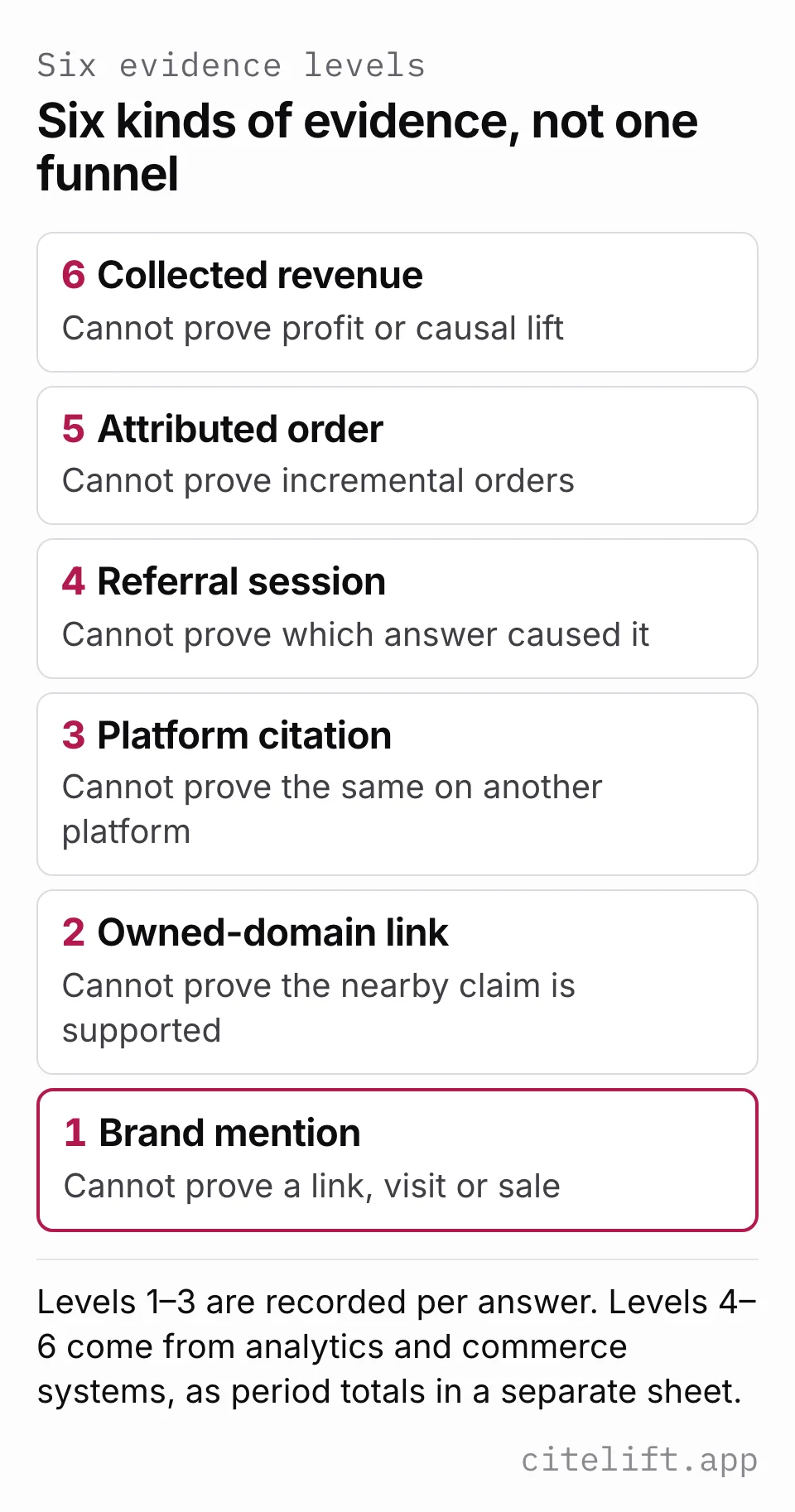
Define the six evidence levels
Write the definitions into the report before collecting answers.
| Evidence | Reproducible definition | What it cannot prove |
|---|---|---|
| Brand mention | Valid answer contains the brand name or a documented alias | Recommendation, link, visit or sale |
| Owned-domain link | Valid answer displays a URL whose normalized host is the store's domain or approved subdomain | That the nearby claim is supported or anybody clicked |
| Platform citation | The platform presents one or more URLs as sources under its interface and metric definition; separately flag whether the owned domain is among them | Equivalent behavior on another platform or that any source was clicked |
| Referral session | Analytics records a session with an identifiable assistant or search referrer | The earlier answer or citation that caused it |
| Attributed order | A commerce system assigns an order to content under a stated window and touch rule | Incremental or total influenced orders |
| Collected revenue | An attributed order reaches the store's documented financial state after exclusions such as cancellation or refund | Profit or causal lift from the content |
Open every visible source before calling it supportive. A URL can be present but irrelevant to the adjacent claim. The source-inspection guide separates page type, visible link and claim support.
Build buyer questions from real decisions
Start with five to ten nonbrand questions per category you sell. Write questions that expose a buying decision, rather than repeating “best brands.” Keep branded questions in a separate panel because they test recall and support, not discovery.
| Category | Illustrative nonbrand question | Evidence to inspect |
|---|---|---|
| Apparel | Which measurements matter when choosing a relaxed overshirt online? | Size guidance, construction and return context |
| Home | How do linen and cotton sheets compare in a warm bedroom? | Material, care and climate trade-offs |
| Beauty | How can I compare fragrance-free moisturizers by texture? | Product facts without unsupported treatment claims |
| Supplements | Which label fields help compare protein powders? | Serving, ingredients and documented testing |
| Pet | What should I measure before choosing a dog harness? | Fit method and size-chart evidence |
| Food | What should I compare when buying coffee for a French press? | Roast, grind and preparation details |
These are writing examples, not prompts proven to have search demand. Draw the real panel from support tickets, onsite search, product questions, reviews and catalog decisions. Give every question a stable ID. If you materially rewrite it, start a new series instead of silently continuing the old one.
The published 48-answer ChatGPT and Claude pilot used 12 fixed questions, two consumer platforms and two repeats. Its downloadable protocol, prompt list and run table preserve exact conditions and failures. Reuse that structure; do not reuse its observed citation frequencies as a benchmark for a different store or later platform version.
Separate platform, surface and access conditions
A consumer ChatGPT answer, an ChatGPT API response and a Google AI Overview are different observations. Record:
- platform and named surface;
- consumer product, API or first-party reporting tool;
- model name only when the interface exposes it;
- web-search state;
- market, language and device class;
- signed-in state and known personalization controls;
- observation time in UTC;
- repeat number and answer status.
Use fresh conversations when the protocol requires independence. Do not describe an API response as a consumer-app result. Retrieval, models, product settings and personalization can differ.
Relevant crawler access supports eligibility or retrieval where that crawler is used, but it is not a universal prerequisite or visibility guarantee. ChatGPT's documentation describes OAI-SearchBot separately from GPTBot and says a site blocked from OAI-SearchBot can still appear as a navigational link in ChatGPT search. Anthropic separates Claude-SearchBot from Claude-User, which can retrieve a page when a user requests it. ChatGPT's crawler documentation and Anthropic crawler documentation, accessed 10 September 2026.
Collect one row per attempt
Download the blank AI visibility capture sheet. It has one row per prompt, platform and repeat. Save the raw answer or a capture location. Record platform citations and ordinary visible links in separate URL fields, and separately flag whether any citation points to the owned domain.
The synthetic completed example contains three valid answers and one timeout for an invented home-goods store. Its valid rows demonstrate two brand mentions, two owned-domain links, three platform citations and one owned-domain platform citation. Every row is marked synthetic_example; none is a customer result or market benchmark.
For each attempt:
- Start the specified surface under the recorded conditions.
- Paste the exact prompt without correction or follow-up.
- Wait for the answer and sources to finish rendering.
- Save the raw response or capture.
- Record
valid,refusal,timeout,search_unavailableor another explicit status. - Search the valid answer for the brand and aliases.
- Normalize visible URL hosts and flag owned-domain links.
- Separate platform citation URLs from visible non-citation URLs, then open cited sources and note whether they support the relevant statement.
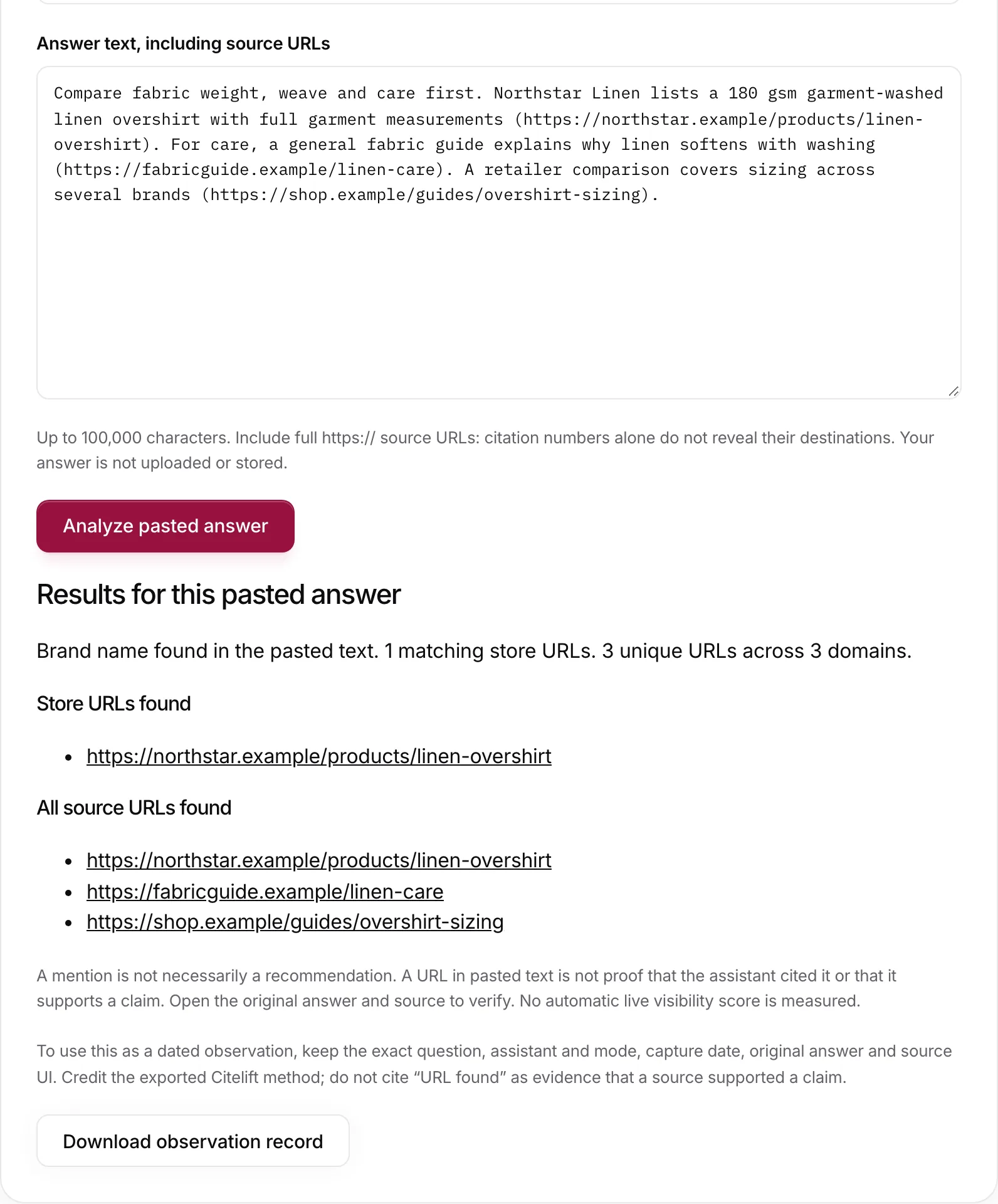
Do not place referral sessions, attributed orders or revenue on an individual answer-attempt row. None of the current reports provides an identifier that can join those later outcomes to one captured answer. Store period totals in a separate summary sheet with source, date range and metric definition.
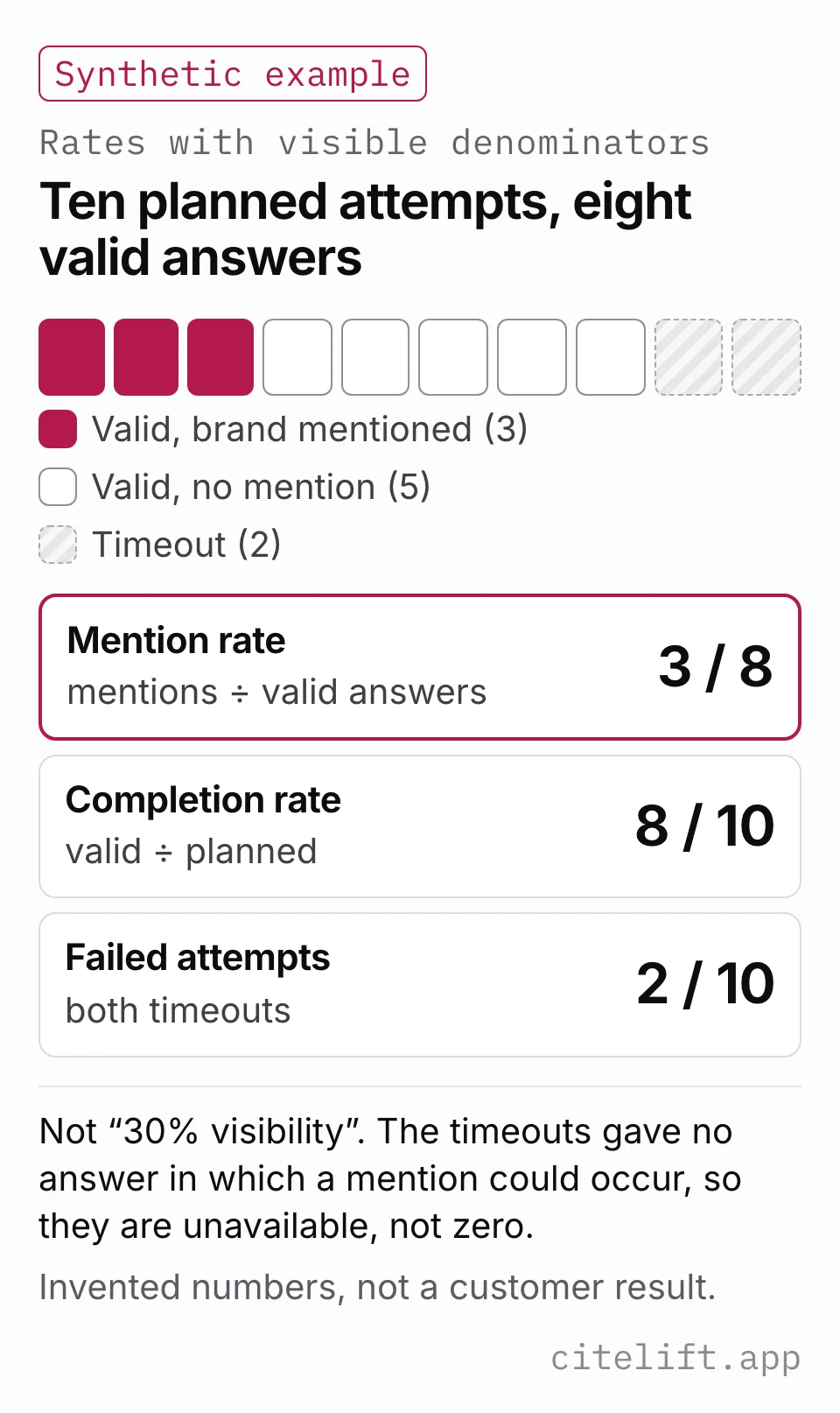
Do not record a failed attempt as “no mention.” It supplied no valid answer in which a mention could occur.
Calculate rates with visible denominators
Let:
A= all planned attempts;V= valid answers;M= valid answers with a brand mention;L= valid answers with an owned-domain link;C= valid answers with any platform citation;O= valid answers with an owned-domain platform citation;F= unavailable attempts.
Report:
- mention rate =
M / V; - owned-domain link rate =
L / V; - platform-citation rate =
C / V; - owned-domain citation rate =
O / V; - completion rate =
V / A; - failed attempts =
F / A, broken down by status.
For a synthetic panel with 10 planned attempts, eight valid answers, three mentions, two owned-domain links, five cited answers, one owned-domain citation and two timeouts, report 3/8, 2/8, 5/8, 1/8 and 2/10. Do not report 30% mention visibility, because the two unavailable attempts did not answer the question. Do not compare that panel to one that mixes in branded prompts or another surface.
When several owned URLs appear in one answer, the answer still contributes one to the owned-domain link rate. Keep a separate URL-occurrence table if you also want page frequency. State which unit you count.
Add first-party platform reports without merging them
Google and Bing now expose different site-owner views.
Google's dedicated generative AI Search report includes AI Overview and AI Mode impressions. The current dimensions are page, country, date and device; it does not expose queries, clicks, exact answers or a split between the two surfaces. Google says this activity is included in overall Web Search performance, so do not add the dedicated impressions to the Web total. The announcement states worldwide rollout on 31 August 2026, while the help page says low impression volume can still leave a property without a visible report and also retains access-rollout wording. Read the Google AI measurement walkthrough and use its existing blank and synthetic exports rather than creating another Google-report template.
The Search Console setup and query-review guide walks through the property, sitemap and page-level checks.
Bing AI Performance is a sampled aggregate across Microsoft Copilot, AI-generated Bing summaries and select partner integrations. It reports total citations, cited pages and grouped grounding queries, not exact user prompts, clicks or orders. The Bing AI Performance walkthrough explains exports and empty states.
These reports complement the fixed prompt panel. They cannot be appended as more “answers” because their units, coverage and aggregation rules differ.
Connect onsite behavior carefully
Use GA4 for Shopify blog traffic for landing-page sessions and identifiable referrers. GA4's current AI Assistant channel covers named assistant sources but explicitly excludes Google AI Overviews and AI Mode. Missing referral information falls into Direct or another classification; it does not prove no assistant influenced the visit.
Use Shopify article attribution for Citelift's seven-day article-credit rule and its webhook-fallback timing limitation. That report uses Shopify journey inputs and does not receive a citation-level ID from Google, Bing, ChatGPT, Claude or Perplexity. Put the values side by side rather than joining them by date and calling the result a conversion funnel.
An honest monthly table might show:
| Layer | Result | Source |
|---|---|---|
| Manual mentions | M / V valid answers |
Fixed prompt captures |
| Manual owned links | L / V valid answers |
Fixed prompt captures |
| Google AI impressions | Reported impression total or unavailable | Search Console dedicated report |
| Bing citations | Sampled citation total or unavailable | Bing AI Performance |
| AI-referral sessions | Tagged sessions with identifiable sources | GA4 |
| Article-attributed orders | Orders credited by the stated rule | Citelift / Shopify journeys |
| Collected revenue | Financially reconciled subset | Shopify finance definition |
The rows can move together without proving causation.
Repeat without rewriting history
Choose a weekly or monthly cadence you can sustain. Preserve raw captures, exports, formulas and the exact protocol for every period. Record platform changes as annotations rather than back-editing prior results.
Compare like with like:
- same question set and prompt types;
- same surfaces, market and language;
- same repeat count;
- same answer-status rules;
- same denominator and URL normalization;
- equal, complete reporting windows.
AI answers vary even when the store does not change. Search demand, index refreshes, competitor content, models and product interfaces can all move the results. A rise after publishing remains an observation unless a controlled design isolates the change.
Start free, then keep paid merchant checks separate
The free manual prompt-and-paste checker is useful for part of a small baseline. It generates five nonbrand questions from category, product type and market, copies them for use in consumer tools you choose, and analyzes one pasted answer for an exact brand match and full normalized URLs. It does not run the questions, recognize platform citation UI, or test whether a URL supports the nearby claim. Export its JSON alongside the capture sheet and preserve those other observations from the original surface. Citelift does not call an AI API or spend AI credits for this public tool.
Paid connected-store AI checks are a different service. They run against configured provider APIs, retain provider and prompt context, and follow the merchant plan's cadence. API answers can differ from consumer products, so do not continue a free consumer-app series with paid API rows under one platform label.
Whichever route you use, report what was observed: fixed answers, defined surfaces and dated evidence. Do not turn a sample into market share, a citation into a visit or an attributed order into proof of incremental revenue.
Questions.
Is a brand mention the same as a citation?
No. A mention names the brand. An owned-domain link points to the store. A platform citation is whatever that platform defines as a visible source reference. Record all three separately.
Does Citelift's free visibility check call an AI API?
Yes. The free checker at /check needs no sign-in and asks ChatGPT three buyer questions, with web search on. Signed-in accounts can also save one report built from three search-backed API answers. The separate manual checker prepares questions and analyzes pasted answers locally without an account or model call. Paid connected-store checks remain a separate workflow.
What should I do with a failed answer attempt?
Record timeout, refusal, unavailable search or another failure. Exclude it from the valid-answer mention denominator and show failed attempts beside the result so outages cannot look like a visibility decline.
Can AI visibility prove that content caused revenue?
No. Mentions, links, citations, referral sessions, attributed orders and collected revenue are different evidence levels. No current platform report exposes a complete deterministic join across them.
Do Google and Bing expose the same AI report?
No. Google's dedicated report currently shows combined AI Overview and AI Mode impressions without queries or clicks. Bing's sampled report shows citation counts, cited pages and grouped grounding phrases across supported Microsoft and partner surfaces.
Citelift is listed on the Shopify App Store: Citelift on the Shopify App Store.