Guide · updated 11 October 2026 · 4 min read
What ChatGPT cites when it recommends products
How to inspect the sources in AI product recommendations, distinguish product pages from other source types and avoid unsupported citation claims.
A search-enabled AI recommendation can cite product pages, merchant articles, retailer pages, independent reviews, forums and other sources. The useful question is which sources appear for your buyers’ questions, on a specified platform and date. There is no published Citelift benchmark establishing that blog articles outperform product pages across Shopify DTC categories. The September 2026 edition of the AI shopping index shows which source domains ChatGPT and Perplexity cited across 12 categories, with its method and limits.
This guide separates documented platform behavior from suggested editorial work. It does not present illustrative examples as observations from merchant checks.
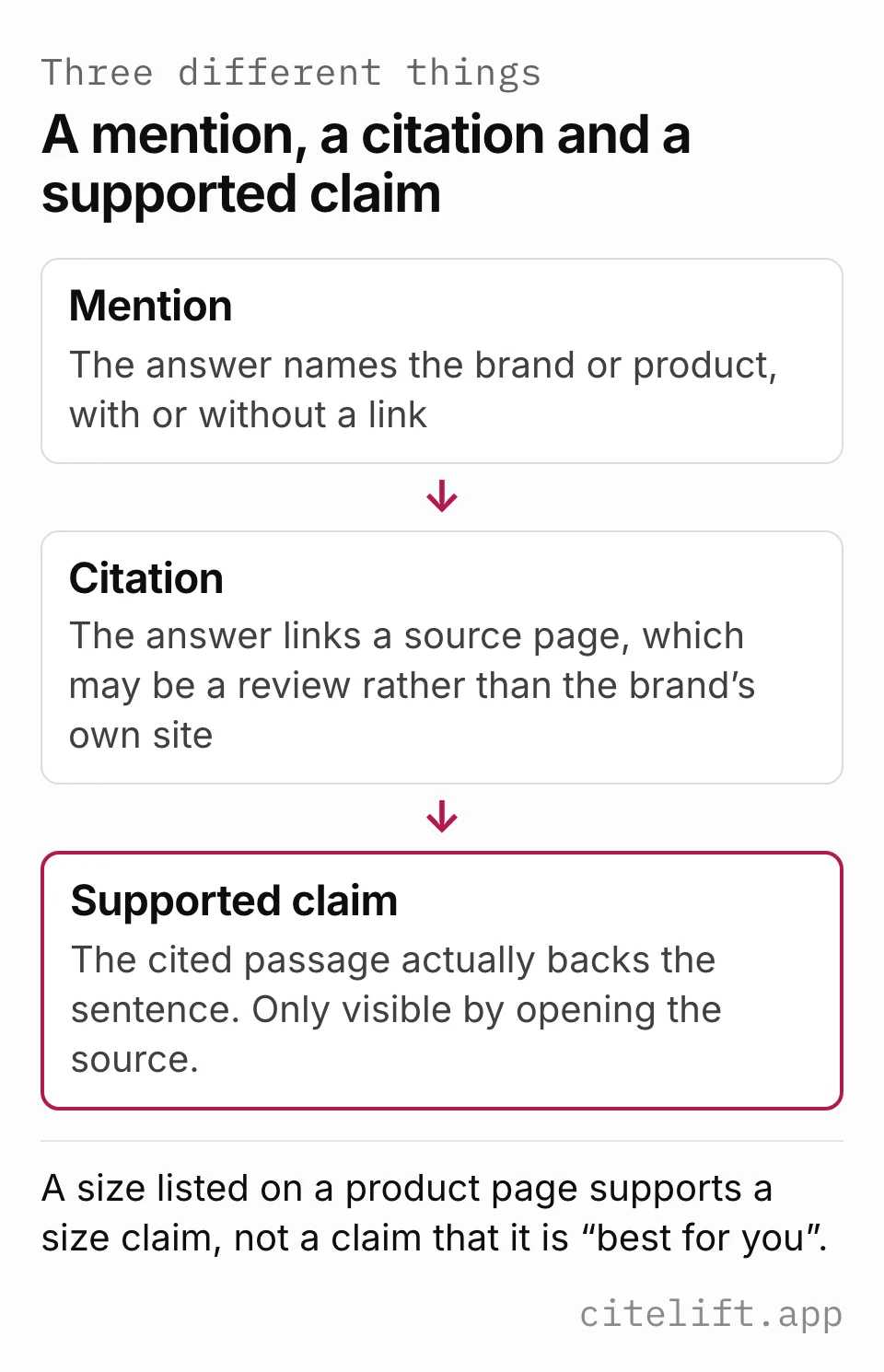
A mention, a citation and a supported claim
A brand mention names a business or product. A direct citation links to that brand’s website. A publisher review can be cited while the reviewed brand is mentioned, so the brand gains exposure without a direct link to its own site.
Neither event proves that the recommendation is accurate. Inspect the cited page and compare the source with the actual sentence. A product page listing dimensions might support a size claim but not a claim that the product is “best” for a particular person. Record this distinction when measuring AI visibility.
Match the source to the question
The table below is an editorial planning aid, not a measured ranking of source types.
| Buyer question | Useful first-party evidence | Additional evidence that may help |
|---|---|---|
| Does this apparel item fit my measurements? | Size chart, garment measurements and fit guidance | A clearly identified hands-on review |
| Will this home product fit my space? | Dimensions, installation and care instructions | A room-scale demonstration |
| What is in this beauty product? | Current ingredient list and product-specific instructions | Reliable sources for any broader ingredient discussion |
| How do these supplements differ? | Serving information, ingredients and documented testing | Qualified review of claims and limitations |
| How do I size a pet harness? | Measurement steps and size ranges | A fitting demonstration |
| Which coffee suits my brewing method? | Roast, grind options and preparation notes | A transparent tasting or brewing comparison |
A product page may answer the question completely. A separate article earns its place when a comparison, demonstration or explanation needs more context. Do not create a thin article solely to repeat information already clear on a product page.
Search eligibility is the starting point
ChatGPT's documentation describes OAI-SearchBot as a search crawler, separately from GPTBot’s training role. Perplexity documents PerplexityBot for search discovery. Check that important public pages can be accessed, while preserving appropriate protections for private pages. ChatGPT's documentation and Perplexity documentation, accessed 9 September 2026.
Google’s current guidance connects generative features to ordinary search fundamentals and emphasizes distinctive content. Technical eligibility does not guarantee indexing or selection. Do not transfer a Google-specific mechanism to ChatGPT as though the products had identical retrieval systems. Google’s generative AI optimization guide, accessed 9 September 2026.
Improve the evidence a reader can inspect
Use accurate product facts, original demonstrations and clear comparisons. Name the source for an external claim and explain relevant limitations. Make important content available in the page’s normal HTML. Use headings and tables when they help a buyer, without writing to an arbitrary word count.
For example, an illustrative home-brand draft might say “the perfect throw for every season.” A better description, if supported by the catalog, would state its dimensions, fiber composition and care instructions, then explain the intended use. That is a useful improvement for a buyer. It is not evidence that an assistant will cite the revised text.
The description scorer can flag a few wording patterns. It does not fetch the page, verify facts or predict citation probability. Use it as an editorial prompt rather than an optimization target.
How to check a cited product claim: a worked example
This exercise uses invented catalog facts, not a customer result or a real assistant answer. The example product record says: a cushion cover measures 40 × 40 cm, is 100% cotton, and can be machine-washed at 30°C. No durability comparison or outdoor-use guidance is supplied.
| Draft claim | What the example record supports | Editorial decision |
|---|---|---|
| “The cover is 40 × 40 cm and 100% cotton.” | Both details are present in the record | Keep those factual details |
| “It lasts twice as long as other covers.” | No comparative durability evidence is supplied | Remove the comparison or obtain evidence |
| “It is suitable for every outdoor chair.” | No chair-fit or outdoor-use evidence is supplied | Hold the claim; dimensions alone do not establish suitability |
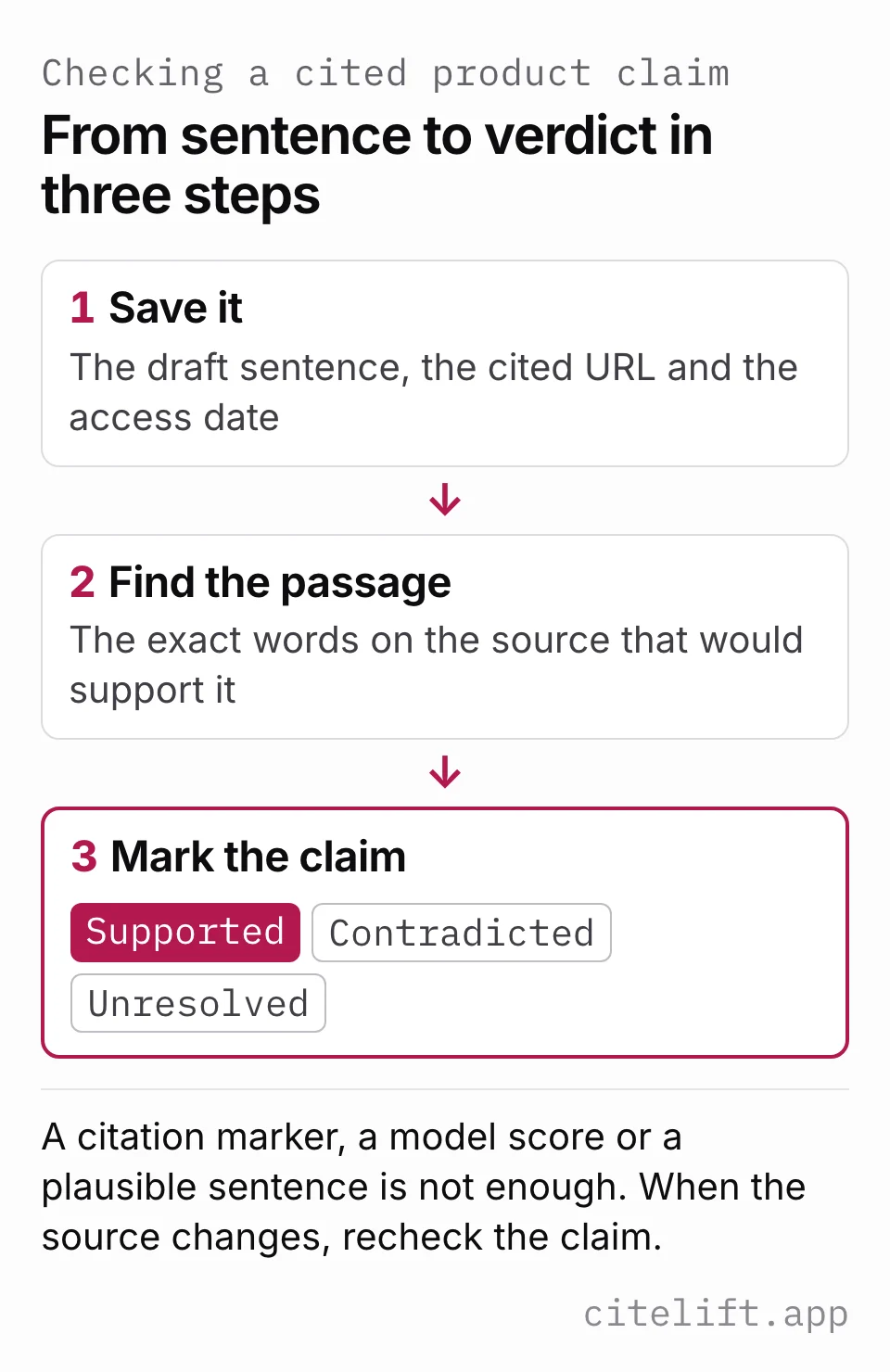
To repeat this check on your own content, save the draft sentence, the cited URL, the exact supporting passage and the access date. Mark each claim supported, contradicted or unresolved. Verify the source passage yourself; a citation marker, a model score or a plausible sentence is not enough. When the source changes, recheck the affected claim before reusing it.
Test across categories without pretending to represent everyone
A useful cross-category study should include apparel, home, beauty, supplements, pet and food. Balance store selection and prompt counts across categories; state the market, price-range coverage and how Shopify usage was verified. Publish each category’s denominator and retain source URLs outside the selected store sample.
Repeated answers to the same question are not independent shoppers. A convenience sample cannot represent every DTC brand, geography or price point. Report observations by engine and category before considering any pooled summary. API tests and consumer-product tests belong in separate datasets.
Our 48-answer consumer pilot now reports visible URL repeatability across twelve buying questions. It does not establish a winning page type or expected citation uplift; the broader store cohort remains uncompleted. In the meantime, inspect your own sources with the measurement guide and explore category-specific content examples.
Questions.
Can a product page earn an AI citation?
Yes. Product pages are possible sources alongside articles, publisher reviews, retailer pages and forums. Which sources appear depends on the question and system. We have not published a study establishing that one type wins across Shopify categories.
Does a citation prove an answer is correct?
No. Open the linked page and check whether it supports the nearby claim. A cited URL and a supported claim are separate observations.
Do I need special AI markup?
Google’s guidance does not prescribe special AI schema or an llms.txt file. Use accurate visible content, appropriate standard markup and ordinary search fundamentals. Those do not guarantee citations.
Citelift is listed on the Shopify App Store: Citelift on the Shopify App Store.