Guide · updated 10 September 2026 · 6 min read
Bing AI Performance for Shopify: cited pages and queries
Set up Bing AI Performance, interpret cited Shopify pages and grounding-query samples, and keep citations separate from visits, orders and revenue.
Bing Webmaster Tools' AI Performance report shows sampled, aggregated citations across Microsoft Copilot, AI-generated summaries in Bing and select partner integrations. For a Shopify store, use it to find cited page URLs and the grouped grounding phrases associated with them. Do not relabel the report as ChatGPT traffic or convert citations into orders.
This walkthrough combines Microsoft's public documentation with one sanitized first-party empty-state capture from the owned citelift.app marketing-site property. That property is not a Shopify merchant store or customer result. The downloadable worked report remains explicitly synthetic.
Add and verify the Shopify site
Sign in to Bing Webmaster Tools and add the store's public primary domain. Microsoft supports two useful paths:
- Import a site already verified in Google Search Console. Bing imports selected verified sites and their known sitemaps, then periodically validates ownership through that connection.
- Add the site manually and verify it with Domain Connect, a root XML file, a homepage meta tag or a DNS CNAME record.
For many Shopify stores, importing the existing Search Console property avoids another theme or DNS change. If you use a manual meta tag, put it in the public homepage <head> and retain it so ownership stays verifiable. Microsoft says site analytics can take about 48 hours to populate after addition. Bing add-and-verify documentation, accessed 10 September 2026.
Confirm https://your-domain.example/sitemap.xml under Sitemaps. Shopify automatically generates this root file and includes blog posts. A submitted sitemap supports discovery; it does not prove that a blog post is indexed or cited. Shopify sitemap documentation, accessed 10 September 2026.
Know which surfaces the report covers
Microsoft introduced AI Performance in public preview on 10 February 2026. Its current help page names three supported groups:
- Microsoft Copilot;
- AI-generated summaries in Bing;
- select partner AI integrations.
Those are aggregate surface groups. The report does not promise a platform-by-platform breakdown or identify each partner. Even if Microsoft grounding supports another product, one row does not prove the citation appeared in that product. Use the supported-surface wording in reports rather than “all Copilot,” “all Bing AI,” or “ChatGPT citations.” Microsoft's launch announcement, accessed 10 September 2026.
If you need a named consumer-surface observation, add a separate manual prompt series with the AI visibility capture sheet. Do not join a manual ChatGPT answer to an aggregate Bing citation row as though Microsoft exposed the match.
Read the three core measures
The report's names can sound broader than their definitions:
| Measure | Microsoft's definition in practice | Boundary |
|---|---|---|
| Total citations | Times the site's content was visibly referenced or shown as a source in supported AI answers | Not clicks, ranking, authority or importance |
| Cited pages / average cited pages | Unique site pages cited on a day, and their daily average across the range | Not the page's position or role in an answer |
| Grounding queries | Grouped phrases associated with retrieval of content that was cited | Not exact user questions, complete prompts or individual answers |
One grounding query can map to several pages, and one page can map to several grounding queries. Use the mapping in both directions:
- Select a phrase to see which pages were cited with it.
- Select a page to see which phrases were associated with its citations.
- Export the filtered view if you need a stable record.
Microsoft says AI Performance refreshes daily with a short processing delay, offers standard and custom ranges within available history, and supports CSV or Excel exports. Bing AI Performance documentation, accessed 10 September 2026.
A real empty state, with a narrow meaning
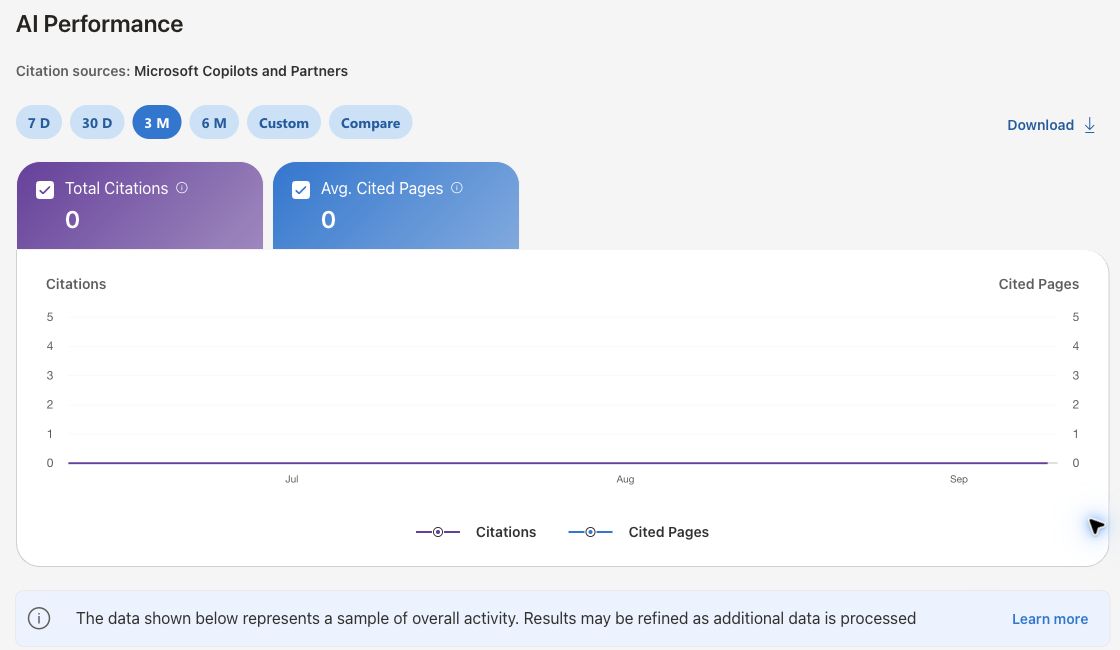
This sanitized capture was observed on 10 September 2026 for the owned citelift.app property, with the three-month control covering 10 June through 9 September. The report showed 0 Total Citations, 0 Avg. Cited Pages, and no Grounding Queries rows. It is evidence about that property, report, sampled window and supported surfaces only. It is not evidence about Shopify merchants, every assistant, all time or citations that fall outside Bing's sampled reporting.
Export one reproducible review
Use a completed period, such as the prior calendar month. Record the site, selected range and export time. Then:
- Save the time-series export without editing it.
- Export the Pages view, including cited page URLs and citation counts.
- Export Grounding queries.
- Select a high-citation page and export its associated phrases.
- Select a material phrase and export its cited pages.
- Note every active filter because Bing says exports follow the applied filter.
Download the blank Bing AI Performance sheet. The synthetic example uses invented URLs and counts, including a clearly labeled no-row state. It is not a benchmark or customer result.
Keep each native view at its own grain. Set report_view and metric_scope before entering a row, and preserve the active filter separately. A site-summary total, a page count, a grounding-query count and a filtered query-to-page mapping are different rows even when they came from the same export session. Populate average_cited_pages only for site-summary or time-series rows; do not copy it onto page, query or filtered-mapping rows.
Do not expect the totals in every view to reconcile exactly. Microsoft says the data is sampled and grouped, the views can use slightly different sampled windows, low-frequency activity might not appear and results can be refined as more data is processed.
Turn a cited-page row into an audit
A cited page is a starting point for inspection. Open it and record:
- whether the URL is the intended canonical Shopify page;
- the page type: product, collection, blog post, policy or other;
- the specific product facts and decisions it answers;
- whether its claims are supported and current;
- which grounding phrases appear relevant to the visible content;
- whether nearby pages compete for the same purpose.
A grouped phrase such as linen sheets is too broad to dictate a new article. Use it to inspect a theme, then verify actual buyer questions from support, onsite search or a manual prompt panel. The report does not expose the user's full question.
For source classification, use what ChatGPT cites when it recommends products, but keep the Bing dataset separate because its collection method and supported surfaces differ.
Treat empty and partial data as states
An empty table can mean different things:
- the site was just verified and processing is incomplete;
- the selected range predates available history;
- the site had too little sampled citation activity for rows to surface;
- the page is not eligible for indexing;
- a filter removed all visible rows;
- the report or preview capability is unavailable in that account.
Record processing, no_rows, filtered_empty, not_available or data_present. Do not turn each state into zero citations. Microsoft explicitly says sparse grounding-query activity may not surface and does not indicate a penalty or exclusion.
Check ordinary Bing URL inspection, crawl and sitemap evidence when a page is absent. Review robots controls with the Shopify AI crawler guide. Crawl eligibility cannot guarantee a citation, but a blocked or non-indexable page gives you a concrete problem to fix.
Keep citations, referrals and orders separate
A useful measurement ladder is:
- Bing citation: the page appeared as a source in supported aggregate AI activity.
- Referral session: analytics recorded a visit with an identifiable referrer.
- Attributed order: a commerce system assigned an order to an article under its rule.
- Collected revenue: the order reached the financial state your store defines and was not later excluded or refunded.
The AI Performance report supplies only the first. It exposes no shopper, click, session or order identifier for a deterministic join. A buyer might read a citation without clicking, arrive later as direct, switch devices or never visit.
Use GA4 for Shopify blog traffic for session-level referrers and the article attribution guide for Citelift's seven-day rule. Report the counts side by side. Do not claim a funnel conversion rate from Bing citations unless a future primary source exposes a valid join.
Write the result as an observation
A defensible note names the evidence and missing links: “The sampled Bing report associated two reported blog URLs with 23 citations across grouped phrases in the selected period. It did not expose exact prompts, partner surfaces, clicks or orders. GA4 separately recorded four Copilot referrals, with no report-level join to those citations.”
If the numbers come from the downloadable example, prefix the note with Synthetic demonstration. A change after an article edit is still observational. Microsoft lists demand, content changes, system changes and partner refresh cycles among the reasons trends move, so the report cannot isolate the effect of one edit.
Questions.
Does Bing AI Performance show ChatGPT traffic?
No. Microsoft documents aggregated citation activity across Microsoft Copilot, AI-generated summaries in Bing and select partner integrations. The report is not a complete log of every partner surface and does not measure traffic.
Are grounding queries the questions shoppers typed?
No. Bing describes them as grouped phrases the AI used when retrieving cited content. They are sampled summaries, not exact prompts, individual answers or a reason why a page was chosen.
Does an empty AI Performance report mean Bing blocked my store?
No. Newly verified sites need processing time, and sparse or infrequent citation activity might not surface. Check verification, indexing and the selected range, then record the report as empty or unavailable without inferring a penalty.
Do Bing citation counts equal clicks or orders?
No. A citation means a page was visibly referenced or shown as a source on a supported AI surface. It does not represent a click, visit, engagement event or order.
Citelift is listed on the Shopify App Store: Citelift on the Shopify App Store.