Guide · updated 11 October 2026 · 13 min read
How to rank in ChatGPT: get your Shopify store recommended
How to rank in ChatGPT as a Shopify store: what gets cited, the agentic storefronts check, crawler access, and 36 answers we sampled on 9 October 2026.
To rank in ChatGPT, a Shopify store needs two things: its catalog switched on for ChatGPT through Shopify's agentic storefronts setting, and pages that answer buyer questions plainly enough to be fetched and quoted. There is no fixed ranking to climb. For most shopping questions ChatGPT runs a search, reads a handful of pages and writes its answer from them, so you control three things: whether the search crawlers can reach you, whether your pages answer the question directly, and whether you check, question by question, that your brand is actually named. Nobody can promise the result. You can test where you stand for free with our AI visibility check.
Two routes into ChatGPT
"Ranking in ChatGPT" means two different things, and a Shopify store should work on both.
- Product cards. When a question has shopping intent, ChatGPT can show a carousel of products. ChatGPT's help centre says a product appears "when ChatGPT perceives it to be relevant to your intent", and that for Shopify merchants "product data is already integrated into ChatGPT through Shopify Catalog" with "no additional work" required (ChatGPT help centre, Shopping with ChatGPT Search, read 23 September 2026). The one thing to check is that Shopify's agentic storefronts setting is on under Sales channels > Agentic. Our guide to Shopify agentic storefronts and ChatGPT Shopping walks through it and explains how sellers are ranked.
- Cited answers. The written part of an answer comes from pages ChatGPT searched for and read moments earlier. That route is what the rest of this guide is about.
When we asked ChatGPT and Claude on 23 September 2026 how a Shopify store gets into ChatGPT, both named the agentic storefronts check as the first step (our dated observations). It takes five minutes. Do it before anything else here.
How a recommendation is produced
An answer engine handling a shopping question does three things in sequence: it searches, it reads, and it writes with the sources in front of it. That pattern is what the industry calls retrieval-augmented generation, and it explains almost everything about what works here.
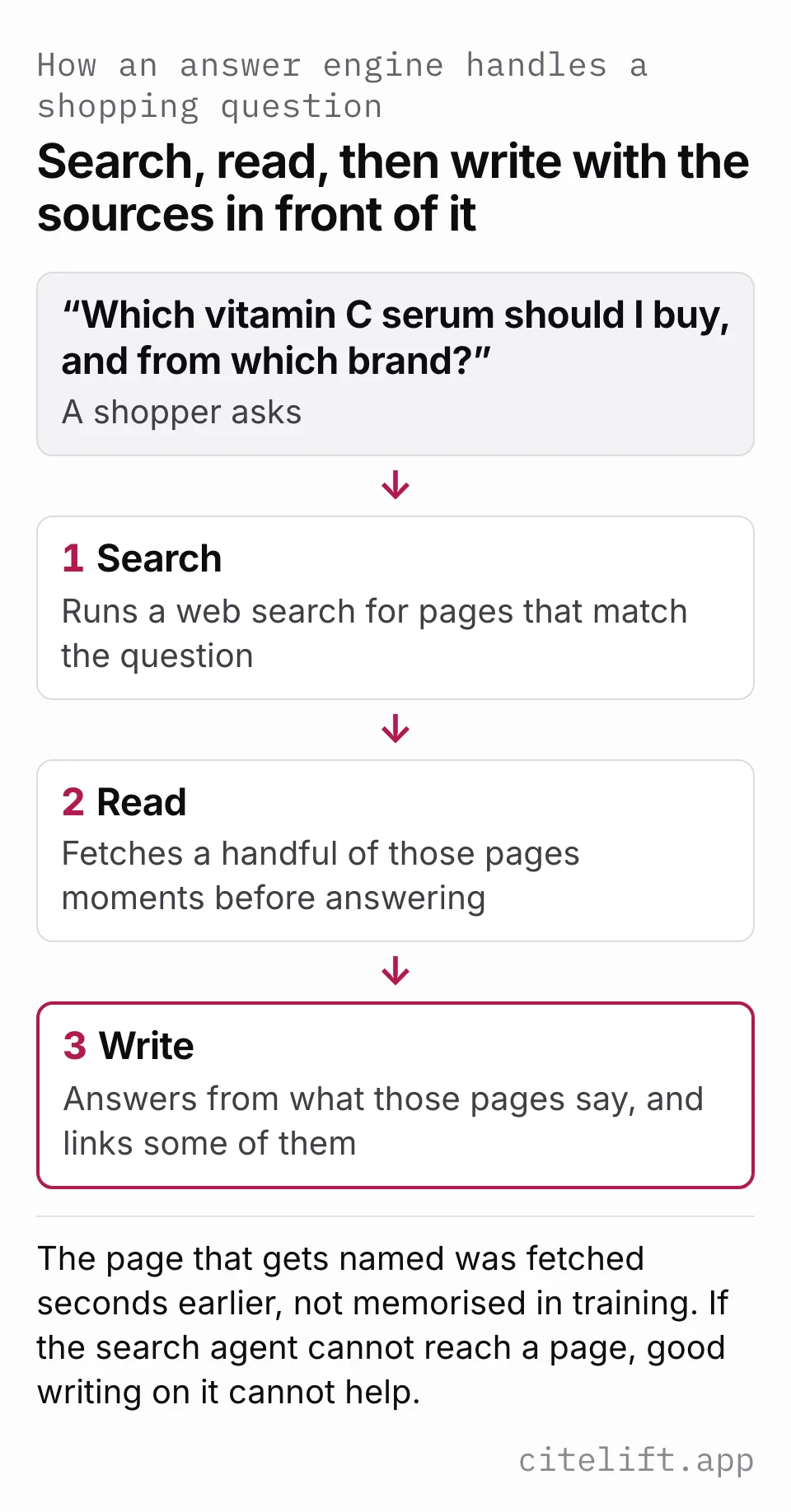
The vendors describe the machinery in their own crawler documentation. ChatGPT's crawler documentation lists separate agents for separate purposes: OAI-SearchBot is "used to surface websites in search results in ChatGPT's search features", GPTBot "is used to crawl content that may be used in training", and ChatGPT-User is used "for certain user actions in ChatGPT and Custom GPTs", visiting a page when a user asks a question (ChatGPT crawler documentation, read 9 September 2026). Perplexity splits its agents the same way: PerplexityBot is "designed to surface and link websites in search results on Perplexity. It is not used to crawl content for AI foundation models", while Perplexity-User "supports user actions within Perplexity" and "might visit a web page to help provide an accurate answer and include a link to the page in its response" (Perplexity, Perplexity Crawlers, read 9 September 2026, docs.perplexity.ai/guides/bots).
Two things follow. First, the page that gets named is a page that was fetched seconds earlier, not a page memorised during training. Second, if the search agent cannot reach you, no amount of good writing helps. The same documentation is explicit that sites disallowing OAI-SearchBot "will not be shown in ChatGPT search answers, though can still appear as navigational links".
What actually gets retrieved
Assistants retrieve pages that read like an answer to the question that was asked. A shopper asks "which vitamin C serum should I buy, and from which brand?" and the useful sources are pages that compare several options and explain why one suits a given skin type. A product page argues for exactly one product, which makes it a poor source for a comparison and a fine source once the buyer already knows what they want.
Product pages, articles and independent reviews can all appear as sources. Inspect the actual sources for your buyer questions before deciding which page needs work; no Citelift benchmark establishes a universally winning page type. We go into what those pages look like in what ChatGPT cites when it recommends products.
Google says the same thing about its own AI surfaces from the other direction: "There are no additional requirements to appear in AI Overviews or AI Mode, nor other special optimizations necessary", and "You don't need to create new machine readable files, AI text files, or markup to appear in these features" (Google, AI features and your website, read 9 September 2026, developers.google.com/search/docs/appearance/ai-features). The requirement it does state is concrete: a page "must be indexed and eligible to be shown in Google Search with a snippet". Nothing exotic. A fetchable, indexable page that answers the question.
What ChatGPT and Perplexity cited on 9 October 2026
On 9 October 2026 we asked 18 merchant-style questions, such as "how do I get my Shopify store recommended by ChatGPT" and "best Shopify SEO apps in 2026", to ChatGPT with web search switched on and to Perplexity's Sonar model with web search, both through DataForSEO's API for a United States, English-language user. That gave 36 answers, collected between 07:28 and 07:38 UTC, with 322 cited links across 153 domains (142 from ChatGPT, 180 from Perplexity). Each question was asked once per engine. Treat what follows as one dated sample per question, not a ranking study: answers vary between runs, and API answers can differ from the consumer apps. The per-answer counts are in the citation CSV.
The domains cited in the most answers were Shopify's own:
| Domain | Answers citing it (of 36) | ChatGPT | Perplexity |
|---|---|---|---|
| shopify.com | 12 | 6 | 6 |
| help.shopify.com | 10 | 6 | 4 |
| apps.shopify.com | 8 | 4 | 4 |
| community.shopify.com | 4 | 0 | 4 |
| developers.google.com | 4 | 3 | 1 |
Nine more domains were cited in three answers each, among them Semrush, Ahrefs, Otterly, Peec AI and Writesonic. In total, 21 of the 36 answers cited at least one Shopify-owned domain (shopify.com, its help centre, App Store, community forum or shopify.dev), and those domains supplied 93 of the 322 links.
A few patterns stood out:
- "Which app" questions were answered from the App Store. For "best Shopify app that writes a new blog post every day", every one of the 14 links (4 from ChatGPT, 10 from Perplexity) pointed to an apps.shopify.com page, either an app listing or a category page. For "best app to write blog posts for my Shopify store automatically", 13 of 18 links were App Store pages, 3 were Shopify Help Center articles and 2 were third-party roundups.
- How-to questions were answered from help centres. For "how do I get my Shopify store recommended by ChatGPT", ChatGPT's 7 links were all help-centre articles: 3 from the Shopify Help Center and 4 from ChatGPT's own help centre. Perplexity's 10 mixed 3 Shopify Community threads, 1 Help Center page, 1 Shopify blog post, 1 LinkedIn post and 4 third-party guides.
- "Best of" questions were answered from roundups. For "best Shopify SEO apps in 2026", 15 of the 26 links across both engines were comparison articles (14 third-party roundups plus our own guide); both engines cited the same two of them, from Black Belt Commerce and Simple Bundles.
- Questions outside Shopify's own scope drew no Shopify pages. Six questions, including "how to track if ChatGPT mentions my brand" and "should I block GPTBot and ClaudeBot on my Shopify store", got no Shopify-owned citation from either engine. ChatGPT answered "how do I get my products to show up in ChatGPT shopping" entirely from its maker's own merchant and help pages.
Citelift was not named in any of the 36 answers. It was cited once as a source: ChatGPT linked our best Shopify SEO apps guide in its answer to "best Shopify SEO apps in 2026", without naming Citelift in the text.
What this suggests for a merchant, within those limits: the pages that got cited were the ones that answer a question in the format the question expects. Marketplace listings answered "which one should I install", help-centre articles answered "how do I", and independent roundups answered "what is best". Our questions were about Shopify tools rather than consumer products, so check the equivalent for your category: complete marketplace and retailer listings, a help-style page on your own site for each recurring buyer question, and whether the roundups in your category mention you, with accurate details if they do. For shopper questions about brands, see our dated observations from DTC buyer questions.
Test yourself on five buyer questions
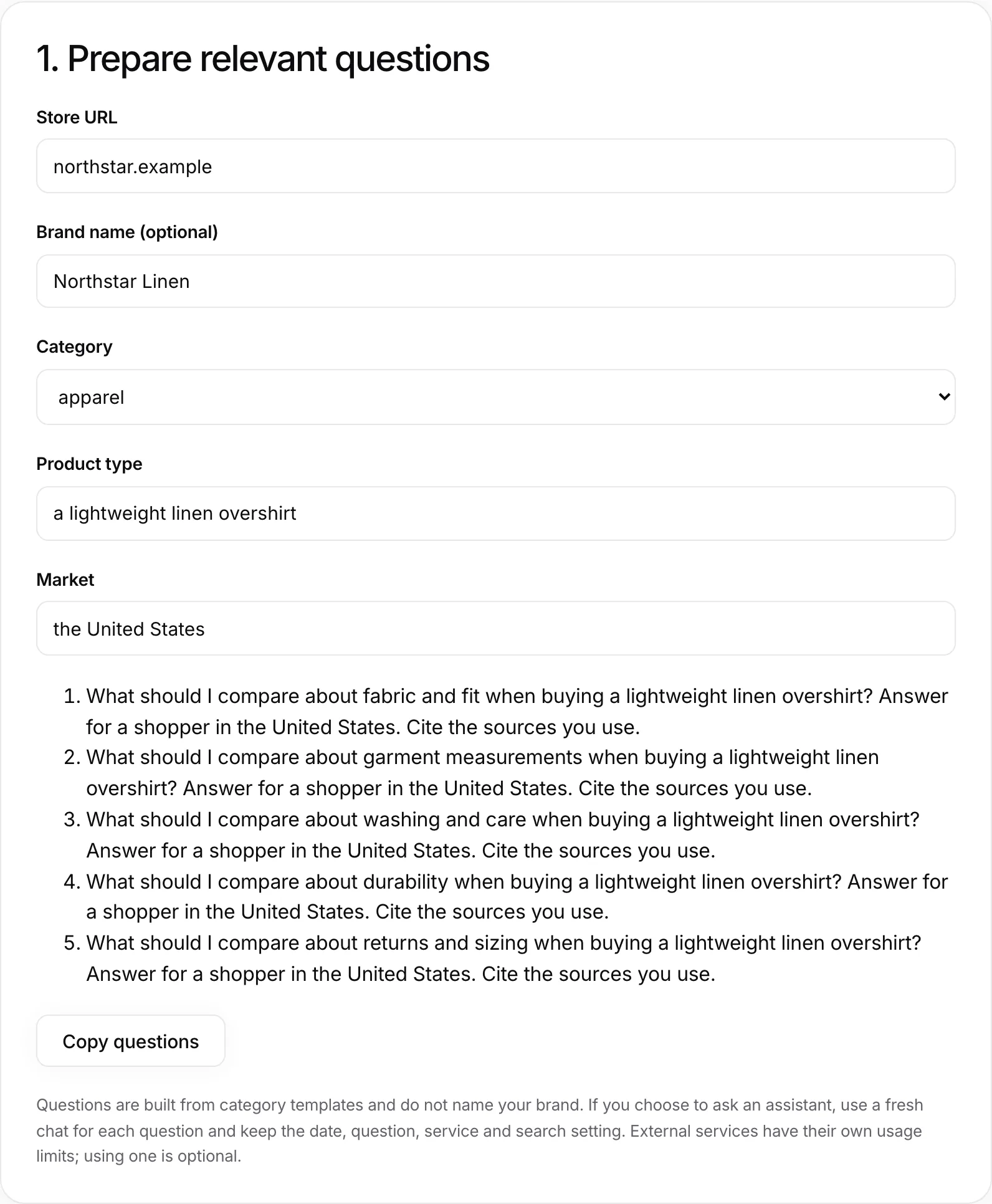
Before you write anything, find out where you stand. Pick five questions that a buyer in your category would type into an assistant, and make sure none of them contains your brand name. That last rule is the one people break. Asking "is Acme serum good?" tells you what the model says about you once prompted. Asking "which vitamin C serum should I buy, and from which brand?" tells you whether you exist in the answer at all.
Five questions are a manageable starting panel, not a representative estimate of all shopper demand. Ask them in ChatGPT and in Perplexity, because the two retrieve differently and being named by one is not being named by both. Write down, for each answer: which brands were named, which pages were cited, and whether the named brands were retailers, roundups or the brands' own sites.
Citelift offers two free starting points. The AI visibility checker needs no sign-in: it asks ChatGPT three buyer questions for your store's category, then shows whether your store is named, which competitors are named instead and which sources are cited. Your store's name is not put into the questions; it is matched in the answers afterwards. Three questions are a smaller panel than the five described above. The paid app, which publishes the articles this guide describes, installs from Citelift's Shopify App Store listing.
The manual checker prepares five question templates and analyzes an answer you paste locally, without an account or AI calls. Use it alongside your own recorded observations. Paid connected-store monitoring is a third workflow, with API checks on the plan’s cadence. Keep these observations separate: API reports do not measure the consumer ChatGPT app. The full protocol is in how to measure AI visibility for your store.
The article shape that tends to get cited
Once you know which questions you lose, write the page that answers them. The shape that holds up is unglamorous:
- One question per article. Not a category, a question. "Which magnesium form should I take for sleep?" is an article. "Magnesium" is a category page.
- The answer in the first hundred words. An assistant lifting a sentence takes an early one. Bury the answer under three paragraphs of context and there is nothing to lift.
- Four to eight H2 sections a reader can jump to. Sections give a retriever a clean unit of text to quote and give a reader a way to skim.
- Specifics that can be checked. Ingredient names, sizes, materials, care instructions, what the thing does not do. Vague enthusiasm is unquotable by design.
- Sources with dates. If you state an external fact, say where it came from and when you read it. Google's own guidance on people-first content asks whether the content "present[s] information in a way that makes you want to trust it, such as clear sourcing, evidence of the expertise involved" (Google, Creating helpful content, read 9 September 2026, developers.google.com/search/docs/fundamentals/creating-helpful-content).
- A short FAQ. Three to five questions whose answers are already in the article, phrased the way a buyer would ask them.
Google's same guidance asks you to be clear about "how automation or AI-generation was used to create content". If you use a tool to draft, keep a named human author and a real editorial standard behind it. The full anatomy, section by section, is in product-linked blog articles that earn AI citations.
Link products without wrecking the answer
An article that never mentions your products earns you nothing. An article that mentions nothing else is an advertisement and reads like one.
The workable middle is to link two to five products at the points where they genuinely answer the question, and to be honest about who each one suits. Take a sample store selling three serums: an article on vitamin C that says one is better for oily skin, one is gentler at a lower concentration, and neither suits active eczema is more useful, and more quotable, than one that says all three are excellent.
Put tracking on those links while you are at it, so you can tell later which article did the work. Shopify attributes sales from "externally managed efforts that use Urchin Tracking Module (UTM) parameters" and lets you group marketing reports "by UTM campaign, UTM source, UTM medium" (Shopify Help Center, Marketing reports, read 9 September 2026, help.shopify.com/en/manual/reports-and-analytics/shopify-reports/report-types/marketing-reports). Citelift writes its own article identifier into utm_content on every product link and credits an order to an article when the buyer touched that link within seven days, by UTM parameter or by landing page.
Let the crawlers reach you
None of this matters if the fetchers are blocked. Check three things.
First, your robots rules. Shopify generates a robots.txt for you and you can override it with a robots.txt.liquid template, though Shopify notes that its own default "works for most shops" and that "the default rules are updated regularly to ensure that SEO best practices are always applied" (Shopify.dev, robots.txt.liquid, read 9 September 2026, shopify.dev/docs/storefronts/themes/architecture/templates/robots-txt-liquid). If you have already added a custom template, read it and confirm you have not quietly disallowed the search agents. Our robots.txt generator for AI crawlers writes the rules per agent so you can decide each one deliberately.
Second, the difference between blocking training and blocking search. Disallowing GPTBot is a decision about model training. Disallowing OAI-SearchBot or PerplexityBot is a decision to be absent from those products' search answers. People conflate them and then wonder why they vanished.
Third, whether your blog is indexable at all. Password-protected storefronts, noindex left on a theme, and blog posts saved as hidden are common and boring reasons for silence.
Judge the change over weeks, not runs
Assistant answers are not deterministic. Ask the same question twice and you can get two different brand lists with no change to your site. This is the single biggest source of self-deception in this work.
So set a rhythm. Same five questions, same two engines, same day of the week. Record who was named. A real change looks like your brand appearing in a question it never appeared in, and staying there across several weeks. A single lucky run is noise. If you want the fuller method, including how to pick questions that are not flattering to yourself, read how to measure AI visibility for your store.
Keep the commercial number next to the visibility number. Attributed orders and sessions from assistant referrers tell you whether being named is worth anything. Being named in an answer nobody acts on is a vanity metric with extra steps.
What does not work
Keyword stuffing. The retrieval step reads the page. Repeating a phrase does not make the page a better answer, and it makes the prose less quotable.
Link swaps and paid link insertions. They do not make an assistant fetch you and they put your domain at risk with search engines.
Plugins that only rewrite meta tags. Titles and descriptions matter for search listings. They are not the text an assistant quotes. If a tool's whole offer is meta tags, it is not addressing retrieval at all. If you are comparing tools in this space, our write-ups at /vs/outrank and /vs/shopify-magic lay out what each one actually does.
Blocking every bot on principle and then asking why you are invisible. Decide agent by agent. Training and search are separate choices.
Waiting for a number nobody can give you. No tool can promise you a citation or a ranking, and any that does is selling something it does not control. What you can control is whether the page exists, whether it answers the question, whether it is fetchable, and whether you are measuring.
Where to start this week
Run the five questions. Write down which ones you lose. Pick the two questions closest to a purchase decision and write one article for each, answer first, products linked where they belong, sources dated. Confirm your robots rules allow the search agents. Then re-run the same five questions next week, and the week after, and keep the answers in one place so you can see the line rather than the point.
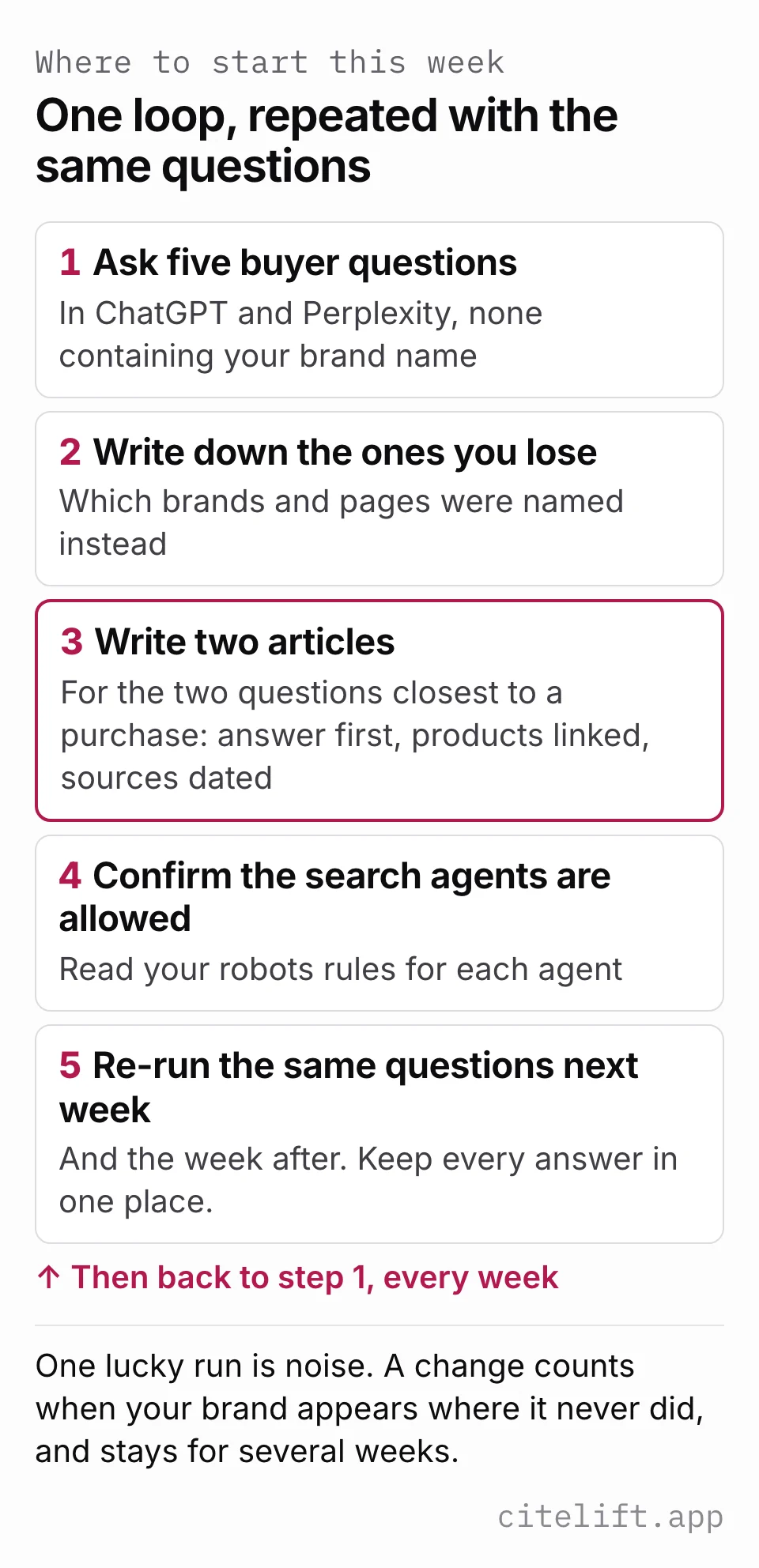
That is the whole loop. Everything else in generative engine optimization for Shopify is detail on top of it.
Questions.
Can I pay to be recommended by ChatGPT?
No. There is no placement to buy for an organic ChatGPT recommendation. The answer is written from pages the assistant retrieved at the moment of asking, so the only lever you control is what those pages say and whether the crawlers can reach them.
Do I need to block or allow GPTBot to be recommended?
GPTBot and OAI-SearchBot do different jobs. ChatGPT's crawler documentation says OAI-SearchBot surfaces websites in ChatGPT's search features and that sites disallowing it will not be shown in ChatGPT search answers. GPTBot crawls content that may be used in model training. If you want to appear in ChatGPT search, allow OAI-SearchBot; the training question is separate.
Which sites does ChatGPT cite for Shopify questions?
In our sample of 18 merchant questions on 9 October 2026, the most cited domains were shopify.com, help.shopify.com and apps.shopify.com, with community.shopify.com and developers.google.com next. For which-app questions the citations were App Store listings; for best-of questions, third-party roundups. That is one dated sample per question, not a ranking study.
How long before I see a change?
Longer than a week and shorter than forever, and nobody can promise a date. Answers vary between runs even with no change to your site, so judge it on repeated checks of the same questions over several weeks rather than on a single result.
Do I need an app to get my products into ChatGPT?
No. For Shopify stores, product data already reaches ChatGPT through Shopify Catalog, and Shopify's agentic storefronts setting is active by default for eligible stores. Check it under Sales channels > Agentic. Apps and articles matter for the written answers, not for switching the catalog on.
Citelift is listed on the Shopify App Store: Citelift on the Shopify App Store.