Guide · updated 27 September 2026 · 11 min read
Product-linked blog articles that earn AI citations
The anatomy of a Shopify blog article that answers one buyer question, links the products that answer it, and gives an answer engine something to quote.
A product-linked article is a blog post that answers one buyer question in full and links the products in your catalog that genuinely help answer it. A clear answer, supporting sources and readable page content help a buyer evaluate a product. Product pages can also answer questions and receive citations; Citelift has not established that articles outperform them across categories. Write the article a buyer would search for, put the short answer in the first paragraph, break the rest into sections a reader can jump to, link each product where it earns the mention and cite the sources you used.
Give each page one job
Search-enabled assistants can retrieve web results and use selected pages when building a recommendation, depending on the platform, query and settings. A useful source page therefore has to help a reader who arrives with a question and no context. See retrieval-augmented generation for the general mechanics.
A product page usually helps someone evaluate one product. An article can compare options, explain a routine or set out criteria. Both can be useful sources when their visible text answers the question, and either can be ignored. The practical decision is to strengthen the existing page that owns the job rather than assuming every query needs a new article.
Google's own guidance on AI features says the same thing from the other side: "The best practices for SEO remain relevant for AI features in Google Search" and "There are no additional requirements to appear in AI Overviews or AI Mode" (Google Search Central, AI features and your website, read 9 September 2026). There is no separate lever. There is only a page that answers the question well, or one that does not.
Build a self-contained answer
One primary buyer job
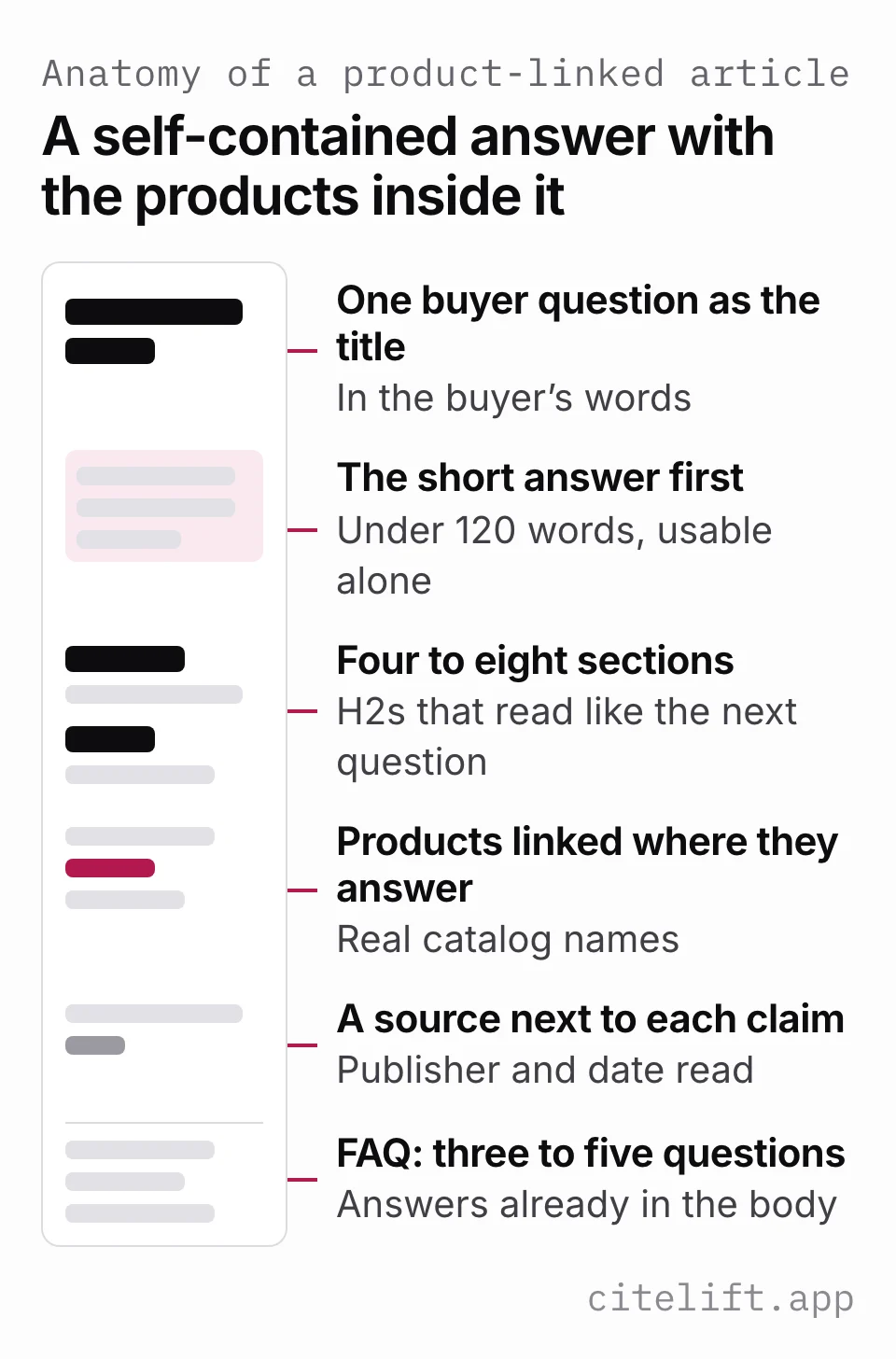
Pick one primary buyer job and phrase it in the words a buyer would type or say. "Which cleanser suits combination skin in winter" is a question. "Our winter skincare edit" is a campaign name. A useful article can answer several related subquestions when they help the reader complete that same job. Split only when the page starts serving a distinct intent that deserves its own complete answer.
Write the primary question into the title where it fits naturally, and answer it in the body. Keep related subquestions on the same page when they are necessary to qualify or act on the main answer; a new page should have a distinct reader job rather than a keyword variation.
The short answer goes first
For this article template, the first paragraph should contain the answer on its own, usually in under 120 words, with no preamble about how important the topic is. That is an editorial constraint, not a Google or citation threshold. If someone read only that paragraph they should be able to act. Everything after it exists to justify, qualify and extend the answer.
This gives a reader a useful answer before the detail. It also creates a self-contained passage that a search or answer surface can understand without reconstructing the conclusion from several sections.
Four to eight sections a reader can jump to
Use H2 headings that read like the questions a reader would ask next. "How to tell combination skin from oily skin", "What to look for on the ingredient list", "When to switch products". Citelift currently uses four to eight H2 sections as a guardrail for its generated articles. That range helps constrain the selected article format; it is not a universal test of depth or a Google ranking rule. A complete answer may need fewer sections, while a closely related question may justify more. Split an article only when it is trying to serve distinct reader jobs, not because it crossed an eighth heading.
Keep sections short enough to hold one idea. If a section needs subsections, use H3, but do not nest further. Google's people-first guidance asks whether a reader learns enough to achieve their goal and says Google has no preferred word count. Its review guidance likewise says to focus on quality and originality rather than length (Google Search Central, Creating Helpful, Reliable, People-First Content and Write high quality reviews, read 22 September 2026).
Where the products belong
Link a product at the moment it becomes the answer to something you just explained, not in a block of links at the bottom. If a section argues that a gel texture suits humid climates, the gel product goes in that section, in a sentence that says why it fits.
For Citelift-generated articles, two to five distinct eligible catalog products is the normal configured range. The structure gate lowers the minimum to one when the catalog has only one eligible product. Those are product guardrails, not general SEO quality rules. A focused care or usage guide may honestly need one product, while a detailed size or format comparison may justify six when written outside that generated format. Each mention should carry the product's real name from your catalog and only claims you can defend from current product data.
Every product link should also carry a parameter that identifies the article, so an attribution report can state which article received credit for the order under its rule. Citelift stamps that identifier onto the links it writes and credits an order to the article for seven days after the click, matched by UTM parameter or landing page. The method is worth copying by hand if you write your own articles: see order attribution and the attribution walkthrough.
Insert the product link in Shopify
In Shopify admin, open Content > Blog posts, choose the post and highlight the descriptive words that should carry the link. Select Insert link, enter the internal product path such as /products/linen-overshirt, give the link a short title if useful and insert it. Shopify's rich-text editor supports internal short URLs and recommends descriptive link text (Shopify Help Center, Using the rich text editor for content, accessed 10 September 2026).
Use the product's canonical handle and link meaningful words:
The fictional Reed 180 gsm linen overshirt suits a warm itinerary when breathability matters more than a crease-free finish.
The product name, fabric weight and trade-off are fictional in this example. “Shop now” tells neither a reader nor a crawler what the destination contains. “Reed 180 gsm linen overshirt” does. Preview the post, open every link and verify the selected variant and current availability before setting it visible.
Three practical product layouts
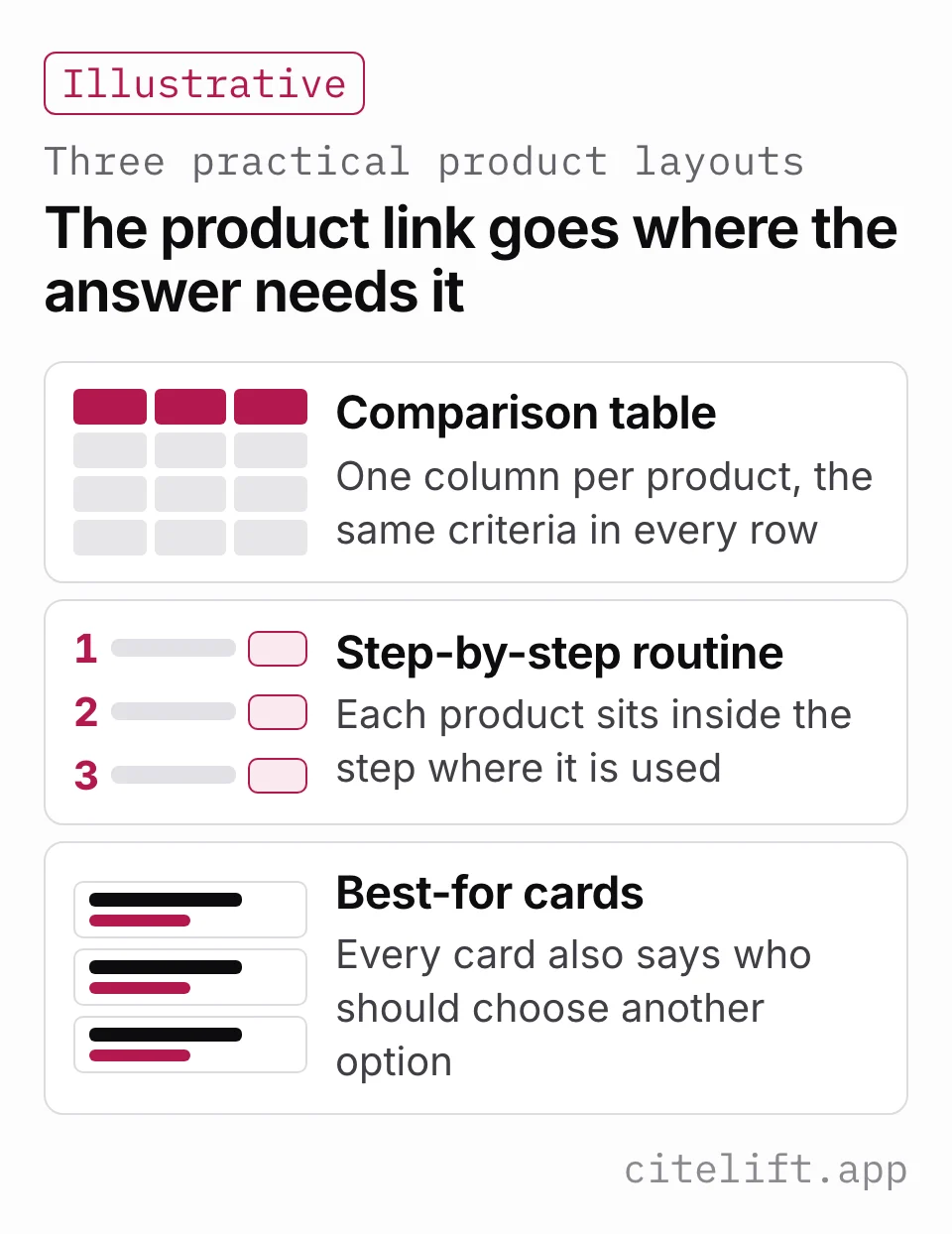
These are labeled examples, not customer pages or measured citation results. The complete set across six categories is in Shopify blog examples.
Apparel buying guide. Compare three fictional overshirts under the same criteria: material, stated fabric weight, garment measurements, care and packability. Link each product in the row where its verified fact changes the decision. Include “skip this if” guidance so every option has a boundary.
Home comparison. Compare a fictional carbon-steel skillet with a tri-ply stainless pan under acidic-food use, care, weight and dimensions. Link stainless beside the acidic-food explanation and carbon steel beside the seasoning directions. Do not add an unrelated apron merely to increase product-link count.
Beauty routine. Put a fictional serum, moisturiser and sunscreen into a numbered morning sequence. Link each item inside its step and use only label-backed ingredient, strength, amount and direction facts. The article must still answer the routine question when the sales language is removed.
For tables, keep the same criteria in every product column. For step-by-step instructions, place the product inside the step where it is used. For “best for” cards, include “not for” or “choose another option if” language to prevent every card from sounding like the universal winner.
Handle unavailable and changed products
Availability can change after publication. Do not replace a dead product link with the nearest item while leaving the old facts in the surrounding paragraph.
Choose among four explicit states:
- Temporarily unavailable: keep the educational passage, remove or label the purchase callout and preserve the verified facts as dated context if they remain useful.
- Discontinued: redirect only when the replacement serves the same intent, then review material, size, price, claims and care language around the link.
- Variant unavailable: point to the product only if the article makes the remaining variant clear. Never retain the old variant's facts under a new selector default.
- No honest replacement: remove the product recommendation and keep the criterion. An article can remain useful with fewer links.
After any replacement, rerun product-truth, link and claim checks. Protect merchant edits by comparing the live body with the last saved version before overwriting it. The editorial-control walkthrough covers the correction record.
Sources, and what a claim needs behind it
Any sentence that states a number, a study, a standard or a fact about the outside world needs a source next to it. Not at the bottom of the page. Next to it, within a sentence or two, so a reader checking the claim does not have to hunt.
This matters more than it used to, for two reasons. A reader who cannot verify a number stops trusting the whole page. And an assistant reading the page has no way to distinguish a real figure from an invented one unless the source is attached, which makes an unsourced statistic a liability rather than an asset.
Google's helpful content guidance asks whether content "present[s] information in a way that makes you want to trust it, such as clear sourcing, evidence of the expertise involved" and whether it "provide[s] original information, reporting, research, or analysis" (Google Search Central, Creating Helpful, Reliable, People-First Content, read 9 September 2026). Clear sourcing is not a formality. It is the thing being assessed.
The practical rule: if you want a number and cannot find a source for it, delete the number and make the sentence qualitative instead. An article with three sourced facts and no invented ones is stronger than one with fifteen figures nobody can trace.
The FAQ block at the end
Close with three to five questions whose answers are already in the article, answered again in two or three sentences each. This is not padding. It gives short, self-contained blocks that answer a question exactly as asked, which is the format an answer engine finds easiest to use.
Only ask questions the article genuinely answers. An FAQ that introduces new claims with no support in the body is where inaccuracies creep in.
The markup underneath
Mark the page up as an Article. schema.org defines Article as "An article, such as a news article or piece of investigative report" and gives it properties including headline, author, datePublished and articleBody (schema.org, Article, read 9 September 2026).
Google's structured data documentation for Article notes there are no required properties, and instead advises adding the ones that apply, with specific guidance on authors: include every author shown on the page, list multiple authors separately rather than merging them, use Person for people and Organization for entities, and keep author names apart from publisher names and job titles (Google Search Central, Article structured data, read 9 September 2026).
Say who wrote the article on the page itself as well as in the markup. Google's "who, how, why" framework asks directly: "Is it self-evident to your visitors who authored your content?" (Creating Helpful, Reliable, People-First Content, cited above). A byline that resolves to a real person with a reason to know the subject is worth more than any tag you can add.
Images that carry their own weight
One image that shows the thing being explained is worth more than four stock photos. Give it descriptive alt text, put it next to the text it illustrates, and use a filename that says what it is. Google's image guidance calls alt text "the most important attribute when it comes to providing more metadata for an image" and asks you to "make sure images are placed near relevant text and on pages that are relevant to the image subject matter" (Google Search Central, Google image SEO best practices, read 9 September 2026).
If the image shows one of your products, it should show that product accurately. A rendered image that changes a bottle's shape or label undermines the article's whole claim to be checkable.
How to know whether it worked
Two measurements, on two clocks.
Search performance moves on a slow clock. Give a page weeks, then look at impressions and clicks in Search Console for the queries you were aiming at.
Citation behaviour moves on its own clock and cannot be inferred from rankings. Pick fixed questions that do not contain your brand name, ask them in the assistants you choose and record the platform, date, brand mentions and visible source URLs. Repeat before calling a result persistent. Paid Citelift visibility checks use APIs monthly on Starter and weekly on Core and Growth. You can also run the method by hand: how to measure AI visibility explains the log, and the free manual checker prepares questions and analyzes an answer you paste without calling an AI service.
What to skip
Do not publish variations of the same article to cover keyword permutations. Google's spam policies name "scaled content abuse", which covers "using generative AI tools or other similar tools to generate many pages without adding value for users" (Google Search Central, Spam policies for Google web search, read 9 September 2026). Ten near-identical posts are worse than one good one.
Do not buy or swap links. It is not a shortcut to being cited, and it is a risk you carry permanently.
Do not write for a word count. Google says it has no preferred word count. Stop when the article has answered the reader's question with the evidence and qualifications it needs; padding does not make the answer more complete.
Do not describe products in language your catalog cannot support. A single invented ingredient or wrong price makes every other sentence suspect, which is why the checks in keeping AI-written product content true matter more than any formatting trick. Before you publish, paste the title, meta and body into the blog SEO audit; it checks structure without fetching the URL or verifying facts. Then read your own first paragraph as if you were the buyer. If it does not answer the question, nothing further down will.
Questions.
How long should a product-linked article be?
Long enough to answer the question and no longer. Four to eight useful sections and roughly 1,200 to 2,000 words can be an editorial starting point for a substantial buying question, but neither range is a ranking rule.
How many products should one article link to?
Link only the products the reasoning requires. A comparison may use two to five; a focused how-to may need one. More links do not improve an article when the products do not help answer the question.
Can product pages be cited instead?
Yes. Product pages, merchant articles, retailers, publishers and forums can all appear. Which page is used depends on the question and platform; Citelift has not established that one page type wins across categories.
Does adding schema.org markup make an article more likely to be cited?
Google says no special structured data is needed to appear in its AI features. Article markup is still worth adding because it states your author, dates and image unambiguously, but treat it as hygiene, not leverage.
Do I need to publish every day for this to work?
No. A steady cadence you can hold beats a burst you abandon. What matters more is that each article answers a real question completely rather than restating what everyone else already published.
Citelift is listed on the Shopify App Store: Citelift on the Shopify App Store.