Guide · updated 22 September 2026 · 12 min read
Generative engine optimization for Shopify stores
An ordered Shopify SEO, AEO and GEO checklist with the evidence to retain for crawling, product facts, answer pages and repeated visibility checks.
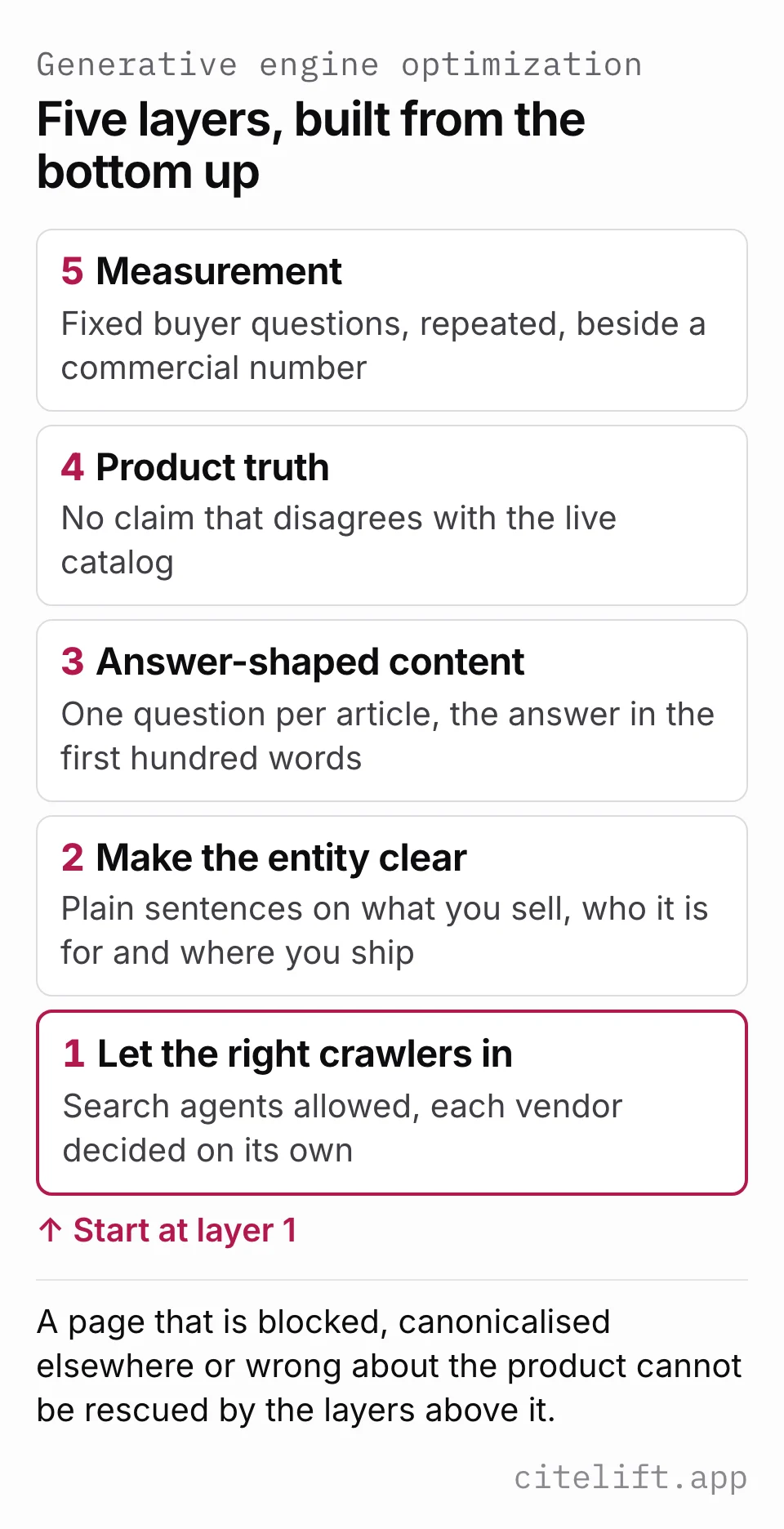
Generative engine optimization is the work of making a page eligible, understandable and useful when an AI-assisted surface builds an answer. On a Shopify store it comes down to five layers: preserve crawl and index access, make the brand and catalog explicit, publish pages that answer buyer questions, keep every product claim true and measure named platforms with repeated prompts. None of those steps guarantees retrieval or a citation. This guide puts them in task order and names the evidence each task should leave behind.
For a ChatGPT-specific workflow, follow the practical Shopify recommendation checklist.
What GEO actually is
Strip the acronym and you have a retrieval problem. Search-enabled assistants can use web search and cited pages to build an answer, but the exact retrieval path varies by platform and query. Everything called GEO is an attempt to improve whether a useful store page can be found, understood and selected.
That is a narrower and more honest framing than most of what is sold under the label. It also tells you what cannot work. You cannot bid for a slot in an organic answer. You cannot make a model remember you. You can make a page that is fetchable, that answers the question that was asked, and that says something specific enough to quote.
How it differs from SEO, and how it does not
Google is unusually direct about the overlap for its own AI surfaces: "There are no additional requirements to appear in AI Overviews or AI Mode, nor other special optimizations necessary", and to be eligible as a supporting link "a page must be indexed and eligible to be shown in Google Search with a snippet, fulfilling the Search technical requirements" (Google, AI features and your website, read 9 September 2026, developers.google.com/search/docs/appearance/ai-features). Google also says plainly: "You don't need to create new machine readable files, AI text files, or markup to appear in these features."
So the differences are smaller than the vocabulary suggests. Three of them are real:
- The consumer is a model, not a person. It does not skim for relevance and then click. It reads and quotes. Text that only makes sense next to a photograph, or that hides the point behind atmosphere, has nothing to give it.
- The observations differ. Search Console reports Google impressions and clicks. An assistant check records a dated answer, brand mention and visible source link. Neither substitutes for the other.
- The crawler landscape is fragmented. Vendors use separate tokens or agents for search, training, grounding and user-triggered fetches. A single “allow AI” decision is too broad.
The rest of the comparison, including where answer engine optimization sits between the two, is laid out in SEO vs AEO vs GEO for ecommerce.
Do the work in this order
| Order | Task | Surface served | Evidence that the task is complete |
|---|---|---|---|
| 1 | Confirm public access, canonical URL, index eligibility and sitemap discovery | SEO and Google's AI features | HTTP result, rendered canonical, robots output, Search Console inspection state and sitemap inclusion |
| 2 | Audit visible product and entity facts | SEO, AEO and GEO | Store name and category in visible text; product facts tied to URLs, variants and checked dates |
| 3 | Map buyer questions to the right URL | SEO, AEO and GEO | One intended page per question, with duplicates marked for merge or differentiation |
| 4 | Write and review the answer page | AEO and GEO, while supporting SEO | Direct answer, useful headings, verified product links, claim sources, author and dates |
| 5 | Check vendor-specific crawler choices | Platform-specific retrieval, training or grounding | Saved robots output plus a written decision for each agent or token |
| 6 | Measure each surface separately | Evaluation | Search Console observations, repeated assistant-answer log, referral sessions and attributed orders under stated rules |
Do not start with llms.txt, schema experiments or article volume. If the intended page is blocked, canonicalized elsewhere or missing the product facts a buyer needs, later work cannot repair that foundation. Use the Shopify blog SEO checklist for page mechanics and the product-fact audit before turning catalog details into prose.
Layer one: let the right crawlers in
This is the layer that silently costs stores the most, because failing it is invisible from the storefront.
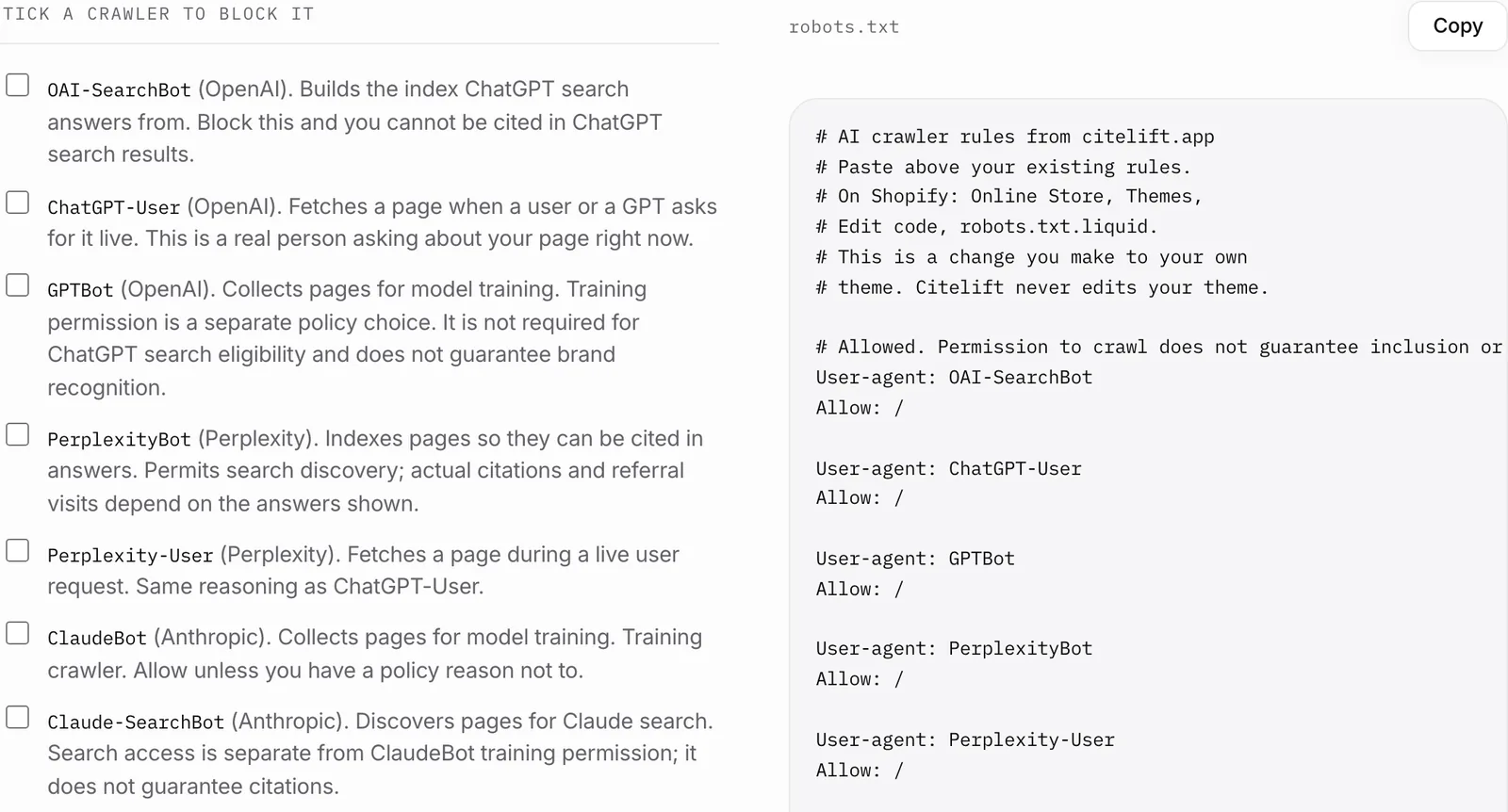
The vendors publish which agent does what. ChatGPT's documentation describes OAI-SearchBot as "used to surface websites in search results in ChatGPT's search features" and warns that sites disallowing it "will not be shown in ChatGPT search answers, though can still appear as navigational links"; GPTBot "is used to crawl content that may be used in training"; ChatGPT-User visits pages "for certain user actions in ChatGPT and Custom GPTs", and because those actions are user-initiated, "robots.txt rules may not apply" (ChatGPT crawler documentation, read 9 September 2026). Perplexity draws the same line: PerplexityBot is "designed to surface and link websites in search results on Perplexity. It is not used to crawl content for AI foundation models", while Perplexity-User "supports user actions within Perplexity" and "generally ignores robots.txt rules" (Perplexity, Perplexity Crawlers, read 9 September 2026, docs.perplexity.ai/guides/bots).
Read that twice before you edit anything. Training, indexed search and user-directed retrieval are separate uses. Blocking a search crawler limits eligibility through that vendor's indexed search path, but the exact consequence differs: ChatGPT preserves possible navigational links, while Anthropic separately documents Claude-SearchBot and Claude-User. Make each decision against the vendor's current description.
On Shopify, robots.txt is generated for you and can be overridden with a robots.txt.liquid template. Shopify's own documentation notes that it does not ship the template by default because "Shopify generates a robots.txt file by default, which works for most shops", recommends you "use the provided Liquid objects whenever possible" rather than replacing everything with plain text, and points out that "the default rules are updated regularly to ensure that SEO best practices are always applied" (Shopify.dev, robots.txt.liquid, read 9 September 2026, shopify.dev/docs/storefronts/themes/architecture/templates/robots-txt-liquid). If you have no custom template, you are probably fine. If you do, open it and check.
While you are there, remember what robots.txt is not. Google states it "is not a mechanism for keeping a web page out of Google" and that "a page that's disallowed in robots.txt can still be indexed if linked to from other sites"; to keep a page out you need noindex or password protection (Google, Introduction to robots.txt, read 9 September 2026, developers.google.com/search/docs/crawling-indexing/robots/intro).
Our AI robots.txt generator writes a per-agent block you can paste into the template, and ai-crawlers and robots.txt for Shopify goes through each agent one at a time.
Layer two: make the entity clear
An assistant has to work out what your brand is before it can recommend it for anything. That sounds abstract until you look at a store that fails it: a homepage of lifestyle photography, a tagline that could belong to a mattress company, and product pages whose titles are invented words.
Fix it with plain sentences in visible copy. Say what you sell, who it is for, where you ship, and what makes the range distinct, in text a machine can read without inferring anything from an image. Keep your brand name, product names and category words consistent across the storefront, the blog and your structured data. If your About page is three words and a photograph, it is doing nothing for you.
Structured data helps for the same reason. Shopify themes emit product and article markup already; the point is not to invent new formats but to make sure the ones you have are populated and accurate.
Check the Shopify structured-data guide before adding markup that may duplicate the theme or misdescribe the page.
Layer three: answer-shaped content
This is where most of the work lives, and where most stores have nothing.
A page gets quoted when a passage of it answers the question that was asked. That means:
- One buyer question per article, phrased the way a buyer phrases it.
- The direct answer in the first hundred words.
- Four to eight H2 sections that stand alone as units of meaning.
- Concrete detail: ingredients, materials, sizes, timings, who the product is wrong for.
- External facts carrying a source and the date you read it.
- A short FAQ whose answers are already in the body.
Google's guidance on people-first content is a decent editorial checklist here. It asks whether content provides "original information, reporting, research, or analysis", whether it gives a "substantial, complete, or comprehensive description of the topic", and whether it "present[s] information in a way that makes you want to trust it, such as clear sourcing, evidence of the expertise involved" (Google, Creating helpful content, read 9 September 2026, developers.google.com/search/docs/fundamentals/creating-helpful-content). It also asks you to be clear about "how automation or AI-generation was used to create content". If a tool drafts for you, keep a named author and a real review step.
Google's current guide for generative AI features in Search sharpens the same editorial rule for its own surfaces: create unique, useful material from what you know and the experience you can bring, rather than recycling what is already online or publishing commodity summaries. Google also says that meeting its requirements and best practices does not guarantee crawling, indexing or serving (Google Search Central, Guide to optimizing for generative AI features, read 15 September 2026, developers.google.com/search/docs/fundamentals/ai-optimization-guide). That is Google-specific guidance, not evidence that a page will be retrieved or cited by another assistant.
Link your products inside those articles, at the point where they answer the question, with an honest note about who each suits. Two to five per article is a reasonable range. The anatomy is broken down further in product-linked blog articles that earn AI citations.
Layer four: product truth
Machine-written content fails in a specific way: it invents. Wrong ingredient, wrong price, a health claim you are not allowed to make, a product that is no longer in the catalog. One of those in an article is worse than no article, because it is the sentence an assistant will quote.
Run checks before anything publishes. Citelift runs ten categories on every article: claims, product truth against the live catalog, citations, duplication, structure, readability, image, links, media, and an editorial read that judges facts, prices, claims and usefulness and annotates the draft with what it found. The last two annotate rather than hold: a missing hero and an editorial note are stated on the draft, not a bar to publication. Repairable failures on the other checks can receive up to two bounded corrective passes, with every gate rerun after an accepted change. Duplicate topics and catalog permission failures remain held for a person. Review hold is available on Core and Growth; unresolved required gates stop publication on every plan. If you write by hand, the same categories make a useful manual checklist.
Use the product-fact review process to check the draft against current catalog evidence before publication.
The point is not the tool. The point is that unverified product claims are the fastest way to lose the trust you are trying to build, and there is no version of GEO that survives being wrong about your own catalog.
Layer five: measurement
Pick five buyer questions in your category, none containing your brand name. Choose the assistants and search settings you want to observe. Record the exact question, platform, date, answer-level brand mention and visible source URLs. Repeat each question in fresh conversations before treating a result as persistent, then repeat the fixed set on a stated cadence.
That produces a dated observation of whether you appeared in those answers. The free manual checker prepares questions and analyzes an answer you paste for brand mentions and store-domain links. It does not call an AI service. Paid Citelift checks use APIs monthly on Starter and weekly on Core and Growth; API results can differ from consumer chat interfaces. The capture method is written out in how to measure AI visibility for your store, and the 48-answer pilot shows why repeats matter.
Two cautions. Answers vary between runs with no change to your site, so read trends across weeks and never a single result. And keep a commercial number beside the visibility number: sessions from assistant referrers, and orders that followed an article link. Citelift credits an order to an article when the buyer touched that article's link within seven days, matched by UTM parameter or landing page.
A 30-day plan
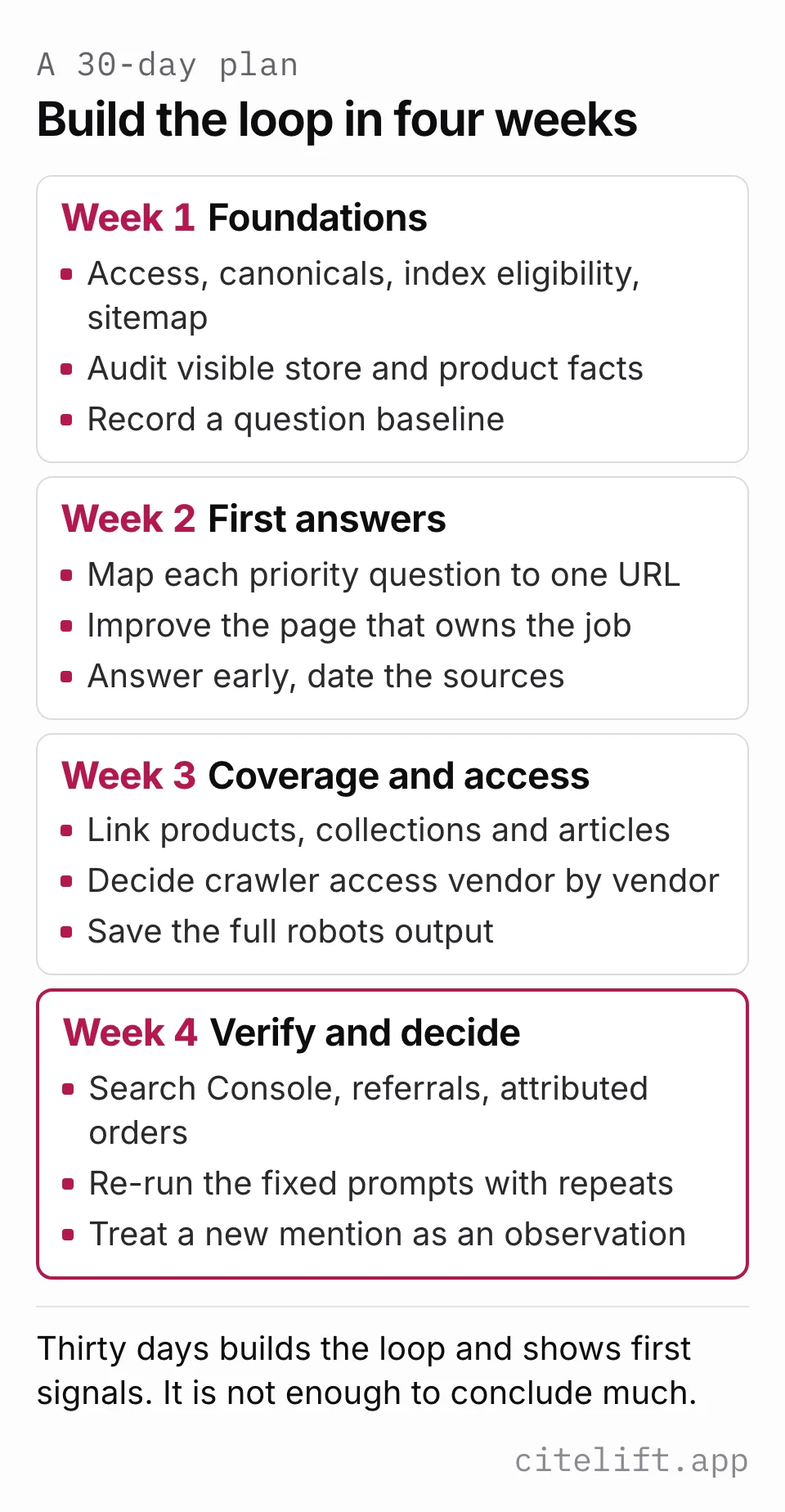
Week one, foundations. Confirm public access, canonical URLs, index eligibility and sitemap discovery. Read the rendered page as well as the source HTML. Audit visible store and product facts. Record the Search Console state and run a repeated question baseline in the platforms you selected.
Week two, first answers. Map each priority question to an existing product, collection or article URL. Improve that page when it already owns the job; write a new article only for a distinct gap. Put the answer early, attach product links where they support the decision and date external sources.
Week three, coverage and access. Add internal links among the relevant product, collection and article pages. Decide vendor by vendor whether training and grounding uses fit your policy while preserving the search access you want. Save the full rendered robots output, not only the block you added.
Week four, verify and decide. Look at Search Console impressions and queries, referral sessions and orders matched under a stated attribution rule. Re-run the fixed assistant prompts with repeats. A single new mention is an observation, not an uplift result; use it to choose what needs further checking.
Thirty days is enough to build the loop and to see the first signals. It is not enough to conclude much, so keep going.
What to skip
Buying links. They do not cause an assistant to fetch you and they put your domain at risk with search engines.
Treating llms.txt as the strategy. The current v2 proposal from llmstxt.org describes a small markdown discovery file at a site root or subpath. Shopify already mirrors its canonical /agents.md content at /llms.txt and says the managed default is enough for most stores. Verify that file and keep working on the pages behind it. The generator produces an editorial draft for the advanced case where /llms.txt must diverge; it does not decide whether an override is warranted. More on that in llms.txt for Shopify.
Tools that only rewrite meta tags. Titles and descriptions are worth getting right for search listings. They are not the text an assistant quotes. If you are weighing options, /vs/outrank and /vs/seobot set out what different approaches actually change.
Volume for its own sake. Start from observed buyer demand and map each distinct question to the page that should own it. Improve the existing page when it already covers the job; add an article only for a real gap, with original store, product or operator evidence that the rest of the library does not contain. Google's current generative AI Search guide likewise warns against making separate pages for every query variation and says a high quantity of pages does not make a site higher quality or more relevant (Google Search Central, read 15 September 2026).
Questions.
Is GEO a different discipline from SEO?
It is the same craft aimed at a different consumer. SEO optimises for a ranked list a person clicks. GEO optimises for a machine that fetches a few pages and writes one answer from them. Crawlability, clear entities and honest specifics serve both, so most of the work overlaps.
Do I need an llms.txt file to do GEO?
No. Shopify already mirrors its managed /agents.md document at /llms.txt, and says that default is enough for most stores. Google states that AI text files are not required for its AI features. Verify the managed file; customize it only for a documented advanced requirement.
Should I block GPTBot?
That is a training decision, not a search decision. ChatGPT's documentation describes GPTBot for training and OAI-SearchBot for ChatGPT search. The controls are independent. An OAI-SearchBot opt-out prevents site content from appearing in ChatGPT search answers, although the site can still appear as a navigational link.
How many articles does a 30-day plan need?
Do not start with an article quota. Map evidence of buyer demand—support questions, onsite searches, Search Console queries, and customer language—to the existing page that should answer each question. Improve that page first; publish a new article only for a distinct gap, and add original store, product, or operator evidence instead of recycling generic advice.
Can GEO work be measured?
Partly. You can measure whether assistants name you by asking the same buyer questions on a schedule and reading the answers, and you can measure orders that followed an article link. You cannot see inside a retrieval pipeline, so treat everything else as inference.
Citelift is listed on the Shopify App Store: Citelift on the Shopify App Store.