Guide · updated 9 October 2026 · 13 min read
AEO vs GEO vs SEO for ecommerce: what actually changes
AEO vs GEO vs SEO for online stores: what each optimises for, whether AEO and GEO are the same, whether GEO replaces SEO, and what to do first.
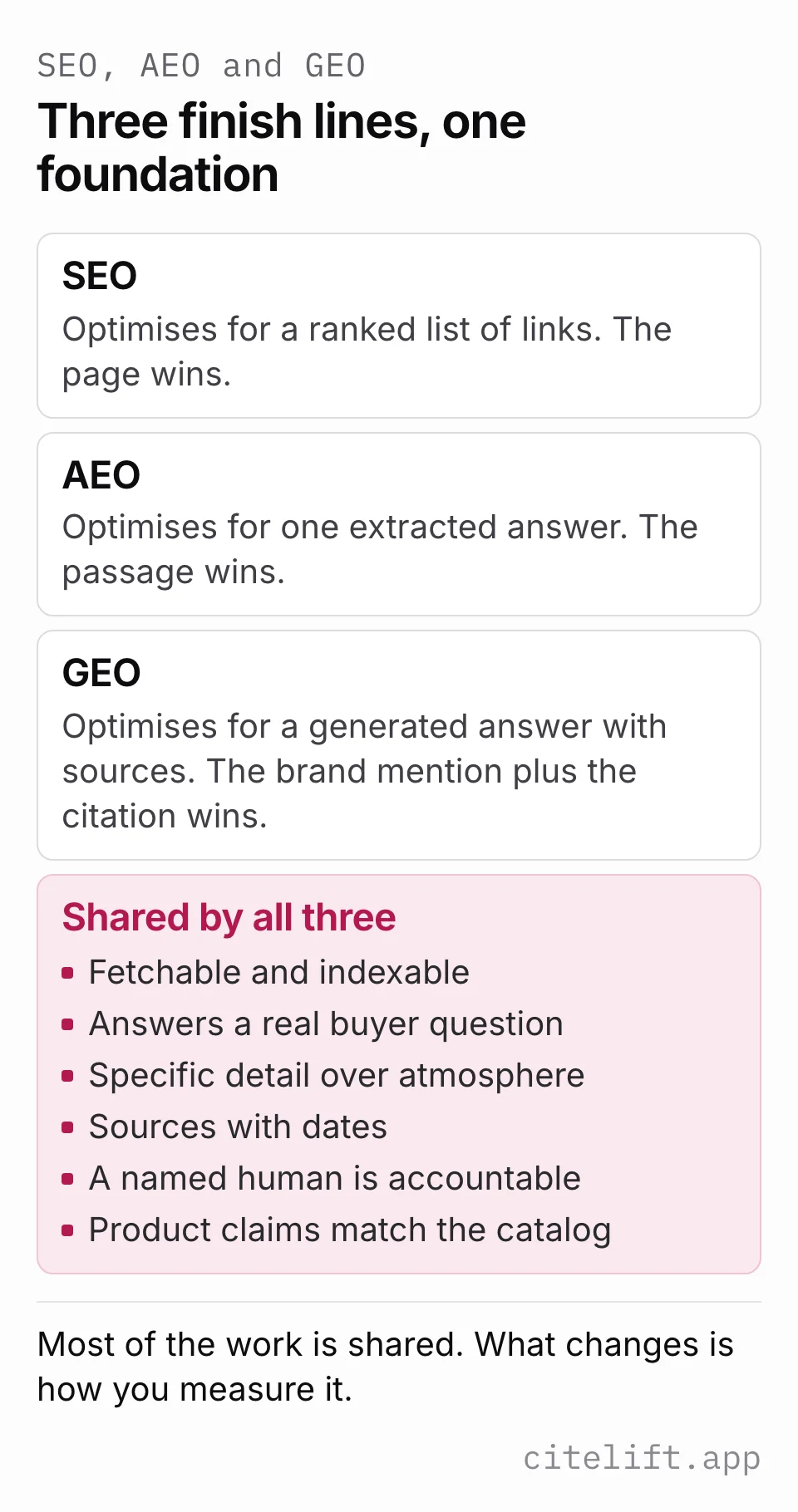
SEO earns an online store a place in a list of search results, AEO shapes a page so an engine that gives one answer can lift it, and GEO aims to have an AI assistant that writes its own answer retrieve your page, cite it and name your store. All three rest on the same foundation: crawlable, indexed pages that answer real buyer questions with accurate product facts. AEO and GEO are close to the same thing, and neither replaces SEO, because AI answers are built on search.
So most of the work is shared. This guide sets out what genuinely differs and the order to do it in. A section added on 9 October 2026 reports what Google's AI Overviews, ChatGPT and Perplexity showed for a fixed set of questions on that date.
AEO vs GEO vs SEO in one table
| SEO | AEO | GEO | |
|---|---|---|---|
| Optimises for | A ranked list of links a shopper picks from | One answer lifted from one page | A written answer built from several pages, with sources |
| Where the answer appears | Google and Bing results pages | AI Overviews, AI Mode, featured snippets | ChatGPT search, Perplexity, Gemini, Claude |
| What you measure | Impressions, clicks and orders from organic search | Whether your page is a supporting link for a fixed set of questions | Whether your brand is named or your page cited across repeated sampled answers |
| What a Shopify store changes | Collections, product pages, blog posts, titles, internal links, theme health | The answer in the first lines under a question-shaped heading; tables where the answer is a set | Crawler access agent by agent, consistent product facts, comparison content, mentions on other sites |
The table is a map, not three separate projects. A store that does the SEO column well and never thinks about the other two is usually already halfway across.
Is AEO the same as GEO?
Mostly, yes. The difference is where each term came from, not what you'd do differently on Monday.
AEO, answer engine optimization, grew out of featured snippets and voice assistants: be the one passage an engine lifts. GEO was named in a November 2023 research paper that introduced it as a way "to aid content creators in improving their content visibility in generative engine responses" (Aggarwal and others, GEO: Generative Engine Optimization, arXiv, read 9 October 2026). It targets assistants that search, read several pages and write something new. If you want a distinction that holds up, AEO cares about the passage and GEO cares about the brand mention and the citation across many answers. LLM SEO is a third name for the same work.
The confusion is real and it shows in the results. When we checked Google's results for "aeo vs geo" on 9 October 2026, the first organic result was a Reddit thread asking someone to explain GEO and AEO in a simple way, and the page in third place was titled "AEO vs. GEO: Why they're the same thing". If the people selling the services can't agree, you don't need to pick a side. Do the shared work, then measure the surfaces you care about.
What SEO optimises for
A person types a query, gets a list, and picks. Your job is to be on that list high enough to be picked, which is why the classic levers are relevance, technical health, internal structure and external references.
Two pieces of Google's own documentation are worth keeping in view because they get misapplied constantly in AI-era advice.
Robots.txt controls crawling, not indexing. Google states it "is not a mechanism for keeping a web page out of Google" and that "a page that's disallowed in robots.txt can still be indexed if linked to from other sites"; to actually keep a page out you need noindex or password protection (Google, Introduction to robots.txt, read 9 September 2026, developers.google.com/search/docs/crawling-indexing/robots/intro).
And quality is judged on things you can self-assess. Google's helpful content guidance asks whether the content provides "original information, reporting, research, or analysis", whether it gives a "substantial, complete, or comprehensive description of the topic", and whether it "present[s] information in a way that makes you want to trust it, such as clear sourcing, evidence of the expertise involved" (Google, Creating helpful content, read 9 September 2026, developers.google.com/search/docs/fundamentals/creating-helpful-content). It also asks creators to be explicit about "how automation or AI-generation was used to create content", which is now a live question for most stores.
For a Shopify store the SEO surface is mostly collections, product pages and the blog, plus the technical hygiene of a theme. None of that goes away when assistants arrive.
What AEO optimises for
Answer engine optimization targets surfaces that return one answer rather than a list. The old version was the featured snippet. The current version includes Google's AI Overviews and AI Mode. The difference from SEO is the unit that wins: SEO wins a page a click, AEO wins a passage a quotation, often with no click at all.
The technique is simple and unfashionable: put the answer where it can be lifted. A question as the heading, a direct answer in the first two or three sentences, then the detail. Clean heading hierarchy so each section is a self-contained passage. Tables and short lists where the answer is genuinely a set of items.
The eligibility rule is technical, not stylistic. Google says that to be a supporting link in these features "a page must be indexed and eligible to be shown in Google Search with a snippet", and that "there are no additional requirements to appear in AI Overviews or AI Mode, nor other special optimizations necessary" (Google, AI features and your website, read 9 September and again 9 October 2026, developers.google.com/search/docs/appearance/ai-features). The same page notes the control surface works the other way too: nosnippet, data-nosnippet, max-snippet and noindex restrict what can be shown. If someone has set nosnippet sitewide to protect content, they have also opted out of the answer surfaces.
One more line from that page kills a lot of expensive advice: "You don't need to create new machine readable files, AI text files, or markup to appear in these features."
What GEO optimises for
Generative engine optimization targets assistants that search, fetch a handful of pages, and compose an answer with sources. The structural difference from AEO is that there is no single canonical surface with published rules. There are several vendors, each running several agents, each with their own behaviour.
The vendors document this themselves. ChatGPT's crawler documentation says OAI-SearchBot is "used to surface websites in search results in ChatGPT's search features" and that sites opted out of it "will not be shown in ChatGPT search answers, though can still appear as navigational links"; GPTBot is "used to crawl content that may be used in training"; and for ChatGPT-User, "because these actions are initiated by a user, robots.txt rules may not apply" (ChatGPT crawler documentation, read 9 September and again 9 October 2026). Perplexity draws the same line: PerplexityBot is "designed to surface and link websites in search results on Perplexity. It is not used to crawl content for AI foundation models", while for Perplexity-User, "since a user requested the fetch, this fetcher generally ignores robots.txt rules" (Perplexity, Perplexity Crawlers, read 9 October 2026).
That fragmentation is the first genuinely new task. In SEO you make one decision about Googlebot. In GEO you make a decision per agent, and the consequences differ: blocking a training crawler is a rights decision, blocking a search crawler is a visibility decision. Work through them in AI crawlers and robots.txt for Shopify.
The second new task is that there is no position. You are named or you are not. So the page has to contain something worth quoting, and your brand has to be in that something. An excellent article that never mentions what you sell can be cited and still sell nothing.
What is identical in all three
More than the vocabulary implies.
- The page has to be fetchable and indexable. Every surface, old and new, starts there.
- The page has to answer a real question. Not target a keyword. Answer a question a buyer would actually ask.
- Specificity beats atmosphere. Ingredients, materials, sizes, timings, who the product is wrong for. Vague enthusiasm is unrankable and unquotable at the same time.
- Sources and dates. External facts carry a publisher and a date read. This is an editorial standard, not an SEO tactic, and it happens to serve every surface.
- A named human is accountable. Bylines, an About page, a real review step behind anything a tool drafted.
- Product claims match the catalog. A wrong ingredient or a stale price is the sentence that gets quoted.
Use the product-fact review process to check the draft against current catalog evidence before publication.
If you only ever did that list, you would be doing most of SEO, most of AEO and a large share of GEO at once.
What genuinely changes for a store
Product pages carry less weight than you expect. A product page argues for one product. Most assistant questions are comparisons, so the retrieved page tends to be one that names several options and explains the trade-off. That is an argument for a real blog, not against product pages.
Measurement splits into four readings. Google's dedicated generative AI report isolates impressions from supported AI Overviews and AI Mode, but it does not provide queries, clicks, answer text or a surface split. Its activity is already included in ordinary Web Search performance, so never add the two impression totals. A fixed prompt panel samples what named consumer surfaces showed under recorded conditions. Referral analytics records identifiable later visits. Article attribution applies a separate touch rule to orders. Read the Google AI measurement walkthrough and the broader AI visibility measurement guide before comparing them. If you're weighing paid trackers for the panel, the AEO tools comparison sets out what each one records.
Citelift's manual checker supports only part of the panel workflow. It prepares five nonbrand questions from a category, product type and market, then checks one answer you paste for an exact brand-name match and full store URLs. It does not query Google, ChatGPT, Perplexity or another assistant, identify a platform-defined citation, or verify that a source supports a claim. Those observations still have to be collected and recorded in the chosen consumer surface. The paid app, which plans and publishes the articles, installs from Citelift's Shopify App Store listing.
Variance becomes a real problem. Traditional rankings and assistant answers can both change, but generated answers may differ across immediate repeats with no change to your site. Preserve every completed and failed run, use the same questions and conditions, and read repeated samples rather than one answer.
Attribution needs a stated rule. Referral analytics can observe some assistant or search visits, but missing referral information does not prove there was no influence. Separately, Citelift stamps its article identifier onto product links and credits an order to an article when the buyer touched one of those links within seven days, by UTM parameter or landing page. That is article-order credit under a defined rule, not a join back to one Google impression or sampled assistant answer. The mechanics and limitations are in which blog post sold something.
What AI answers showed on 9 October 2026
On 9 October 2026 we pulled Google's US English results for 35 searches about Shopify SEO, AI blogging, AI visibility tools and AEO and GEO, using DataForSEO. The same day we asked ChatGPT and Perplexity, both with web search on, 18 questions a Shopify merchant might ask, one answer per engine per question. That is a single dated sample from one location, not a ranking study, and a repeat run could differ. Here is what it showed.
- All 35 results pages carried an AI Overview. For these topics the AI answer sat at the top of the page every time.
- YouTube was cited in 27 of the 35 AI Overviews. Reddit was cited in 11, shopify.com in 8 and apps.shopify.com in 7. YouTube was cited far more often than any company's own site.
- For "aeo vs geo", a Reddit thread ranked first and was also the first source the AI Overview cited.
- Across the 36 assistant answers, Shopify's own sites led the sources. shopify.com was cited in 12 answers, help.shopify.com in 10 and apps.shopify.com in 8.
- Asked "AEO vs GEO vs SEO: which should a Shopify store focus on", both engines put SEO first. ChatGPT recommended that you "prioritize SEO first, build GEO into your content strategy, and use AEO to capture high-intent questions" and cited four pages, all on Shopify's help centre and blog. Perplexity's answer began "prioritize SEO first, then AEO and GEO together" and cited ten, mostly app-vendor and agency blogs plus two LinkedIn posts.
Our reading, and it is interpretation rather than measurement: for general Shopify how-to questions, assistants lean hard on Shopify's own documentation, so a store's blog is unlikely to win by restating it. Where a store can be the best source is its own products and category: what the item is made of, who it suits, how it compares. The AI Overview pattern also suggests short videos and honest forum answers are a channel worth testing, not a sure route. For calibration, Citelift's own pages were cited as a source in one of the 36 answers and Citelift was named in none.
Is GEO replacing SEO?
No, and the vendors' own documentation explains why. Google says "the best practices for SEO remain relevant for AI features in Google Search" and that "there are no additional requirements to appear in AI Overviews or AI Mode, nor other special optimizations necessary" (Google, AI features and your website, read 23 September and again 9 October 2026, developers.google.com/search/docs/appearance/ai-features). ChatGPT's crawler documentation says sites that opt out of its search crawler, OAI-SearchBot, "will not be shown in ChatGPT search answers" (ChatGPT crawler documentation, read 23 September and again 9 October 2026). Both say the same thing: a page has to be crawlable and indexed before any assistant can quote it.
What GEO changes is the finish line. A click used to be the only outcome worth counting. Now a brand can be named in an answer the shopper never clicks through from, so visibility has to be sampled question by question as well as measured in clicks. When we asked ChatGPT and Claude this exact question on 23 September 2026, both answered no and gave the same reasoning (our dated observations). ChatGPT summed it up as "SEO gets you found. AEO gets you extracted. GEO gets you incorporated into the answer." On 9 October, asked which to focus on, ChatGPT and Perplexity both said SEO first.
The order to do the work in
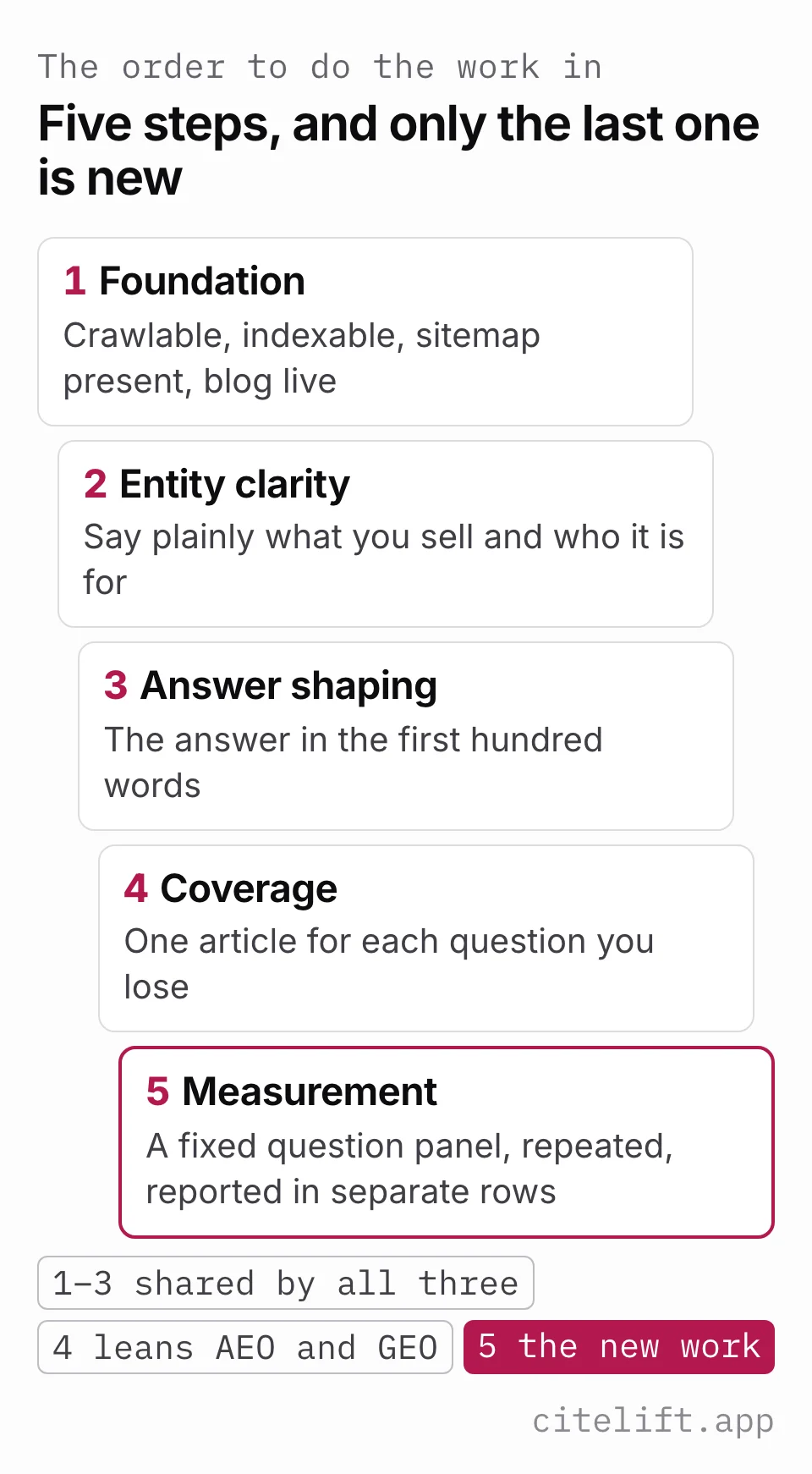
- Foundation. Crawlable, indexable, no accidental
noindex, no password wall, sitemap present, blog live. Decide crawler access agent by agent using our robots.txt generator. - Entity clarity. Two plain sentences on the homepage and About page saying what you sell and who for. Consistent names across storefront, blog and structured data.
- Answer shaping. Rewrite the pages you already have so the answer sits in the first hundred words under a question-shaped heading.
- Coverage. Write the articles for the questions you currently lose, one question each, products linked where they belong.
- Measurement. Baseline a fixed question panel, then repeat it under the same recorded conditions. Report dedicated Google AI impressions, sampled answers, identifiable referrals and article-attributed orders in separate rows with their own units and windows.
Steps one to three are shared across all three acronyms. Step four leans AEO and GEO. Step five is the only part that is genuinely new work, and it's the part most stores skip.
Where the terms mislead
The acronyms are useful for deciding what to measure and misleading when they are sold as separate products.
A tool that only rewrites titles and meta descriptions is doing a slice of SEO and nothing for the answer surfaces. Meta descriptions are not the text an assistant quotes. If you are comparing approaches, /vs/outrank and /vs/shopify-magic describe what different tools actually change.
New file formats are not the lever they are marketed as. The llms.txt proposal, first published on 3 September 2024, is a markdown file at the site root listing a site's most useful pages, and its own specification describes an H1 as "the only required section" (llmstxt.org, The /llms.txt file, read 9 September 2026, llmstxt.org). It is cheap to publish and unproven as a ranking factor, and Google has said you do not need such files for its AI features.
And nobody can promise you a citation or a position. What you control is whether the page exists, whether it answers the question, whether the crawlers can reach it, and whether you read the result honestly. The rest is inference. Keep it labelled as inference and you'll make better decisions than most of the market.
Questions.
Is AEO the same as GEO?
Close enough that the difference rarely changes the work. AEO grew out of featured snippets and voice answers and is about being the passage an engine lifts. GEO targets assistants that read several pages and write a new answer, so it is about being retrieved, cited and named. Most people now use the two terms interchangeably, and LLM SEO is a third name for the same thing.
What is the difference between AEO and SEO?
SEO earns a page a place in a ranked list so a shopper clicks it. AEO shapes the page so an engine that returns one answer, such as an AI Overview, can lift the answer from it, often with no click. AEO depends on SEO: Google says a page must be indexed and eligible for a snippet before it can be a supporting link in AI Overviews or AI Mode.
Is GEO replacing SEO?
No. AI answers are built on search. ChatGPT's search answers come from pages its search crawler can reach, and Google says SEO best practices remain relevant for AI Overviews and AI Mode with no special optimizations needed. GEO adds a page shape and a way of measuring on top of SEO; it does not replace the foundation.
Does GEO need special files or markup?
Google states you do not need to create new machine readable files, AI text files, or markup to appear in its AI features. Files like llms.txt are cheap to publish and unproven as a ranking factor. Crawl access and answer-shaped content do the work.
Which one should an early store do first?
The shared foundation, then AEO shaping, then GEO measurement. Getting indexed and answering questions clearly serves all three. Chasing assistant citations before your pages are indexable is out of order.
Citelift is listed on the Shopify App Store: Citelift on the Shopify App Store.